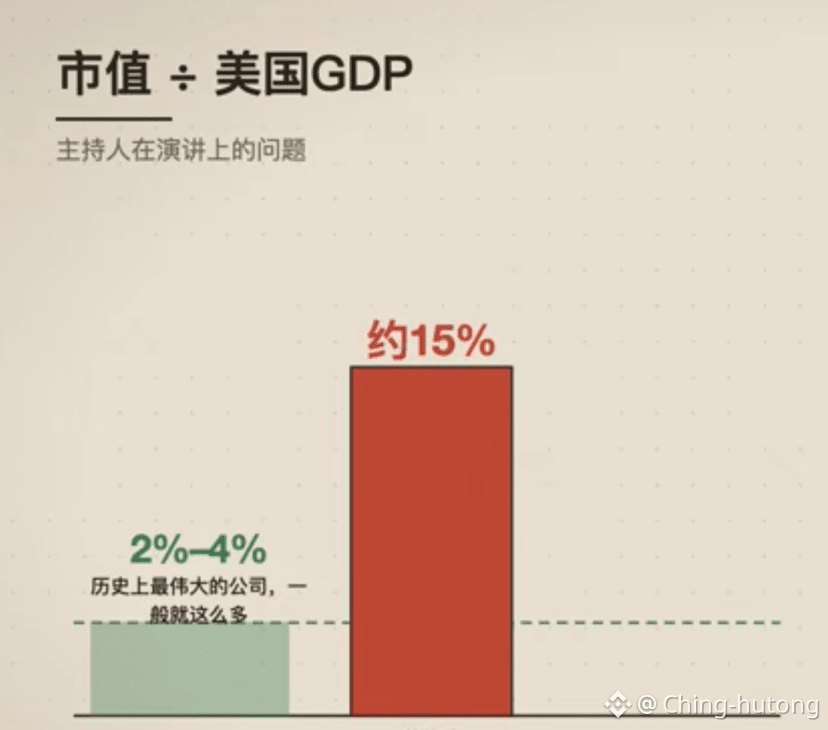
#英伟达 If NVIDIA’s (NVDA) market capitalization fell back to 4% of U.S. GDP (assuming U.S. GDP remains unchanged), its stock would need to fall approximately 64%–65% further from its current price ($150.96)—a decline of about $96–$98 per share—bringing the target price to the $53–$55 range.
Here is the detailed calculation:
1. Calculate the target market capitalization corresponding to “4% of GDP”
* Based on the IMF’s estimate of U.S. nominal GDP for 2026 ($32.64 trillion):
$$32.64\text{ trillion} \times 4\% \approx \mathbf{1.306\text{ trillion}}$$
* Based on annualized nominal U.S. GDP for the third quarter of 2026 ($33.01 trillion), the target market capitalization would be approximately $1.320 trillion.
2. Compare the current share price and market-cap benchmarks (as of the close on November 18, 2026)
* Current share price: $150.96 (down about 38% from its 52-week high of $243.37).
* Current total market capitalization: approximately $3.65 trillion–$3.75 trillion (based on about 24.15 billion shares outstanding), or 11.2%–11.5% of U.S. GDP.
3. Derive the remaining decline and target share price
* Required market-cap decline:
$$1 - \frac{1.306}{3.65} \approx \mathbf{64.2\%}\quad\text{(or }\mathbf{65.2\%}\text{ using a $3.75 trillion market cap)}$$
* Corresponding target share price:
$$\$150.96 \times (1 - 64.2\%) \approx \mathbf{\$54.07}\quad\text{(a further decline of about }\mathbf{\$96.89}\text{ per share)}$$
Historically, at the peak of the dot-com bubble in 2000, the market capitalizations of individual tech giants such as Microsoft and Cisco reached 5%–6% of U.S. GDP, before falling back to the 1%–2% range after the bubble burst. For NVIDIA today, a valuation equal to 4% of U.S. GDP would mean shedding about $2.34 trillion in market value, bringing its share price roughly back to early 2024 levels (around $50–$55 after the stock split).
At the same time, NVIDIA being overvalued suggests that other areas are undervalued.