
Gold's Biggest Enemy Might Not Be War. It Might Be the Federal Reserve.
There's something about gold that investors often misunderstand.
When the world becomes unstable, people rush toward safe-haven assets.
Wars escalate.
Oil prices rise.
Inflation fears return.
And suddenly, gold becomes one of the most attractive places to protect wealth.
But here's the part that deserves much more attention:
The same inflation that initially pushes gold higher can eventually create the conditions that push it lower.
History has already demonstrated this.
THE 1979–1980 GOLD BOOM: A LESSON WALL STREET HASN'T FORGOTTEN
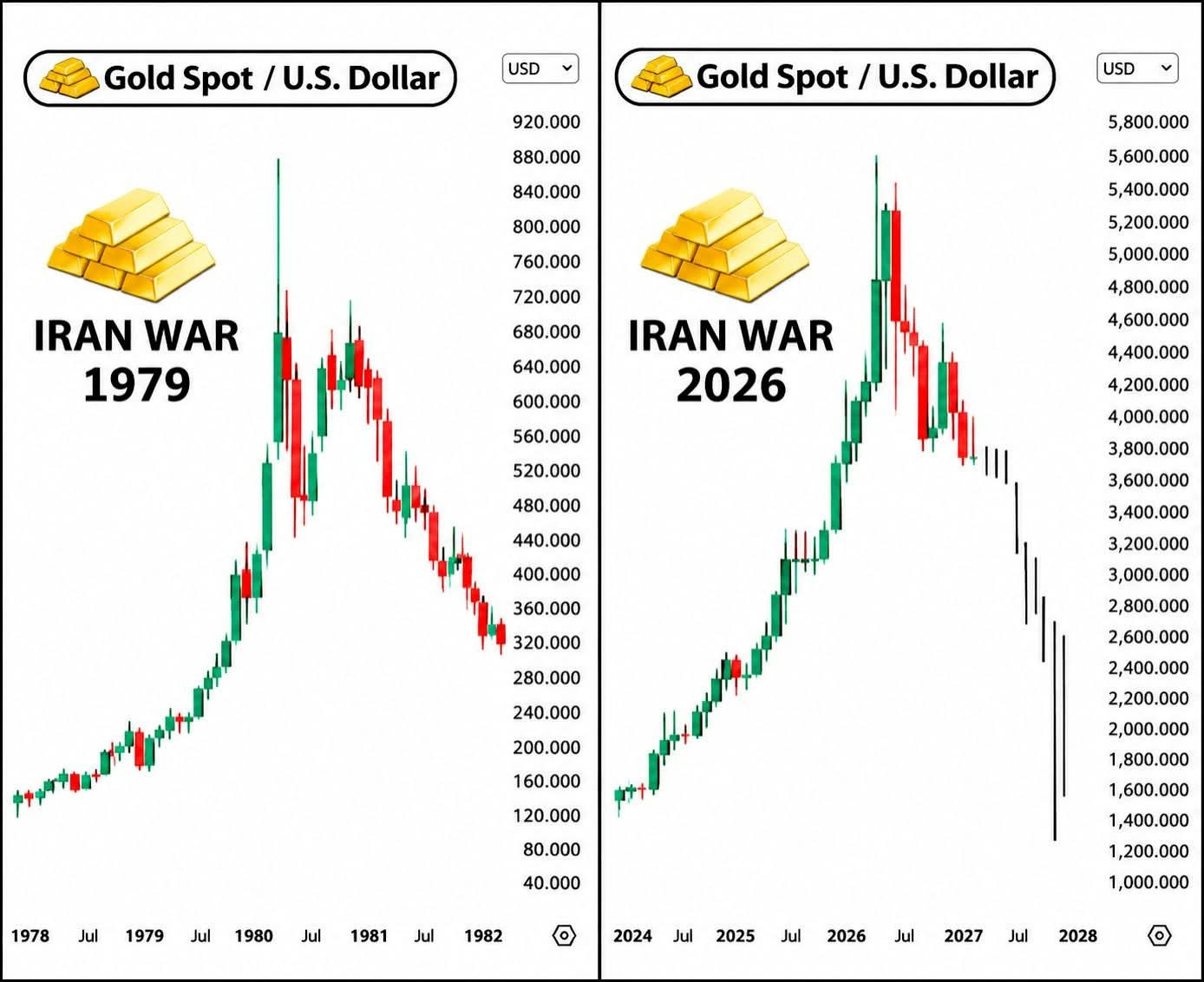
During the late 1970s, gold experienced an extraordinary rally.
The Iranian Revolution, the hostage crisis, the Soviet invasion of Afghanistan, rising oil prices and accelerating inflation created enormous uncertainty.
Investors wanted protection against declining purchasing power and geopolitical instability.
Gold climbed from approximately $236 per ounce in April 1979 to $850 in January 1980.
That's an increase of more than 250% in roughly nine months.
But the rally didn't last.
Between September 1980 and June 1982, gold fell approximately 52%.
By February 1985, it had reached around $285 per ounce.
What changed?
THE FED CHANGED THE FINANCIAL ENVIRONMENT.
Paul Volcker, then Chairman of the Federal Reserve, was determined to bring inflation under control.
Interest rates climbed dramatically, reaching approximately 20% during parts of 1980 and 1981.
That changed the economics of holding gold.
Unlike Treasury securities or bank deposits, gold doesn't pay interest.
When investors can earn attractive returns on interest-bearing assets, the opportunity cost of holding gold increases.
At the same time, higher real interest rates and a stronger U.S. dollar can reduce demand for bullion.
Gold didn't suddenly become useless.
The financial conditions that had supported its extraordinary valuation were changing.
NOW LOOK AT THE 2026 MARKET.
Gold is facing another difficult combination.
The metal reached a record high of approximately $5,595 per ounce in January.
By November 16, it had fallen to approximately $3,831.
That's a decline of around 31.5%.
And several developments are putting pressure on the market.
1. THE U.S. DOLLAR IS GETTING STRONGER
Gold is priced internationally in U.S. dollars.
When the dollar strengthens, gold becomes more expensive for buyers using other currencies.
That can reduce international demand and put downward pressure on prices.
2. TREASURY YIELDS ARE RISING
The 10-year U.S. Treasury yield recently reached approximately 5.14%.
Higher yields make interest-bearing investments more competitive with gold.
For institutional investors managing enormous portfolios, that opportunity cost matters.
3. INFLATION IS CREATING A POLICY PROBLEM
Geopolitical tensions and higher oil prices can increase inflationary pressure.
But here's the contradiction:
Inflation fears can initially increase demand for gold.
If those same inflation pressures force the Federal Reserve to maintain restrictive policy or raise interest rates, gold can subsequently face selling pressure.
That's the mechanism investors need to understand.
4. THE FED'S NEXT MOVE COULD MATTER MORE THAN THE HEADLINES
Markets are currently anticipating a possible 25-basis-point rate increase in December.
But expectations are not the same as an actual Federal Reserve decision.
If inflation remains persistent and the Fed becomes more aggressive, gold could face additional pressure.
If economic growth weakens or rate expectations reverse, the picture could change again.
HERE'S MY BIGGEST TAKEAWAY FROM THE 1979 COMPARISON.
Gold is not automatically bullish during every war.
And it doesn't automatically collapse when geopolitical tensions ease.
The bigger drivers are often the relationship between inflation, real interest rates, the U.S. dollar, central-bank policy and investor demand.
There is also an important difference between 1980 and 2026.
Today's gold market has substantial central-bank participation, investment funds and different global reserve dynamics.
History can explain the risks, but it cannot guarantee that the same outcome will repeat.
A 50% historical decline is a warning about volatility, not a prediction of the next move.
The real question isn't simply whether gold is expensive or cheap. It's whether the financial conditions supporting its price are getting stronger or weaker.
That's what serious gold investors should be watching.