Beginner Lesson 46: Your short-term trade is still open when you finish for the day. Should you hold it overnight?
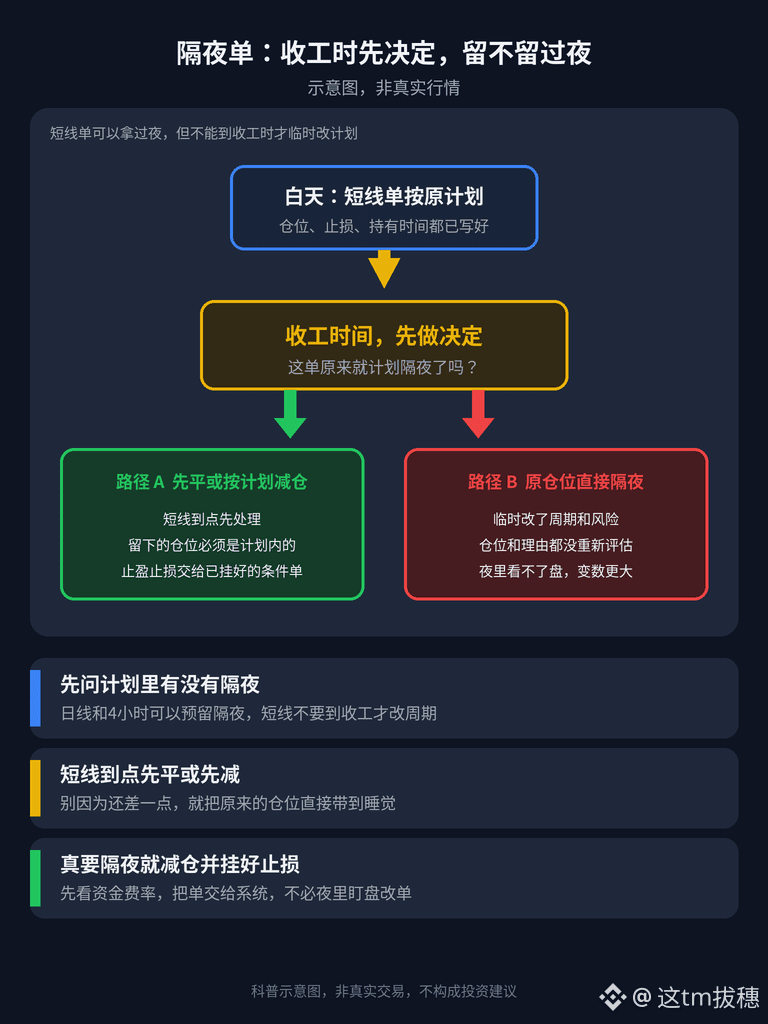
The time-based stop-loss from the previous lesson helps you decide whether a trade is still worth holding. But there’s another situation: you’re about to leave your screen, and your trade is still open. Holding overnight isn’t necessarily wrong—a daily or 4-hour trade may naturally carry over to the next day. The real problem is turning a short-term trade into an overnight hold at the last minute, without changing the position size or the rationale.
1. First ask: Was holding overnight part of the plan?
1) If you’re trading short-term on a 15-minute or 1-hour chart, the default when you finish for the day should be to close the trade, or reduce it according to plan to a size you’re comfortable holding overnight. Don’t go to sleep with the original position just because “it’s almost there.”
2) If you’re trading on a 4-hour or daily chart, holding overnight can be part of the plan—but write that into your plan when you open the trade, and set your take-profit and stop-loss orders. Don’t expect to keep watching the market all night.
3) If you do hold overnight, check the funding rate first and make your position more conservative than a short-term trade. The market keeps trading while you sleep, and during a sharp move, a nearby stop-loss may not execute at the price you expect.
For example, in Binance spot market data at around 14:08 on November 18 (Taipei time), the popular coin $BREV was up about 90.02% over 24 hours, with a trading volume of about 32.98 million USDT. At the same time, $BTC and $ETH were down about 0.12% and 1.13%, respectively. A single altcoin being up that much over 24 hours doesn’t mean the whole market is rising, and it certainly doesn’t mean “the market is strong today, so it’s safe to hold overnight.” If you only noticed the coin after it had already risen sharply and you had no plan to hold overnight, don’t take the trade to bed with you.
Quick question: If one of your short-term trades is still open when evening comes, do you usually deal with it first, or go to sleep with it still open?
2. A planned overnight hold is not the same as leaving a trade open at the last minute
If you planned in advance to hold a trade overnight, check before you finish for the day that your conditional orders are still in place, then let the system manage it according to plan. There’s no need to keep changing your stop-loss during the night. If the reason for opening the trade is no longer valid, or you’re just reluctant to take a small loss or gain, don’t use “I’ll hold it for one more night and see” to prolong the trade. The time-based stop-loss from the previous lesson applies here too: if there’s been no progress, you can close the trade when the time comes.
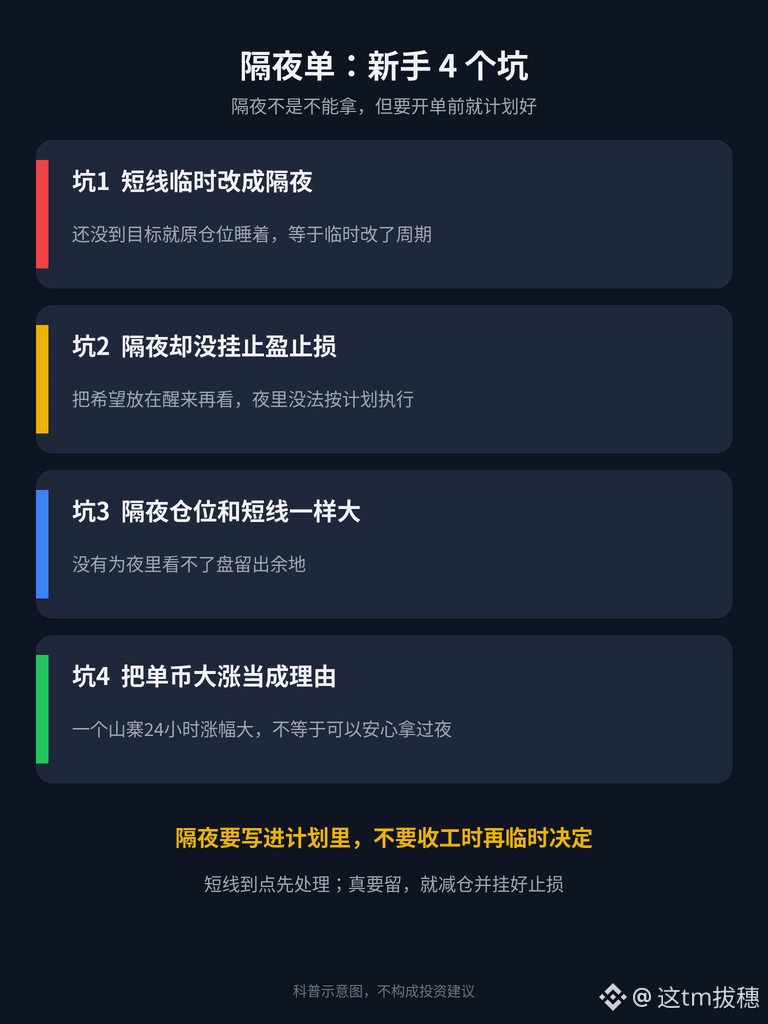
3. Common beginner pitfalls
1) Holding a short-term trade overnight at the original position size because it hasn’t reached its target yet—in effect, changing the time frame on the fly;
2) Holding overnight without setting take-profit and stop-loss orders, and just hoping to check the trade when you wake up;
3) Keeping the overnight position as large as the short-term position you held during the day, without allowing for the fact that you can’t watch the market at night;
4) Seeing one altcoin with a huge 24-hour gain and treating that as a reason to feel safe holding it overnight.
This goes hand in hand with Lesson 12 on conditional orders, Lesson 13 on funding rates, Lesson 20 on screen time, and Lesson 45 on time-based stop-losses: manage trades by short-term rules when you can watch the market, and decide whether to keep a trade open before you leave your screen.
In short: You can hold a trade overnight, but you need to plan for it before opening the trade. When it’s time to finish for the day, close or reduce your short-term position first. If you really do plan to hold overnight, reduce the position, set your stop-loss, and check the funding rate. Don’t take an unplanned position to bed with you.
A specific question: If your short-term trade is still open when it’s time for you to finish for the day, would you choose A) close it or reduce it according to plan, or B) keep the original position open until the next day? Just reply A or B in the comments.
The content above is for educational purposes only and does not constitute investment advice. Crypto assets are extremely volatile, and futures carry even greater risk. Only trade with money you can afford to lose.
#新手入门 #技术分析 #Binance Square