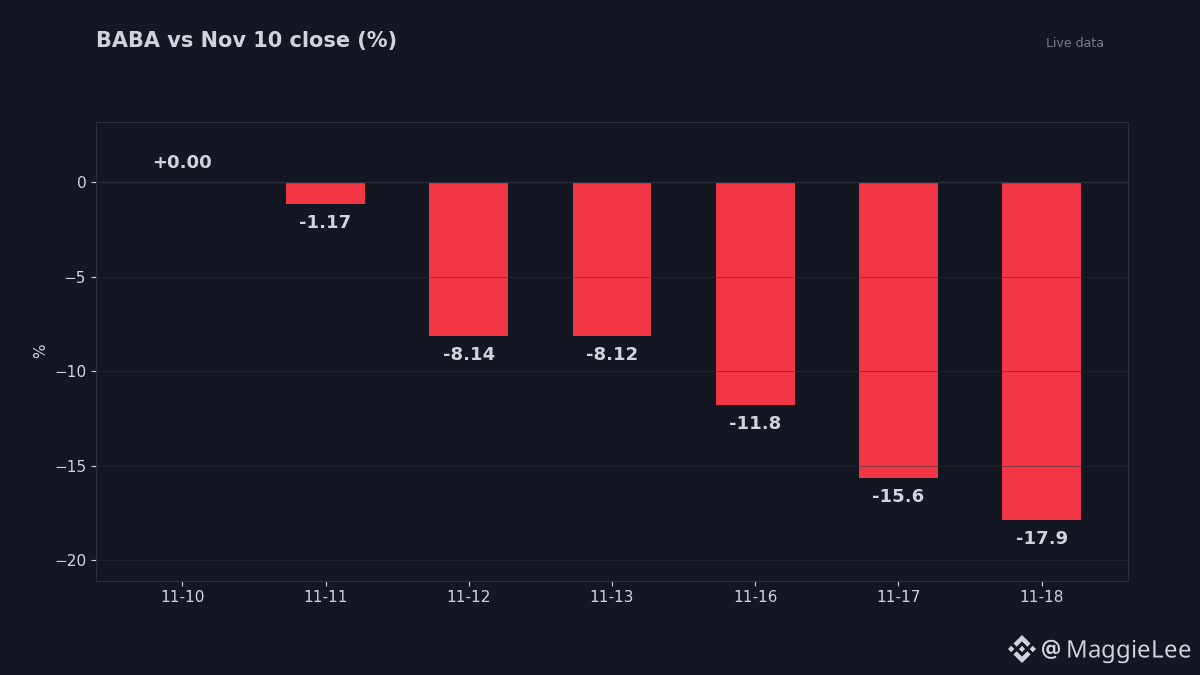
Alibaba's earnings report comes out tonight, but the stock has already fallen nearly 20% in advance. Over in Hong Kong, it dropped almost 5% in a single day on Tuesday. The report hasn't even been released yet, and the bears have already taken their positions.
The table I have in hand tracks it down from the Nov. 10 close of $102.72: Nov. 11 at $101.52, Nov. 12 plunging straight to $94.36, more than a 7% drop in one day. After that it drifted lower each day, and by yesterday's close it was down to just $84.37. In six trading days it lost 17.86%, only managing a mild bounce to $85.33 after hours.
The trigger was the new chip export control rules announced on Nov. 16. Advanced chips heading to data centers in certain countries now need a license, and overseas computing infrastructure is included too. Alibaba's Hong Kong shares fell 4.9% the next day, Baidu dropped 6.8%, and the whole China concept chip chain got hit.
Tonight, the September quarter earnings report comes out before the open, with the call at 8 p.m. Beijing time. The market expects earnings of $1.62 per share and revenue of $40.23 billion. Options are pricing in a move of plus or minus 5%, or about $4.36. Pinduoduo is also reporting tonight, so China concept consumer and cloud names are being compared side by side.
What I'm watching isn't just whether revenue beats expectations. Last quarter, cloud revenue rose 45% to 48.44 billion yuan, AI-related product revenue posted triple-digit growth for the 12th straight quarter, and the story sounded great. But capital expenditure jumped 75% to 67.68 billion yuan, free cash flow was a net outflow of 44.67 billion yuan, and e-commerce customer management revenue still fell 7%. The pace of burning cash is faster than the pace of making it. Where the stock goes after earnings will depend half on how management talks about computing power on the call, whether cloud growth can stay near 45%, and whether losses in instant retail have narrowed.
Institutions are still pretty upbeat on paper: Aletheia just raised its target price to $190 and kept a Buy rating; Goldman Sachs has $177, Bank of America $178, and JPMorgan cut it in October from $210 to $200 but still has Overweight. The target prices are more than double the current level, yet the stock has already fallen nearly 20%. That contrast itself shows the market doesn't believe the story right now, only the cash flow.
The risks are right there too: tighter chip controls, cloud growth lagging, and continued spending in instant retail. If any one of those plays out, post-earnings volatility won't be small.
On Binance Futures there is a BABAUSDT perpetual contract, listed on April 20, with up to 10x leverage, settled in USDT, and tradable 24 hours a day, so you don't have to wait for the U.S. market open to trade this earnings move.
Personal research only, not investment advice.
$BABA $BABAUSDT
#阿里巴巴 #美股 #earnings
The table I have in hand tracks it down from the Nov. 10 close of $102.72: Nov. 11 at $101.52, Nov. 12 plunging straight to $94.36, more than a 7% drop in one day. After that it drifted lower each day, and by yesterday's close it was down to just $84.37. In six trading days it lost 17.86%, only managing a mild bounce to $85.33 after hours.
The trigger was the new chip export control rules announced on Nov. 16. Advanced chips heading to data centers in certain countries now need a license, and overseas computing infrastructure is included too. Alibaba's Hong Kong shares fell 4.9% the next day, Baidu dropped 6.8%, and the whole China concept chip chain got hit.
Tonight, the September quarter earnings report comes out before the open, with the call at 8 p.m. Beijing time. The market expects earnings of $1.62 per share and revenue of $40.23 billion. Options are pricing in a move of plus or minus 5%, or about $4.36. Pinduoduo is also reporting tonight, so China concept consumer and cloud names are being compared side by side.
What I'm watching isn't just whether revenue beats expectations. Last quarter, cloud revenue rose 45% to 48.44 billion yuan, AI-related product revenue posted triple-digit growth for the 12th straight quarter, and the story sounded great. But capital expenditure jumped 75% to 67.68 billion yuan, free cash flow was a net outflow of 44.67 billion yuan, and e-commerce customer management revenue still fell 7%. The pace of burning cash is faster than the pace of making it. Where the stock goes after earnings will depend half on how management talks about computing power on the call, whether cloud growth can stay near 45%, and whether losses in instant retail have narrowed.
Institutions are still pretty upbeat on paper: Aletheia just raised its target price to $190 and kept a Buy rating; Goldman Sachs has $177, Bank of America $178, and JPMorgan cut it in October from $210 to $200 but still has Overweight. The target prices are more than double the current level, yet the stock has already fallen nearly 20%. That contrast itself shows the market doesn't believe the story right now, only the cash flow.
The risks are right there too: tighter chip controls, cloud growth lagging, and continued spending in instant retail. If any one of those plays out, post-earnings volatility won't be small.
On Binance Futures there is a BABAUSDT perpetual contract, listed on April 20, with up to 10x leverage, settled in USDT, and tradable 24 hours a day, so you don't have to wait for the U.S. market open to trade this earnings move.
Personal research only, not investment advice.
$BABA $BABAUSDT
#阿里巴巴 #美股 #earnings