
Independent Research |
Not financial Advice
I. Counting Products Is Not Counting Risks
A yield product looks diversified when its dashboard lists several tokens from several issuers. An allocator measures diversification by independent risk factors: who holds the asset, who services it, who lends against it, and where the exit sits. When two tokens share an underlying fund, a custodian or a venue, the dashboard counts two positions and the portfolio holds one exposure.
This paper argues that most onchain "diversified" yield strategies combine products that share an underlying fund, a borrower, a curator or a venue, and that the shared layer is where the remaining risk sits. I trace six places this shows up, each with a disclosed number, and finish with a five question look through test.
II. Layer One: The Shared Underlying
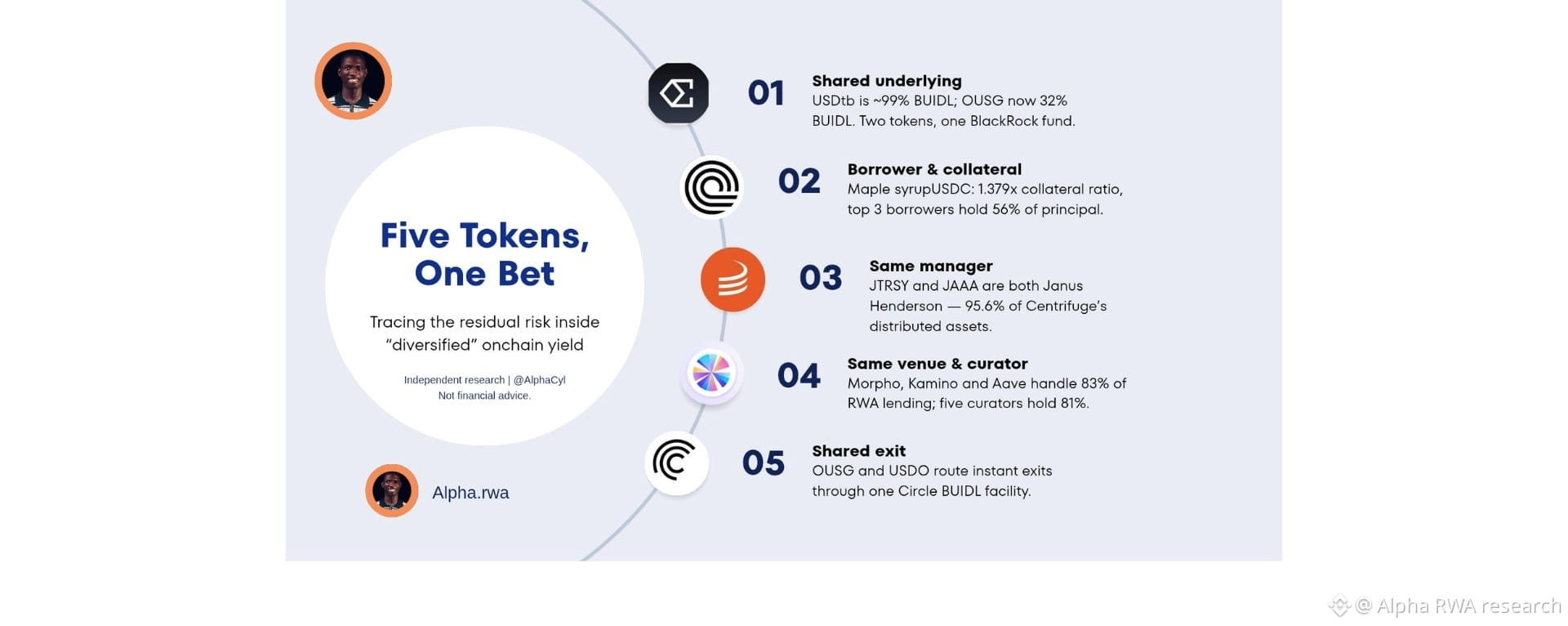
Take @Ethena Labs 's $USDtb. An August 31, 2026 reserve examination (@Deloitte , via @Anchorage ) listed $525,205,527 in $BUIDL and $5,214,126 in bank demand deposits, so about 99% of reserves were BUIDL. A holder of USDtb is a holder of one #blackRock fund.pharos.watch/stablecoin/usd…
The overlap spreads. A DeFi guide lists BUIDL as backing USDtb, feeding Frax's sFRAX reserves, sitting in @sparkfinance 's allocator behind $sUSDS , serving as margin collateral at FalconX, and underpinning @Ondo Finance 's $OUSG .
The OUSG case shows how a product page can lag its holdings. AltStreet's reading of Ondo's page on October 23, 2026 shows $319.4 million of underlying assets: State Street's SWEEP at 47.49%, BUIDL at 31.96%, Franklin's BENJI at 12.18%, Fidelity's FYOXX at 7.38%, and about 1% cash. RWA.xyz's page still says OUSG primarily holds BUIDL, and the same AltStreet piece notes that Ondo's FAQ still describes the portfolio as mostly BUIDL. The holdings table changed, and the descriptions did not. Even after the shift, all four sleeves are tokenized government money funds, so their shared exposure is the Treasury bill and repo market.
altstreet.investments/guides/superst…
Now ahttps://app.rwa.xyz/assets/ousg
hypothetical "diversified" vault with five tokens: $USDtb 30%, $OUSG 25%, $syrupUSDC 20%, sUSDS 15% and $JAAA 10%. On the disclosed figures, USDtb contributes about 29.7% BUIDL (30% × 0.99) and OUSG about 8.0% (25% × 0.3196), so BUIDL alone is roughly 37.7% of the vault before looking through sUSDS. The top level weights give a Herfindahl index of 2,250, or 4.4 effective positions. The look through leaves fewer independent exposures than that.
III. Layer Two: The Borrower and the Collateral
@Maple Finance Official 's syrupUSDC shows the credit version. @LlamaRisk 's July 17, 2026 analysis for @aave governance measured the USDC open term book at $1,330 million of principal against $1,834 million of collateral, a ratio of 1.379x. The top three borrowers hold 56% of principal and the top five hold 77%. The largest, at $345 million or 26.0%, posted $PYUSD and USTB as collateral. A yield product backed by loans therefore holds collateral that is itself a tokenized Treasury product, which other sleeves may also hold.
governance.aave.com/t/arfc-onboard…
The same analysis lists the top holders of syrupUSDC: @SkyEcosystem 's AML proxy at 45.19% of supply, a cross chain pool at 18.98%, @Morpho at 10.05% and @grovedotfinance at 7.39%. @Dune 's May 2026 count found that $522 million of Maple's $1.8 billion syrup market capitalization is deployed across five venues, making one asset family nearly 30% of all RWAs in DeFi. The Yearn curation report from February 2026 split Maple's collateral as BTC at about 54%, XRP at 25.38% and USTB at 16%.
governance.aave.com/t/arfc-onboard…
dune.com/blog/tokenized…
IV. Layer Three: The Same Manager Under Different Allocators
@centrifuge 's $JTRSY and $JAAA are both Janus Henderson funds. A July 2026 snapshot found they made up 95.6% of Centrifuge's distributed assets, with Grove holding about $895 million across the two and @ethena allocating $250 million to $JAAA.ETF in June 2026. Grove's June 2025 launch came with a $1 billion allocation from Sky to JAAA. Several "diversified" allocators therefore share one underlying manager.
businesswire.com/news/home/2025…
V. Layer Four: The Same Venue and the Same Curator
Dune's April 2026 count put RWAs deposited into DeFi lending at about $2.7 billion, roughly 10% of $27 billion, with credit near 80% of deposits against 17% of AUM, and @Morpho , @KaminoFinance and @aave handling 83% of RWA lending activity.
dune.com/blog/the-rise-…
cryptobriefing.com/dune-report-to…
@RWA_xyz 's November 2 analysis traced the curators. Of $6.1 billion supplied to Morpho's variable rate stablecoin markets on October 28, 2026, the five largest curators (@SteakhouseFi , @SentoraHQ , @gauntlet_xyz , @SparkDao and @RockawayX ) oversee $5.0 billion, or 81%. Markets accepting tokenized collateral took $2.4 billion. The same report puts aggregate utilization near 90%, since about $5.5 billion is already borrowed. CoinbaseLend and Robinhood Earn both route into Steakhouse curated Morpho vaults, and Spark and Grove supply through that curator layer as well. Steakhouse also incubated Grove. A depositor who picks Coinbase, Robinhood or Sky for "diversification" meets one curator layer under three brands.
app.rwa.xyz/blog/the-lende…
VI. Cases
Case One: @StreamDefi and @elixir , November 2025. The loss started with an "external fund manager" and reached lenders through shared collateral. Elixir lent $68 million in $USDC to Stream, about 65% of deUSD's backing. Stream held roughly 90% of the deUSD supply, so Elixir's backing was a loan to its largest holder. Analysts at YAM mapped about $285 million of debt across @eulerfinance , @SiloFinance , @Morpho Labs 🦋 ho and @GearboxProtocol , with @MEVCapital , @Re7Capital and TelosC among the exposed curators. Gauntlet had no xUSD exposure but paused some markets because of the Elixir contagion. RWA.xyz adds that fixed price oracles in affected markets did not reflect the decline, so liquidations did not trigger and lenders took bad debt. Several vaults chose different curators and the same collateral.
theblock.co/amp/post/37749…
Case Two: USDtb and the regulators' question. The OCC's March 2026 proposal floated a 20% cap on tokenized reserve assets, and @BlackRock argued that risk depends on credit quality, duration and liquidity and not on whether an asset is held on a ledger. The final rule of October 21 permits tokenized reserves if they carry the same legal rights, drops prescriptive portfolio requirements, and limits exposure to a single counterparty to 40% of reserve assets, subject to exceptions. BlackRock had asked the OCC to confirm that issuers need not look through fund holdings when applying that limit to fund custodians or service providers. I did not find how the final rule resolves that point.
natlawreview.com/article/occ-is…
theblock.co/news/business/…
Case Three: a shared exit. From @Ondo 's April 2025 post and @OpenEden_X 's docs: OUSG and $USDO route instant exits through the same Circle facility for $BUIDL , and that facility had 23 hours of limited availability on March 27, 2025. The two products show up as separate lines on a dashboard and as one dependency in an outage.
VII. The Structural Question: Is Overlap Always Bad?
Not always. A Treasury bill fund from BlackRock is a lower risk place to concentrate than a thinly examined yield wrapper, and Spark's 2024 selection process shows allocators choosing winners on purpose. A single large underlying can be defensible if it is disclosed.
The risk in this paper comes from overlap the buyer cannot see. The dashboard says five tokens while the holdings table says three funds, two operators and one curator. Stream is the cost of that gap in a bad credit. A look through is cheap by comparison. Counts of tokens or issuers should not be shown as diversification until the shared layers are netted out.
The look through test. For any "diversified" yield product, ask five questions:
1. After look-through, which three underlying exposures are largest?
2. Which single operator (transfer agent, custodian, redemption facility) sits in the exit path for most sleeves?
3. Do two sleeves share a borrower, a collateral asset, or a manager?
4. What share of supply sits on one venue or with one curator?
5. Does the vault's accounting and oracle treatment differ by sleeve, or does one pricing assumption cover several?
VIII. Where the Research Points
This paper's thesis is that disclosure will move from product lists toward look-through exposures, because the shared layers are now measurable. Three things to watch:
1. How the OCC applies its 40% single counterparty limit to fund shares, and whether look-through becomes a requirement.
2. Whether vault curators publish netted exposure by underlying manager and operator.
3. Whether Morpho's utilization near 90% pushes lenders to price shared-collateral risk.
Independent research. Not financial advice. Always conduct your own due diligence.
Sources: protocol and issuer documents, governance, analytics publishers
- Business Wire, Grove launch (June 25, 2025); Centrifuge blog
- governance.aave.com/t/arfc-onboard… (LlamaRisk, July 17, 2026)
- app.rwa.xyz/blog/the-lende… (Nov 2, 2026)
- dune.com/blog/the-rise-…; dune.com/blog/tokenized…; dune.com/rwa-report
- Pharos USDtb page (Anchorage/Deloitte reserve report, Aug 2026)
- OCC final GENIUS rule summary, natlawreview.com (Oct 2026); The Block, BlackRock comment letter (May 2, 2026)
- curation.yearn.fi/report/maple-s…