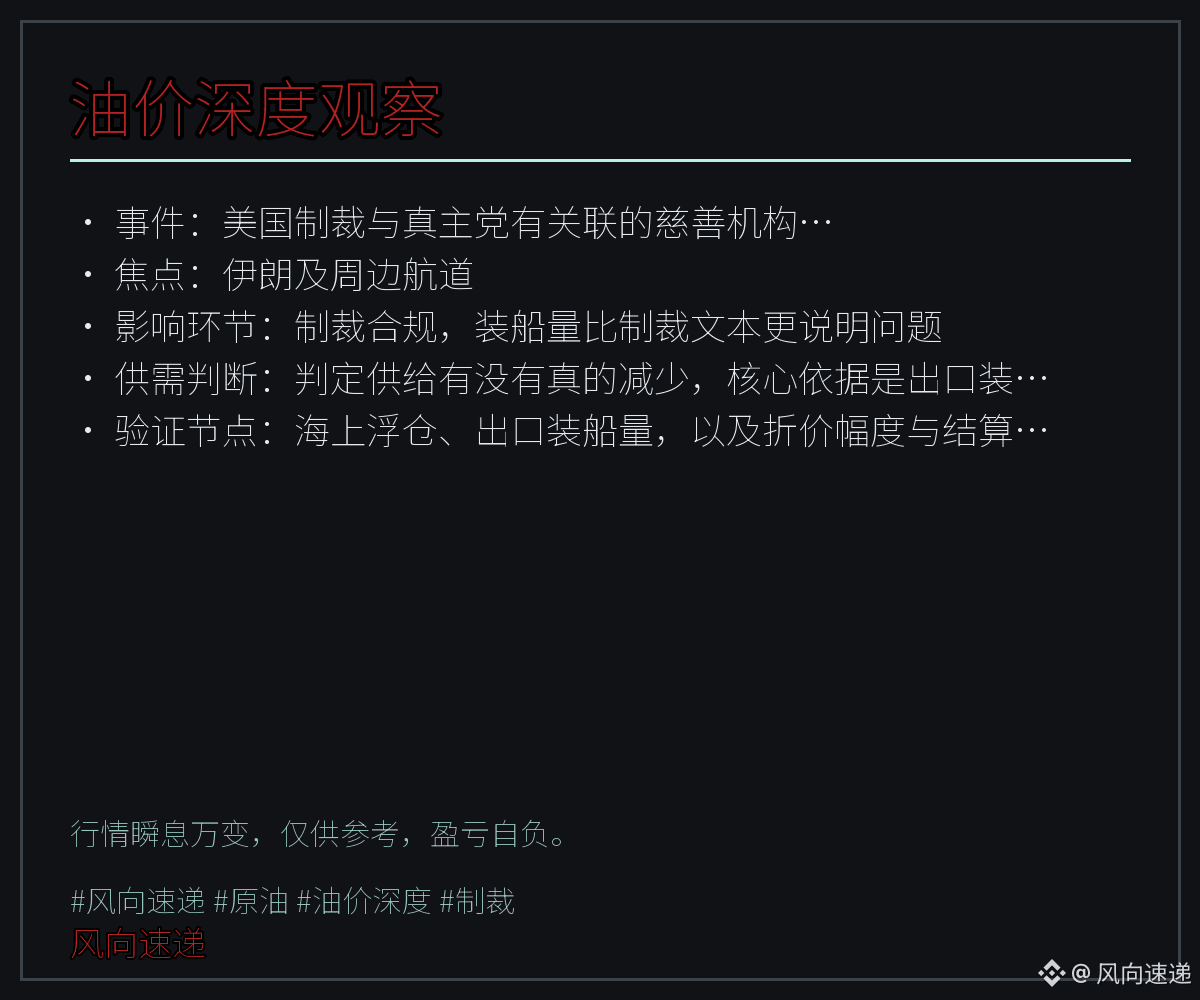
In-Depth Oil Price Watch
【Key Event】
U.S. sanctions charity linked to Hezbollah, aiming to pressure Iran - Al-Monitor (within the past hour)
【Who Is Affecting Oil Prices】
Iran is tightening energy trade rules. The focus is on Iran and nearby shipping routes. The sanctions affect whether crude can be settled, insured, and brought into port smoothly. Sanctioned production may not disappear, but its destinations and discounts will be reshaped.
【Transmission Mechanism】
When enforcement tightens, shadow fleet capacity, insurance, and payment channels face constraints first. Buyers turn to alternative sources, pushing up premiums for compliant crude.
Sanctioned crude typically trades at a steeper discount, widening global price spreads and causing feedstock costs to diverge among refineries.
【Supply, Demand, and Pricing】
The key indicator for determining whether supply has actually fallen is export loading volume; the sanctions text itself only indicates a change in the rules.
WTI is currently trading around $82.94, with a 24-hour change of -4.20%. Volatility has increased, indicating that this type of risk is being priced in rapidly. Next, it will be even more important to see whether actual supply and demand data bear this out. Sanctions news often causes a one-off jump, after which the market recalibrates based on the actual level of enforcement.
【What to Watch Next】
Track floating storage at sea, export loading volumes, and changes in discount levels and settlement channels.
【What Would Invalidate This Thesis】
If exemptions are expanded or enforcement is relaxed, the premium for compliant crude will fall, and trade flows will adjust again.
Markets change rapidly. For reference only; you are responsible for any gains or losses.
#风向速递 #原油 #油价深度 #Sanctions