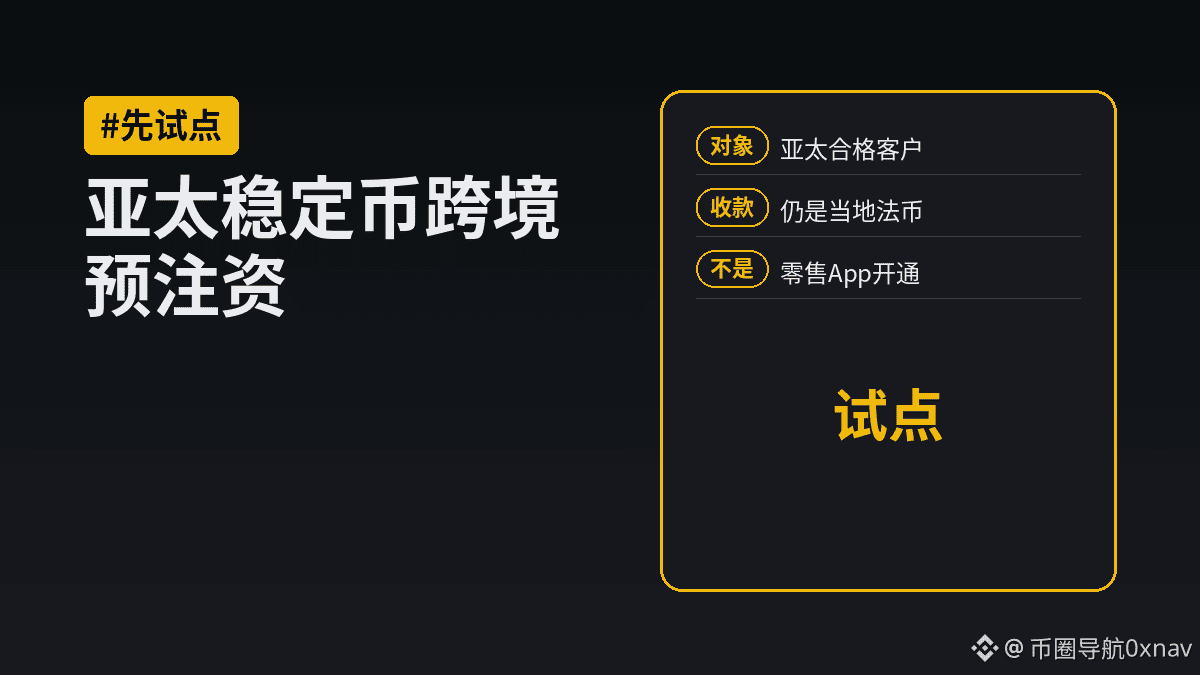
The trending headline says “plans to launch cross-border stablecoin prefunding in Asia Pacific.” Don’t take that to mean you can open your wallet today and use stablecoins to send money to anyone anywhere in Asia Pacific.
On November 18, Visa’s official press release said it plans to let eligible customers in Asia Pacific use supported stablecoins to prefund cross-border payments through Visa Direct; recipients will still receive fiat currency. Availability depends on eligibility and region. This is a way for businesses to prepare funds for payments—not a new “cross-border withdrawal” button in a personal exchange app.
A few points that are directly relevant to everyday users 👇
🔹 This is currently a pilot—not a rollout across all of Asia Pacific of the system already in full commercial production in the US. In October this year, Visa Direct’s stablecoin prefunding entered commercial production in the US with Inyo Global. In Asia Pacific, Visa says it is running a pilot with Singapore-based payments company dtcpay.
🔹 In its own announcement that same day, dtcpay said it holds a Major Payment Institution (MPI) licence issued by the Monetary Authority of Singapore (MAS), and that the pilot uses USDC for prefunding. It is aimed at business customers that frequently make cross-border payments, such as platforms, remittance providers, marketplaces, and payroll services. Payout options include US and Hong Kong bank accounts, eligible Visa cards, and supported digital wallets. Visa’s own Asia Pacific announcement did not name a specific stablecoin, referring only to “supported stablecoins.”
🔹 Visa also made clear that it does not provide regulated digital asset services; those services are provided independently to customers by licensed partners. Official details on fees, the full list of available regions, and whether everyday users can access this payment channel have not yet been published.
So when you see the words “launch in Asia Pacific,” think of an expanded pilot for business payment channels—not “you can already send stablecoins to anyone.” Business customers should ask their payment service provider whether they are eligible to participate. For individuals, recipients will still receive fiat currency, and this is nowhere near a full-scale launch yet.
Would you first keep an eye on where the pilot can send money, or wait until it moves from pilot to general availability?
#Visa拟在亚太推出稳定币跨境预注资 #BTC #ETH