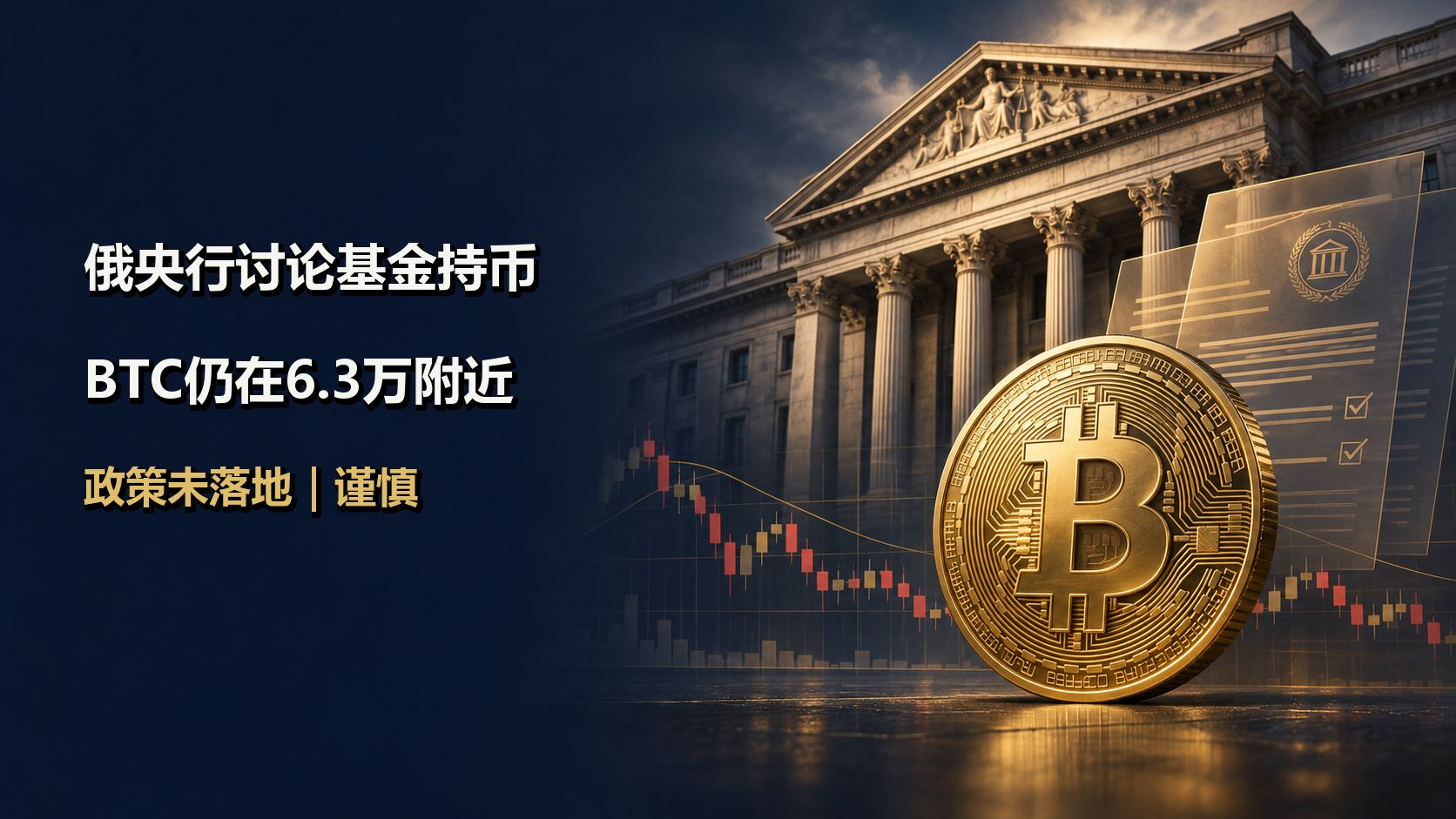
Russian Central Bank discusses funds holding crypto|BTC remains near $63,000|Regulatory tailwinds do not mean immediate buying
My view is that we are seeing progress toward a regulatory pathway, but a “plan” should not be treated as funding that has already arrived. A trending topic on Binance Square mentioned that Russia’s central bank may allow investment funds to hold cryptocurrencies directly in 2027. The original report came from an interview by Russian media outlet RBC with Olga Shishlyannikova, a department head at the central bank: the bank is considering amending the rules next year to allow funds aimed at qualified investors to buy cryptocurrencies directly. Whether any products launch will also depend on the amendments and their registration with the Ministry of Justice. What is confirmed is that an official publicly discussed a proposal under consideration. It would be inaccurate to say that funds have already been approved or have already bought BTC, much less count a 2027 proposal as spot inflows today.
I cross-checked the Bank of Russia’s official announcement dated November 6. It confirms that the list of tradable assets for non-qualified investors includes BTC, ETH, and USDT, and that the relevant directive took effect on November 17. Brokers, management companies, exchange services, and other providers must still comply with testing, risk disclosures, and purchase limits. This retail rule, which is already in force, is separate from the future funds for qualified investors mentioned in the RBC report. What is worth tracking in the market is not the headline, but subsequent fund-rule texts, approved products, custody arrangements, and actual subscriptions. If there is only a policy statement, BTC supply and demand do not change immediately.
In principle, if compliant funds are eventually allowed to hold crypto directly, this could broaden access for long-term capital and increase custody and liquidity requirements. But cross-border capital restrictions, product eligibility, and the scale of any such activity are unknown, so it cannot be assumed that this would replicate the trading volume of U.S. spot ETFs. I checked Binance BTC/USDT at around $63,257, still down about 1.23% over 24 hours, with a low of $62,279 and a high of $65,268. The price has not reclaimed the high on this news, suggesting that risk appetite remains cautious, at least based on current quotes. The area around $63,000 is a short-term zone to watch: first look to $64,000 on the upside, then $65,268; on the downside, watch $62,280. If the Fed meeting minutes later prompt a repricing of interest-rate expectations, macro volatility could overshadow this long-term policy signal.
If I were trading this myself, I would stay out for now and only consider a spot long, using at most 1.5% of total capital, with no leverage. The entry trigger would be BTC reclaiming and holding $64,000 after the minutes are released, then defending that level on an hourly retest, with no new risk events. I would take half off near the first target of $65,200, reduce again near the second target of $66,500, and close the remaining position if an hourly close falls back below $64,000. The initial stop would be below $63,200. If the price breaks straight through $62,280, I would cancel all long plans and close any existing probe positions. If the fund-rule amendments are not approved, the process is delayed, or the market continues to fail to reclaim $64,000, I would revise my view that regulatory tailwinds could provide short-term support. Verify the policy and the price first, then act.
#RussianCentralBankPlansToAllowFundsToHoldCryptoIn2027 #BTC
The above is only my personal market observation and does not constitute investment advice.