

Today, reports emerged in the crypto industry of cryptocurrency theft involving counterfeit Ledger hardware wallets in Dubai. Eastern Europe recorded the steepest decline in crypto activity of all the regions tracked by Chainalysis, while Google announced that it had identified hackers using AI agents to fully automate the discovery and exploitation of software vulnerabilities for the first time.
Ledger hardware implant story reaches Virgin Megastore in Dubai
Two Ledger owners reported cryptocurrency theft from hardware wallets that they said they had purchased from an authorized seller in Dubai. This raises concerns that the hardware wallet tampering campaign has also spread to the UAE.
User X, who posts under the name Rewinsky, said on Monday that he had discovered tampering with his Ledger Flex after reporting the loss of about 1,300 Solana (SOL). The Ledger Implant OSINT database, created by Mark Karpelès, later confirmed the device contained a hardware implant.
A second owner, who posts under the name New Babylon Order Worldwide, said on Tuesday that 507,000 USDt had been stolen from his Ledger Stax on Saturday. He said the device was bought new at Virgin Megastore Dubai on October 11, two days after Ledger publicly disclosed an investigation into cryptocurrency losses involving devices sold by Southeast Asian reseller CryptoBilis.
These reports suggest Ledger device tampering has spread beyond retail sellers in Asia and Europe. Ledger lists Virgin Megastores as an authorized seller in the United Arab Emirates.
Eastern European crypto flows fell 7.9%, while Ukraine attracted $12 billion in stablecoins
According to a report published Tuesday, Eastern Europe saw the sharpest decline in cryptocurrency activity among the regions tracked by Chainalysis in the year ending June 2026: activity fell 7.9%, despite an increase in the value of retail-sized transfers.
According to the report, the region’s crypto economy shrank from $697.1 billion a year earlier to $642.1 billion, compared with a global decline of 1.6%. Russia, which accounted for about 44% of the regional total, saw activity fall 14.7% to $284.1 billion over the period. Meanwhile, Belarus recorded growth of 27.6%, while Bulgaria, Moldova and Ukraine saw smaller increases.
According to the report, transfers of $10,000 or more to crypto services fell 17.4%, from $591.5 billion to $488.6 billion.
Meanwhile, the volume of smaller transfers to crypto services rose 8.3%. Retail-sized transfers accounted for 13.1% of the value of funds sent to crypto services in Eastern Europe—the highest share among all regions studied and above the global average of 10.1%.
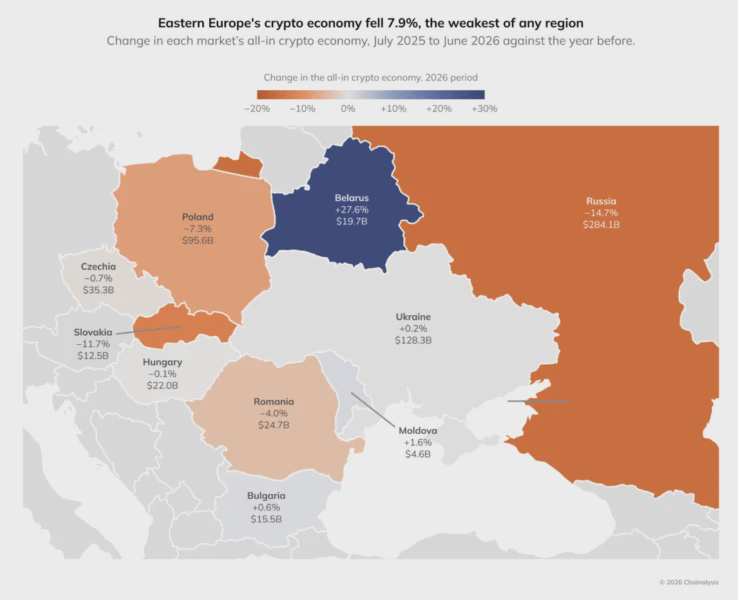
Crypto activity in Eastern European countries from July 2025 to June 2026. Source: Chainalysis report
Google: Hackers use AI agents to find and exploit software vulnerabilities
Google Threat Intelligence Group (GTIG) said it had identified, for the first time, malicious actors using large language model (LLM) frameworks to automate the discovery and exploitation of software vulnerabilities without step-by-step guidance from a human.
In a report published Monday, researchers described a tool discovered on an exposed staging server. It compared software versions, identified potential vulnerabilities, and created and executed exploit code.
“Last quarter, GTIG identified malicious actors using LLM frameworks to fully automate vulnerability discovery and exploitation without human involvement for the first time,” the researchers said.
GTIG discovered an exposed staging server hosting a multi-agent framework for researching vulnerabilities and turning them into attack tools. It was configured to perform continuous differential analysis, comparing code before and after patch announcements for popular web applications. The model autonomously identified and exploited software vulnerabilities.
Google warned that these automated workflows give organizations less time to install security patches before malicious actors develop ways to exploit vulnerable systems.