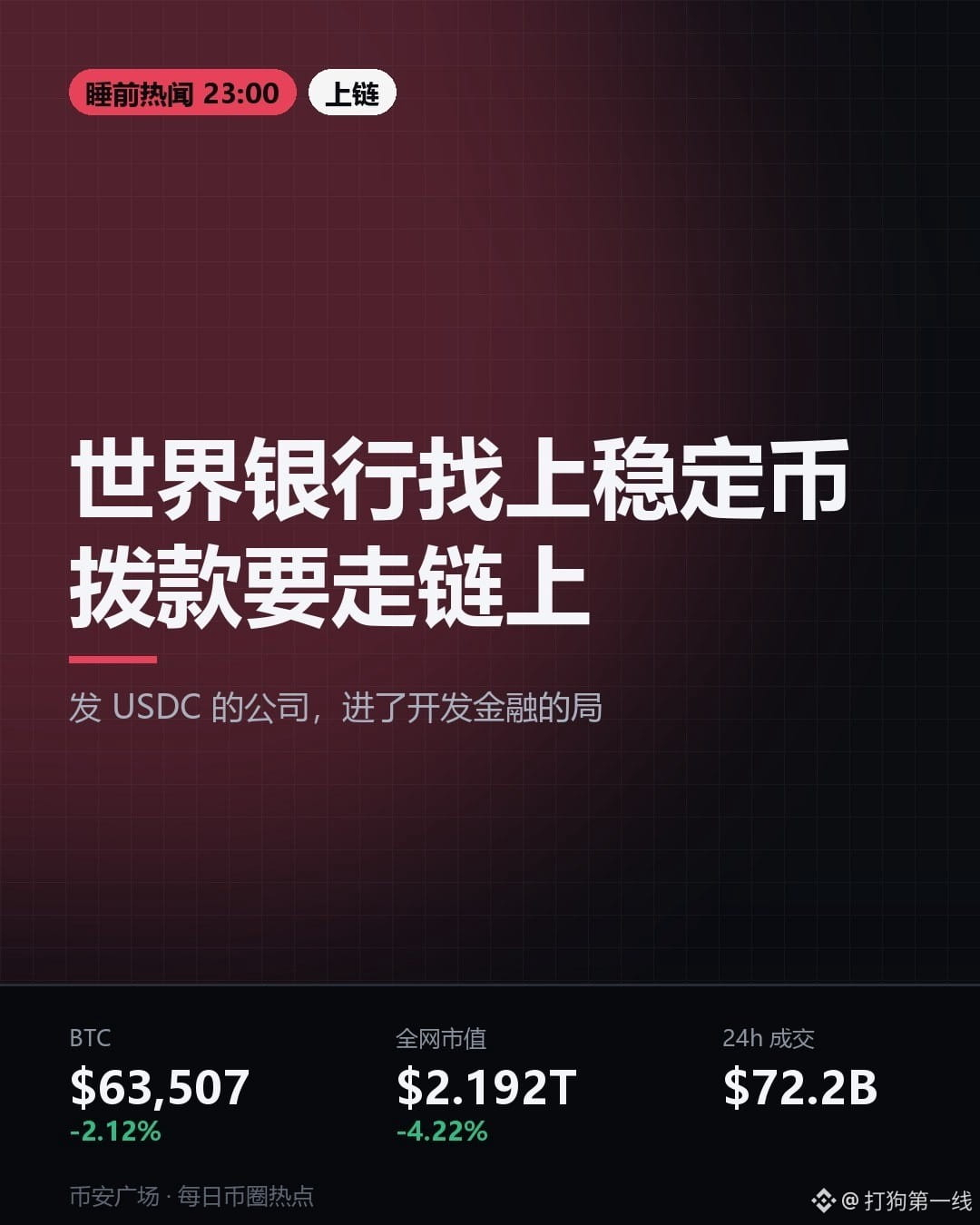
The World Bank wants to fund developing countries, with Circle and Citi as partners. What qualifies a company that issues USDC to be part of this effort?
Cointelegraph reported tonight that the World Bank Group is working with Circle and Citi to explore using stablecoins for payments. The project is built on the World Bank’s existing blockchain platform, with the goal of making funds sent to developing countries easier to track.
Stablecoins have faced criticism over money laundering and losing their pegs. Now, institutions working in development finance are treating them as a transparency tool. Once money goes on-chain, every hand it passes through leaves a trace. With cross-border funding, the hardest part has traditionally been the many layers of subcontracting, which make it difficult to reconcile the books.
On-chain traceability depends on being able to link addresses to people. The money ultimately has to reach projects and contractors, and once it leaves the blockchain, banks still have to recognize it. For now, this is only at the “exploration” stage; there’s more on paper than on the ground.
There’s another story tonight, in the opposite direction. Decrypt reported that Tyler Buchanan, a Scot, stole $11.6 million in crypto assets through phishing and SIM swapping. He was sentenced to 6 years, making him the last of five defendants to be sentenced. The methods aren’t new: trick someone into giving up a verification code, take over their phone number, and transfer the crypto.
The blockchain doesn’t lie. People do.
The market wasn’t having it. $$BTC 63,507, down 2.12% in 24 hours. The total market cap was $2.192 trillion, shrinking 4.22% in a day, with $72.2 billion in trading volume.
Tomorrow at the open, watch for two things: whether the World Bank’s list of participating banks and the date of the first round are announced; and whether $USDC institutional players follow through with minting and redemption volumes. Only then will it truly be underway.
There’s a gap between exploring an idea and actually spending money on it—regulatory approvals and internal bank processes. Don’t mistake a headline for a launch. When it comes to your positions, it’s better to think things through before bed than to stare at the charts in the middle of the night.
Which do you trust more: that string of on-chain records, or the bank statement mailed to you?
#稳定币结算 #SIM卡盗币 #OvernightRisk