The money that should be holding stocks for the long term is surprisingly starting to pull out.
Insurance funds are, in theory, among the most patient long-term investors in the capital market.
With policies often lasting ten, twenty, or even more years, insurance companies naturally need to allocate funds to long-term assets.
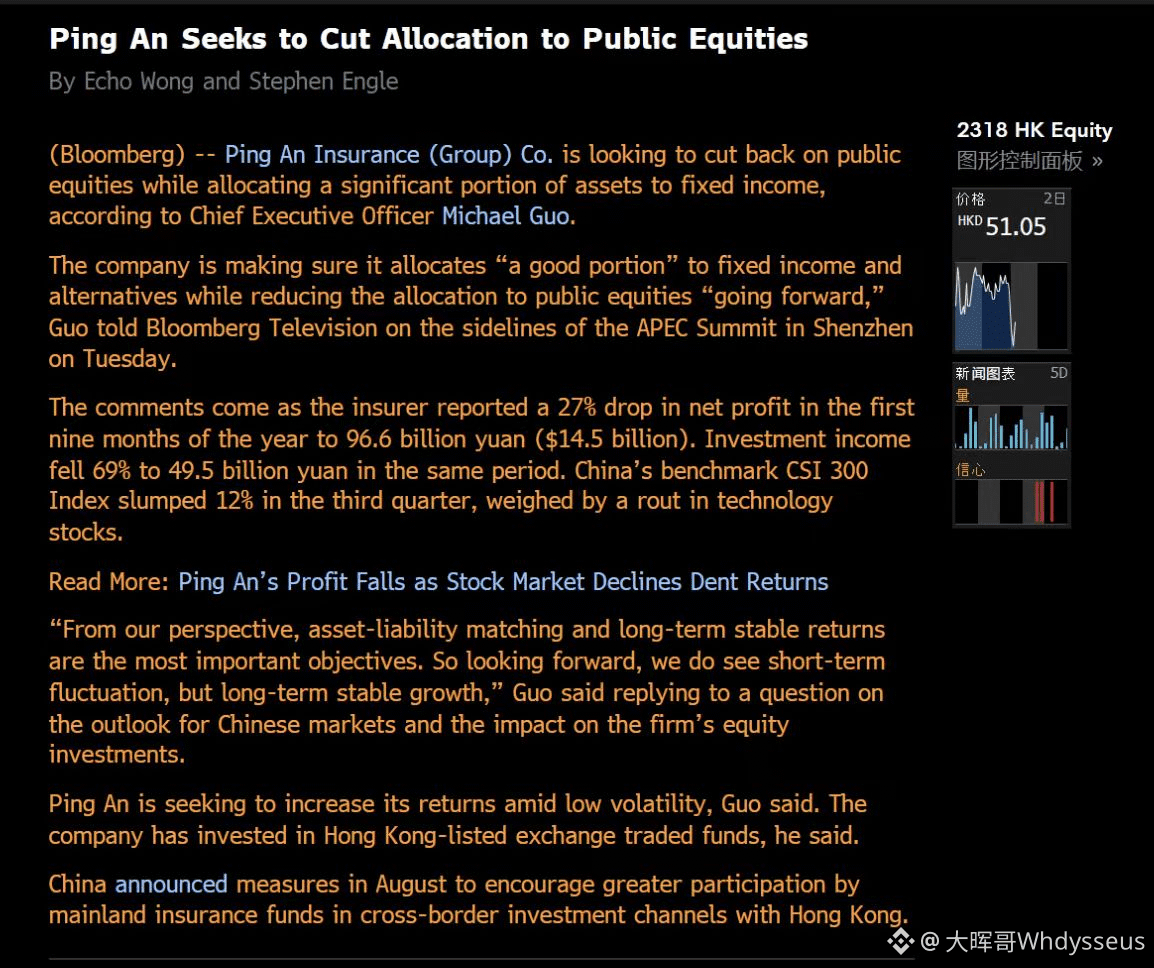
In an interview with Bloomberg during the APEC summit in Shenzhen, Guo Xiaotao, CEO of Ping An Insurance, said the company would reduce its allocation to publicly traded stocks in the future and shift toward fixed-income and alternative investments.
The context for Guo’s remarks was that in the first nine months of 2026, Ping An’s net profit fell 27% year on year, while investment income plunged 69%.
When retail investors pull out, you could say they can’t withstand the volatility; when funds pull out, you could say they’re facing redemption pressure.
But now even insurance funds—the kind of money that truly invests for the long term—are unwilling to bear market volatility.
Insurance funds are, in theory, among the most patient long-term investors in the capital market.
With policies often lasting ten, twenty, or even more years, insurance companies naturally need to allocate funds to long-term assets.
In an interview with Bloomberg during the APEC summit in Shenzhen, Guo Xiaotao, CEO of Ping An Insurance, said the company would reduce its allocation to publicly traded stocks in the future and shift toward fixed-income and alternative investments.
The context for Guo’s remarks was that in the first nine months of 2026, Ping An’s net profit fell 27% year on year, while investment income plunged 69%.
When retail investors pull out, you could say they can’t withstand the volatility; when funds pull out, you could say they’re facing redemption pressure.
But now even insurance funds—the kind of money that truly invests for the long term—are unwilling to bear market volatility.