U.S., U.K. and Canadian Law Enforcement Agencies Join Forces to Crack Down on Crypto Approval Phishing Scams
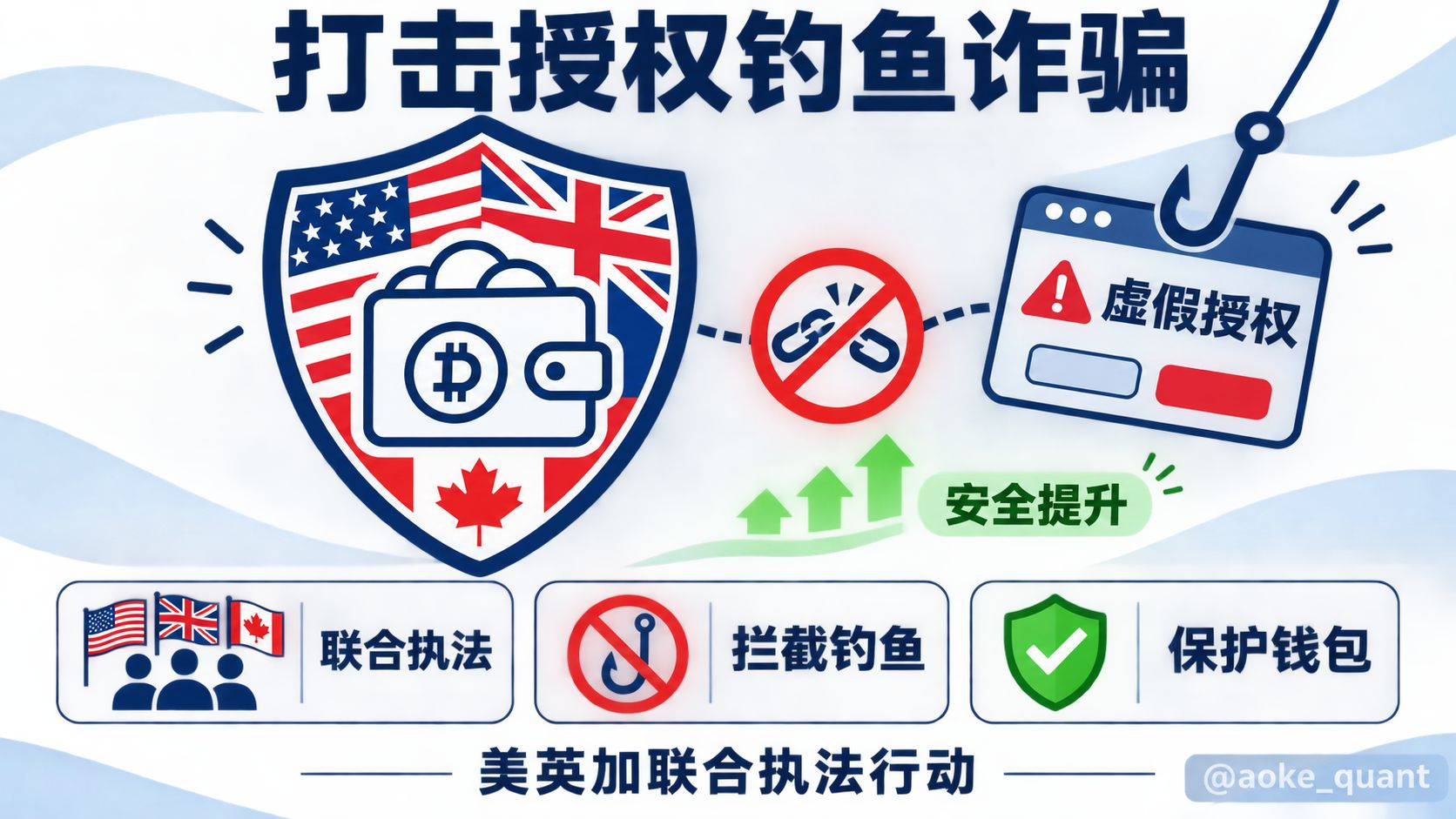
Approval phishing has long been a persistent security problem in the crypto industry: scammers use fake pop-ups, bogus security warnings or airdrop pages to trick users into signing wallet authorizations. Once users click to confirm, attackers can transfer assets from their wallets at any time afterward—even without asking users to enter another password. Now, these scams are prompting a coordinated response from law enforcement agencies across borders. According to public reports this March, law enforcement agencies in the United States, the United Kingdom and Canada launched a joint operation called “Operation Atlantic,” targeting approval phishing scams in the crypto sector. The operation has three clear priorities: first, to disrupt phishing activity in real time; second, to warn potential victims; and third, to help victims secure compromised wallets and trace stolen funds. These are the key facts of the case. Looking at the underlying logic, approval phishing is being prioritized because it bypasses the “obvious irregularities” found in traditional transfer scams: the authorization transaction signed by the user is entirely legitimate on-chain, making it difficult for risk-control systems to detect malicious intent at the moment of signing. The risk only materializes later, when the attacker uses the authorization. And the attack surface extends far beyond pop-ups. One previously disclosed case involved an angel investor who had long evaluated Web3 projects. While testing a browser game, the investor was tricked into downloading a game launcher containing malware. Several wallets connected to browser extensions were ultimately drained, resulting in losses of at least RMB 100,000. The incident was reported to the police. This case involved system-level credential theft, rather than approval phishing, but both are part of a social-engineering-driven chain of asset theft. It shows that even professional investors are not necessarily immune. The impact on the crypto market can be viewed on three levels. First, user trust and barriers to entry: frequent phishing attacks will continue to raise the security costs faced by new users and suppress activity in wallets and on-chain applications. This is a relatively certain outcome. Second, products and compliance: the “Coalition Against Online Scams,” formed by U.S. consumer protection organizations, has jointly written to Congress calling on platforms to take responsibility for prevention, detection and response. This suggests that features such as authorization management and transaction risk alerts may become standard in wallet products. Third, market sentiment: if real-time enforcement can shorten the lifespan of phishing infrastructure, it could theoretically reduce the volume of stolen assets entering the market and ease concerns about selling pressure following security incidents. However, this is an inference, and its actual impact remains to be seen. Editorial assessment: Joint cross-border enforcement signals a shift in the response to crypto scams from “investigating after the fact” to “intervening in real time”—a positive direction. But it is important to recognize that scam tactics will continue to evolve, and fake customer support, bogus airdrops and malware will remain persistent threats. For ordinary users, a few simple principles still apply: never download software from unknown sources; never share your seed phrase or two-factor authentication details; regularly revoke smart contract approvals you no longer use; and avoid concentrating your assets in a single hot wallet. Security is never a one-time setup; it is an ongoing habit.
#加美联合打击授权钓鱼诈骗 #BTC #ETH #BNB
Approval phishing has long been a persistent security problem in the crypto industry: scammers use fake pop-ups, bogus security warnings or airdrop pages to trick users into signing wallet authorizations. Once users click to confirm, attackers can transfer assets from their wallets at any time afterward—even without asking users to enter another password. Now, these scams are prompting a coordinated response from law enforcement agencies across borders. According to public reports this March, law enforcement agencies in the United States, the United Kingdom and Canada launched a joint operation called “Operation Atlantic,” targeting approval phishing scams in the crypto sector. The operation has three clear priorities: first, to disrupt phishing activity in real time; second, to warn potential victims; and third, to help victims secure compromised wallets and trace stolen funds. These are the key facts of the case. Looking at the underlying logic, approval phishing is being prioritized because it bypasses the “obvious irregularities” found in traditional transfer scams: the authorization transaction signed by the user is entirely legitimate on-chain, making it difficult for risk-control systems to detect malicious intent at the moment of signing. The risk only materializes later, when the attacker uses the authorization. And the attack surface extends far beyond pop-ups. One previously disclosed case involved an angel investor who had long evaluated Web3 projects. While testing a browser game, the investor was tricked into downloading a game launcher containing malware. Several wallets connected to browser extensions were ultimately drained, resulting in losses of at least RMB 100,000. The incident was reported to the police. This case involved system-level credential theft, rather than approval phishing, but both are part of a social-engineering-driven chain of asset theft. It shows that even professional investors are not necessarily immune. The impact on the crypto market can be viewed on three levels. First, user trust and barriers to entry: frequent phishing attacks will continue to raise the security costs faced by new users and suppress activity in wallets and on-chain applications. This is a relatively certain outcome. Second, products and compliance: the “Coalition Against Online Scams,” formed by U.S. consumer protection organizations, has jointly written to Congress calling on platforms to take responsibility for prevention, detection and response. This suggests that features such as authorization management and transaction risk alerts may become standard in wallet products. Third, market sentiment: if real-time enforcement can shorten the lifespan of phishing infrastructure, it could theoretically reduce the volume of stolen assets entering the market and ease concerns about selling pressure following security incidents. However, this is an inference, and its actual impact remains to be seen. Editorial assessment: Joint cross-border enforcement signals a shift in the response to crypto scams from “investigating after the fact” to “intervening in real time”—a positive direction. But it is important to recognize that scam tactics will continue to evolve, and fake customer support, bogus airdrops and malware will remain persistent threats. For ordinary users, a few simple principles still apply: never download software from unknown sources; never share your seed phrase or two-factor authentication details; regularly revoke smart contract approvals you no longer use; and avoid concentrating your assets in a single hot wallet. Security is never a one-time setup; it is an ongoing habit.
#加美联合打击授权钓鱼诈骗 #BTC #ETH #BNB