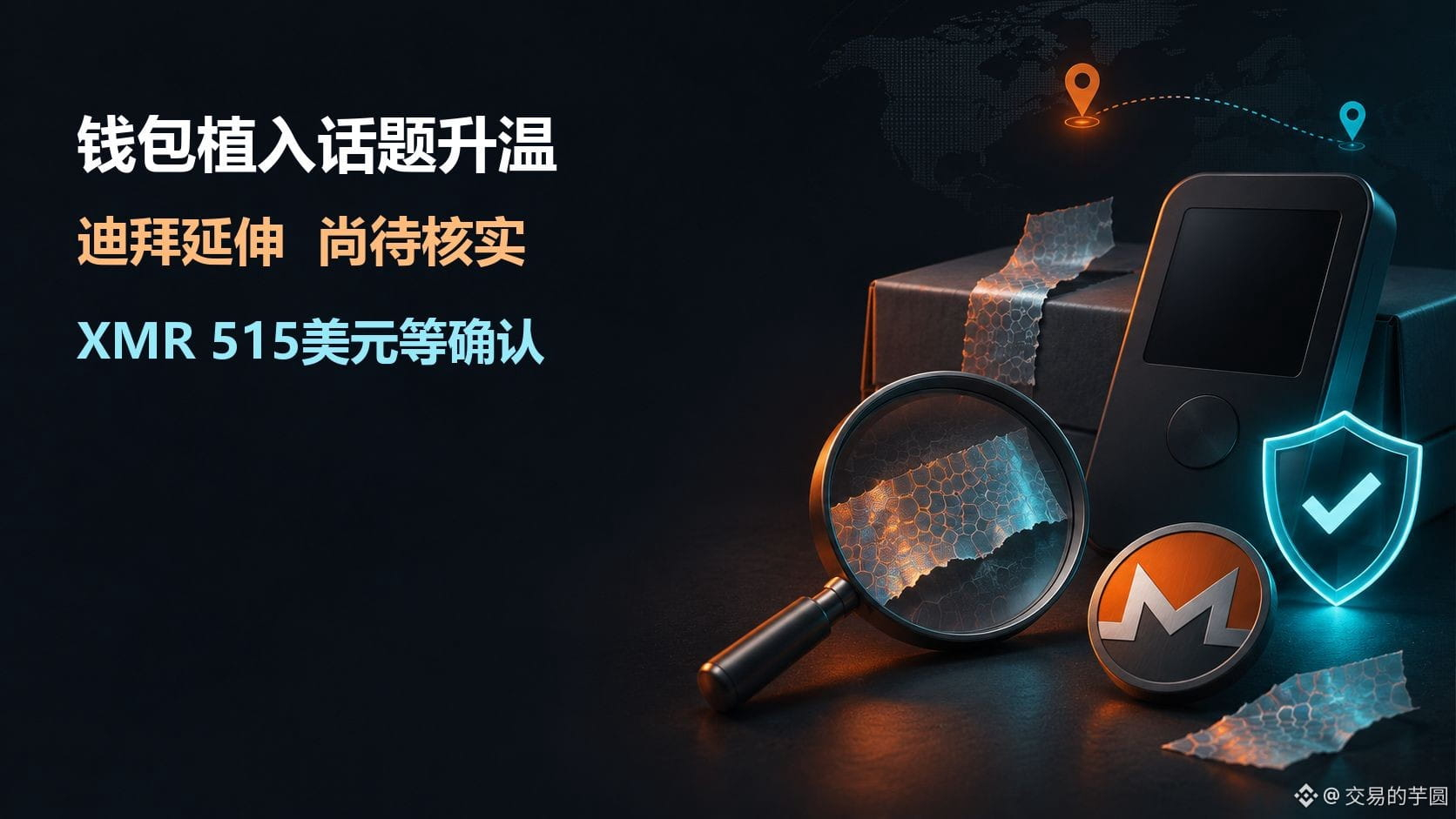
Hardware wallet tampering rumors intensify | Ledger confirms scope of earlier incident | XMR: maintain self-custody discipline
My approach is to verify first and discuss price second. Binance Square is discussing the topic “Ledger hardware tampering report extends to Dubai,” but the first-hand information I found from Ledger only confirms that devices from some distributors in Southeast Asia were previously opened, fitted with components designed to steal recovery phrases, and put back into circulation. Ledger says its chips, systems, and servers were not compromised, and that it has asked local distributors to suspend sales. That official statement does not confirm that the same attack occurred in Dubai. For now, “extends to Dubai” should be treated only as an unverified claim—not written up as a confirmed new affected region, much less as evidence that all Ledger devices have been compromised.
This has very practical implications for XMR holders. Monero emphasizes on-chain transaction privacy, but on-chain privacy cannot protect recovery phrases stolen during wallet setup. The risk boundary for a cold wallet includes purchase, delivery, initialization, and backup. Ledger Donjon’s official threat model also warns that seals can be copied or removed and replaced without a trace, so intact packaging alone cannot prove a device is safe. If I had just bought a device, I would verify its authenticity through trusted channels, never use recovery phrases preprinted inside the packaging, and never enter a recovery phrase on a website or share it with anyone claiming to be customer support. If I suspected a device had been tampered with, I would stop using it to receive or transfer assets and check with the manufacturer through its official support channels first; I would be wary of any direct-message link urging an “emergency migration.” This is about self-custody operational risk, not a vulnerability in Monero’s mainnet, and it should not be treated as direct negative news for XMR supply and demand.
Price action has not provided a clear attribution to this event either. When I checked Kraken XMR/USD, the current price was about $504.94, today’s open was about $508.88, and today’s range was $497–$514.39; the 24-hour range was $493.04–$523.29. XMR is below today’s open, but that alone does not prove the wallet rumors are weighing on the price; overall risk appetite, exchange liquidity, and previous price movements could all affect short-term volatility. I’m treating $514.39–$515 as the recovery zone to watch, and around $493 as the 24-hour risk boundary. I’ll reassess the scope of the incident only if a verifiable new announcement from Ledger or local regulators emerges; if the price falls and stays below $493, my short-term recovery thesis is invalidated.
If I were trading this myself, I wouldn’t chase rumor-driven moves at this stage, and I certainly wouldn’t use high leverage. I would only consider a small spot position to go long on XMR: wait for a one-hour close above $515, then see if a retest of around $514 holds before entering with 3% of my trading capital. First target: $523; take half off there, with a target of $535 for the remainder. I would stop out if the price closes below $505 on a one-hour candle after entry. If $493 breaks before entry, I would cancel the entire plan. I would take profits in stages at $535; if a new security incident is confirmed, I would close the position and wait rather than let speculation replace risk management.
Sources: Ledger’s official statement on the earlier hardware tampering incident; Ledger Donjon’s authenticity threat model; Kraken XMR/USD price snapshot. #LedgerHardwareImplantReportsExtendToDubai #XMR
The above is solely my personal market commentary and does not constitute investment advice.