
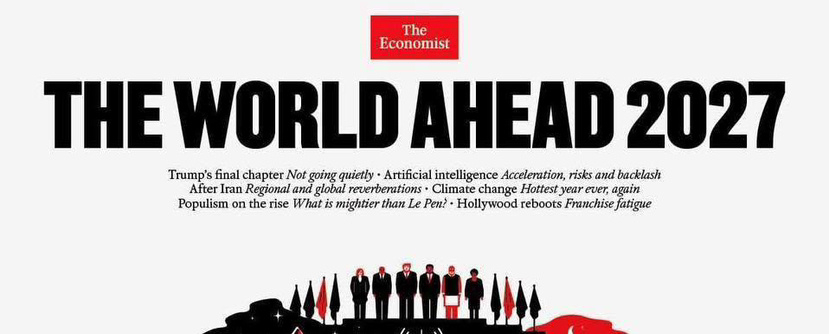

The World Ahead 2027: an attempt to decipher The Economist cover. There’s a lot of text, so get comfortable 👌 because this is a more realistic version.
The main idea: the world is entering a period of global transformation
Our initial hypothesis is that the cover of The World Ahead 2027 depicts not merely a set of forecasts for the coming year, but a unified picture of sweeping changes to the world order.
This does not necessarily mean the inevitable collapse of the existing system. Rather, it points to a redistribution of influence, capital, technology, and military power among different centers.
The world is gradually moving away from a model in which one center has an unquestioned advantage and toward a more complex system with several influential players.
1. The formula and the chart: the market’s reaction to events that not everyone has yet recognized
This is one of the most important elements of our initial analysis.
We did not interpret the chart as a direct prediction of a financial market crash. Instead, we offered another explanation: it may reflect investors’ reaction to major changes whose true causes and consequences are not yet fully understood.
The reasoning is as follows:
Geopolitical, military, economic, and technological changes are taking place around the world.
Investors receive signals about these changes, but cannot immediately assess all their consequences.
Uncertainty forces markets to reassess risks, resulting in volatility and declines in some assets.
Over time, the events that triggered this reaction become clear.
In other words, the chart may symbolize not a financial collapse in itself, but the financial system’s reaction to processes that are changing the world.
And in our interpretation, the formula or sequence of symbols next to the chart may offer a clue to the causes of these changes. This is an important point: we are trying to understand not only what is happening in the markets, but also what events lie behind the market reaction.
The exact meaning of the formula cannot yet be stated without reviewing its image again.
2. The redistribution of global influence
Another important part of the cover is the geopolitical realignment.
We considered several centers of influence:
The United States — maintains leading positions in finance, the military sphere, and technology, but its ability to set the rules unilaterally may be weakening.
China — is increasing its influence through industry, trade, technology, and international economic ties.
India — gradually becoming an independent center of power thanks to the scale of its economy, population, technological potential, and manufacturing.
Europe — trying to preserve its own agency and strategic autonomy between the United States and China.
Singapore — an important financial and corporate hub through which international businesses coordinate their activities in Asia.
This does not necessarily mean that one center will completely replace another. A system may be taking shape in which influence is distributed among several regions.
3. A robot and an open safe filled with money
We interpreted this element as a symbol of technological and financial transformation.
The robot may represent artificial intelligence, automation, and changes in the structure of work. The open safe filled with money suggests access to capital and financial resources, and raises the question of who controls them.
Technology is becoming not merely a tool of production, but a factor that is changing economic competition and the distribution of wealth.
This raises an important question: who will control the new technologies, and who will receive the main economic benefits from their adoption?
4. An airplane and a radio tower
These symbols can be linked to global infrastructure.
The airplane represents the movement of people, goods, and capital, while the radio tower represents communications, information networks, and connectivity.
In a world where influence is distributed among different centers, transport routes, logistics, and communications infrastructure take on particular importance.
Whoever controls these networks gains additional economic and strategic advantages.
5. An aircraft carrier and military aircraft
This element reflects the military dimension of global rivalry.
An aircraft carrier is not just a ship, but a symbol of the ability to project military power far beyond one’s own territory.
Its presence on the cover can be linked to competition among major powers, struggles for strategic regions, and the strengthening of military deterrence.
Global competition is not only about markets and technology, but also about control over territory, sea routes, and strategic positions.
6. Drones, burning houses, and people in tents
This fragment can be read as an image of the new reality of war.
Drones symbolize changes in military technology and the nature of warfare. Burning houses and people forced to live in temporary tents show the consequences of conflicts for civilian populations.
Here, it is important to see the contrast: technological progress does not necessarily mean an improvement in people’s lives.
On the contrary, new technologies can make conflicts more complex and their humanitarian consequences more widespread.
7. A deer in a burning forest: possible symbolism of Europe
We also considered the possibility that the deer symbolizes Europe.
This is our interpretation, not a confirmed explanation from the cover’s creators.
The reasoning is that Europe may have seen warning signs of danger but failed to react quickly enough. Now it finds itself in the middle of a crisis that directly affects it.
The burning forest may symbolize not only geopolitical danger, but also environmental problems: global warming, droughts, large-scale fires, and the destruction of natural ecosystems.
In this composition, the deer may represent vulnerability in the face of large-scale processes beyond the control of any single country.
8. How all the symbols come together
If we bring our assumptions together, the logic looks like this:
Geopolitical competition is changing the balance of global influence.
The technological revolution is changing the economy, production, and the distribution of capital.
Military confrontation is creating new risks for international security.
Conflicts are causing humanitarian consequences and destruction.
Climate problems are exacerbating instability.
Financial markets are responding to these processes by reassessing risks and future prospects.
Thus, the chart next to the formula may serve as a kind of indicator of this entire transformation. It shows the reaction of the financial world, while the other symbols help us consider which processes may lie behind it.
Conclusion
Our main hypothesis is this: The World Ahead 2027 may depict not simply a year of crises, but a period of transition to a new world order.
Financial fluctuations in this picture are not necessarily the root cause of events, nor necessarily a harbinger of global collapse. They may be the result of deeper changes taking place in global politics, the economy, technology, and security.
That is why it is important to read the cover as a unified composition: the chart shows the reaction, the formula may offer a clue to its causes, and the remaining symbols reveal possible directions of global change.
This is our symbolic interpretation, not an official key to the cover. But its central idea is consistent: the world is not simply experiencing another round of upheavals—it is being reshaped, and financial markets and societies are responding to that transformation.