


null
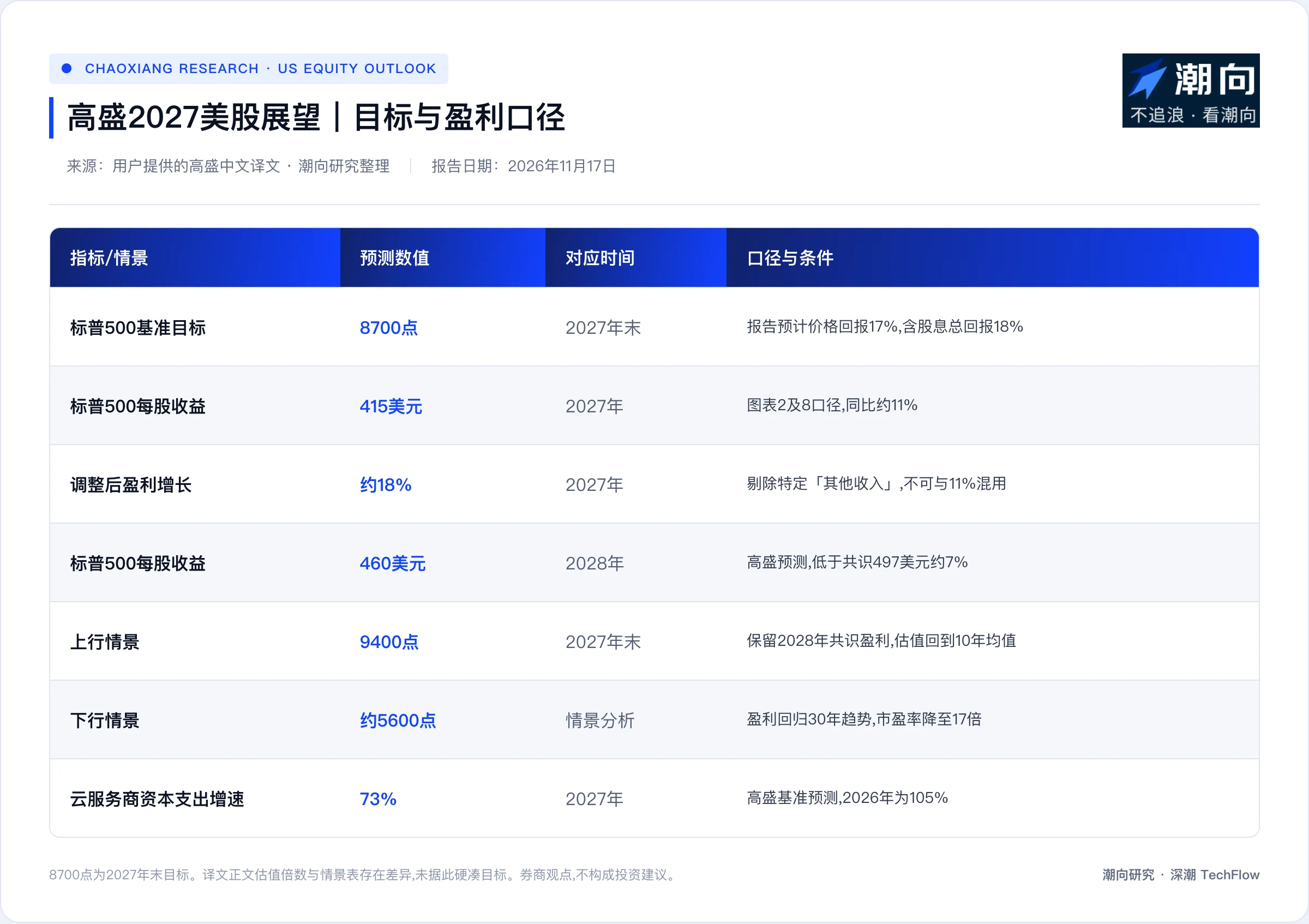
The U.S. stock market’s super bull run is not over, but the fervor has quietly entered its middle innings. In its (2027 U.S. Equity Outlook), published on November 17, 2026, Goldman Sachs says a healthy economic foundation and continued AI investment will still drive the S&P 500 to 8,700 by the end of 2027. This means U.S. stocks still have about 17% room to rise next year. However, as the growth rate of AI capital spending peaks, market focus is shifting from infrastructure bets to practical tracking of monetization.
Cooling earnings growth anchors the valuation floor at 18 times earnings
U.S. stocks in 2026 were driven by soaring earnings. But this exceptional high growth will be difficult to replicate next year.
Goldman Sachs’ U.S. equity strategy team forecasts that S&P 500 earnings per share growth will slow sharply, from around 30% in 2026 to 11% in 2027. Even excluding the additional revenue tech giants generate from their investments, core earnings growth will be only about 18%.
Valuations, by contrast, appear relatively safe. The S&P 500’s 12-month forward price-to-earnings ratio contracted by 19% in 2026 and has now fallen back to around 18 times, right in line with its average over the past 10 years.
Goldman Sachs’ 8,700 target is based on its 2028 earnings forecast and an 18-times price-to-earnings multiple. Given the dual uncertainties of a high-interest-rate environment and the evolution of AI, Goldman Sachs believes the market is unlikely to see a broad-based valuation expansion. Next year’s gains will have to be driven by earnings, plain and simple.
The AI relay race passes the baton: infrastructure gives way to monetization
The biggest spenders in the AI boom are starting to slow the pace of their spending.
Over the past few years, most of the U.S. equity market’s excess returns have come from AI infrastructure. Goldman Sachs estimates that capital expenditure by hyperscalers alone contributed 12 percentage points to broad-market earnings growth in 2026.
A turning point will come in 2027. As capital expenditure continues to balloon in absolute terms, its year-over-year growth is expected to plunge from 105% to 73%. The depreciation burden from these massive investments is also beginning to erode profits. By 2028, hyperscalers’ capital expenditure could even weigh on S&P 500 earnings by a net 5 percentage points.
The flow of capital is shifting. With expectations for infrastructure stocks already running too high, Goldman Sachs recommends turning attention to the next leg of the relay. Companies that can meaningfully monetize AI technology or use AI to boost productivity will become the new favorites. To mitigate the risk of technological disruption, Goldman Sachs is particularly bullish on beneficiaries of productivity gains with substantial physical assets or tangible operations.
Corporate leverage returns; buyback aristocrats show their scarcity value
Frenzied AI investment is not only pricing in future earnings growth but also quietly driving up corporate leverage.
Goldman Sachs credit strategists expect U.S. investment-grade and high-yield bond issuance to climb to $2.8 trillion in 2027. Hyperscalers are not only borrowing heavily on their balance sheets but also taking on massive off-balance-sheet lease and purchase commitments.
The cost of leveraging up to build infrastructure is a major drain on cash flow available for shareholder returns. S&P 500 share buyback growth had stalled by the third quarter, and the buyback yield fell to 1.4%, its lowest level in 20 years outside of recessions.
With corporate cash flows broadly under pressure, “buyback aristocrats” have become truly scarce assets. Goldman Sachs emphasizes that companies with strong free cash flow that can steadily reduce their share count will deliver excess returns against a backdrop of slowing growth.
Finding gems in growth and hedging volatility with defensive assets
As broad-market earnings growth approaches the low double digits, market leadership is bound to shift toward companies that can sustain organic growth.
Goldman Sachs favors growth stocks with long-term secular growth characteristics. In terms of specific sector allocations, it highlights energy infrastructure and transportation. Energy infrastructure is one of the few sectors poised to accelerate earnings growth next year. The transportation sector, meanwhile, offers excellent cyclical exposure to a potential upside surprise in macroeconomic growth.
Defensive assets are also essential. The high concentration of earnings in the broader market is a sword hanging over U.S. equities. Goldman Sachs recommends defensive positioning in healthcare and select consumer staples, both of which trade at a valuation discount. Mid-cap stocks have not yet seen their earnings growth run ahead of itself, and their price-to-earnings ratios are also relatively low, making them an ideal way to diversify away from mega-cap risk.
This article is a summary and interpretation by Chaoxiang Research of a third-party brokerage research report. The ratings, target prices, earnings forecasts, and related views cited herein are those of the brokerage’s analysts and represent only the position of their firm. They do not represent the views of Chaoxiang Research and do not constitute investment advice.
Markets involve risk; investment decisions should be made independently. This article should not be relied upon as a basis for buying or selling any securities.