#XRP
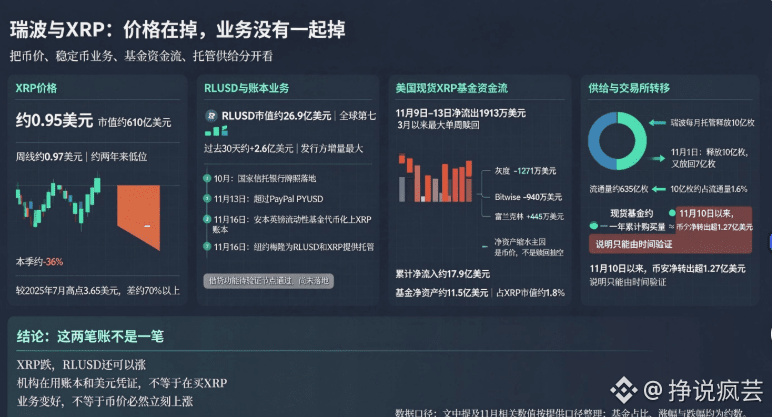
It is now around $0.95, with a market value of about $61 billion. The weekly line has come in around $0.97, which is a roughly two-year low, and it once touched $0.89 intraday. The July 2025 high was $3.65, and it is now more than 70% below that level. This quarter it has fallen about 36%.
The price is dropping, but the business on the company side has not dropped along with it. These are the two things that need to be separated most in this market.
Ripple's U.S. dollar stablecoin RLUSD had a market cap of about $2.69 billion on November 13, just surpassing PayPal's PYUSD to rank seventh globally. Over the past 30 days, it increased by about $260 million, the largest increase among the issuers being tracked. In October, its national trust bank charter was already in place, to be used to custody this stablecoin.
At the Swell event on November 16, abrdn put tokenized shares of a pound sterling liquidity fund on the XRP Ledger, and BNY Mellon provided custody for RLUSD and XRP. The lending feature still needs validator approval and has not yet been launched.
These are institutions using the ledger and dollar instruments, not buying XRP. Stablecoins want no volatility. XRP falls, while RLUSD can still rise. Improving the company's business and directly treating that as a reason for the coin price to rise are two separate things.
The capital flow is also split. U.S. spot XRP ETFs saw a net outflow of $19.13 million from November 9 to 13, the largest weekly redemption since March. Grayscale saw an outflow of $12.71 million, Bitwise an outflow of $9.40 million, and Franklin saw a reverse inflow of $4.45 million. Cumulative net inflows are still about $1.79 billion, and the funds' net assets are about $1.15 billion, only about 1.8% of XRP's market cap. That week, net assets shrank even more, mainly because of the coin price, not because redemptions drained the base.
Supply is even firmer. Ripple releases 1 billion coins from escrow each month; on November 1 it released 1 billion, then returned 700 million, and on December 1 another 1 billion coins reached the unlocking condition. The circulating supply is about 63.5 billion coins, and 1 billion coins is less than 1.6% of that. Spot ETFs have been around for about a year, and the amount they have bought is only about the same as one month of escrow releases. Bitcoin ETFs account for a much higher proportion of their own supply than this.
Since November 10, large holders have net transferred more than $127 million out of Binance. What does it mean when coins leave an exchange? Only time can tell...