

For deposits and withdrawals in the crypto world, the core risk lies not in the exchange’s custody itself, but in the “contamination of funds by illicit activity” within the fiat currency transfer chain. Receiving funds linked to telecom fraud, money laundering through online gambling, or other crimes can easily trigger big-data anti-money laundering controls at banks or judicial freezes imposed by public security authorities. This module provides a systematic overview of the underlying mechanisms, screening criteria, fund segregation, and the full process for lifting a freeze.
I. Underlying Differences Between Bank Risk Controls and Judicial Freezes
Accurately distinguish between the following two entirely different types of account irregularities:
1. Big-data risk control in banking systems (non-counter services/protective payment suspension): Automatically triggered by models in the bank’s anti-money laundering (AML) system. Common triggers include frequent large transfers immediately after opening a new account, frequent late-night transactions, funds moving in and out rapidly (transferred out within minutes of receipt), balances remaining close to zero for extended periods, and sensitive terms in transaction notes. This type of restriction typically takes the form of online banking limits, suspension of non-counter services, or allowing deposits but not withdrawals. Cardholders can usually restore in-person banking services by providing the bank with documentation of legitimate income and transaction records.
2. Public security/judicial case-related freeze (compulsory legal measure): instructions are issued directly from local public security criminal investigation units and anti-fraud centers to the head office system to lock the account. Usually, this is because during a C2C cash-out, the buyer’s payment itself is proceeds from upstream illegal crimes such as e-fraud or online pyramid schemes, and the cardholder’s account is caught up as part of the “second-, third-, or even fourth-level chain” of illicit funds. It is divided into a [3-day emergency payment suspension review] (preliminary screening, automatically unfrozen when the term expires if suspicion is ruled out) and a [6-month judicial freeze] (case review, usually requiring case closure or refund negotiation).
Prioritize merchants that offer freeze compensation. Usually, compensation is only provided if a judicial freeze exceeds 180 days and meets the conditions (however, the submitted materials are relatively complicated, so it is best to learn about them in advance).
2. The “golden screening rules” for high-quality C2C/OTC merchants
Cash-out must be completed strictly within the official licensed escrow platform’s C2C section, and counterparties must be screened according to the following six hard criteria; never allow merchants that fail to meet the standards to proceed:
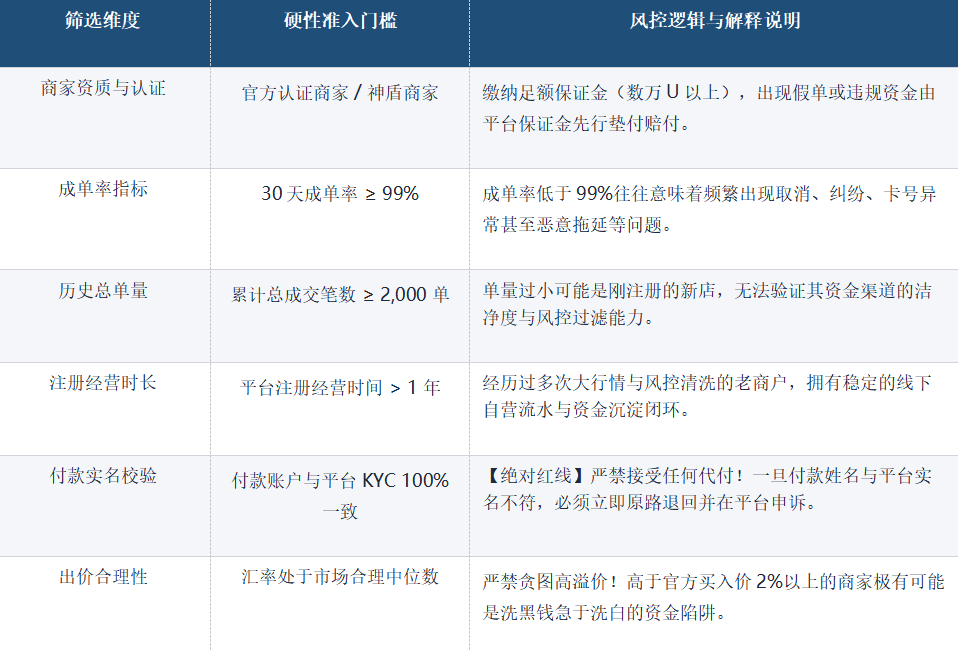
3. Practical mechanism for physical account isolation and stepped fund accumulation
The most effective firewall against card freezes is “physical account isolation” and “fund accumulation,” cutting off the possibility of dirty money spreading to the main account used for daily life:
1. Use dedicated physical accounts: specifically open 1–2 Type II debit cards or local city commercial bank/rural commercial bank cards for deposits and withdrawals. These cards must never be linked to mortgages, car loans, social security, housing provident funds, payroll, or the main WeChat/Alipay spending accounts used for daily life.
2. T+1 / T+3 / T+7 stepped accumulation method: after funds arrive, you must not transfer large amounts to other major bank cards in your name within 30 minutes, otherwise it will very likely trigger a chain of risk controls. You must follow stepped accumulation:
• T+1 stage: keep the funds idle for 24 hours after arrival and observe whether there is any SMS payment suspension notice;
• T+3 stage: if no abnormalities are confirmed, the funds can be transferred in batches into large certificates of deposit, bank-proprietary low-risk R1 wealth management products, or money market funds (such as Lingqiantong / Yu’ebao);
• T+7 stage: after circulation and cleansing through compliant financial products, the funds have been fully reconstructed, and the safety factor for withdrawing and using them increases by more than 95%.
3. Natural consumer outflow method: use cash-out funds to repay credit cards, repay mortgages and Huabei, pay for online shopping, or directly spend by swiping cards offline. Bank systems rarely trace compliant consumer destinations, and the fund outflow efficiency is highest.
4. The “eight high-risk red lines” for deposits and withdrawals that must never be crossed
[Eight red lines strictly prohibited for deposits and withdrawals]
Red line 1: It is strictly forbidden to accept payment on behalf of others. No matter what excuse the buyer gives (such as payment by a relative or by a company account), if the names do not match, you must refuse to proceed and return the funds.
Red line 2: It is strictly forbidden to use ATM cash deposits or cardless deposits. Underground and gray-market operators rely heavily on cardless deposits to cut off the flow of funds, which can easily lead to criminal investigation officers coming directly to your door to lock the account.
Red line 3: It is strictly forbidden to be greedy for high exchange-rate premiums. Any buyer offering 1%–3% more than the official spot price is highly likely to have high-risk e-fraud proceeds.
Red line 4: It is strictly forbidden to make frequent large transfers late at night. Large transfers between 0:00 and 6:00 directly trigger commercial banks’ anti-money-laundering key monitoring rules.
Red line 5: It is strictly forbidden to include sensitive words in transfer remarks. Do not write words such as BTC, ETH, USDT, digital currency, investment, or deposit; keep it blank at all times.
Red line 6: It is strictly forbidden to conduct private offline transactions outside the official platform. Private “cash face-to-face deals” and “off-platform OTC” have no platform escrow guarantee, so you may be cheated out of coins or treated as an accomplice to money laundering.
Red line 7: It is strictly forbidden to rapidly move funds in and out of a new card. If a newly activated bank card receives large sums continuously and transfers them out within 5 minutes, there is a 99% chance it will be instantly frozen for non-counter transactions by the anti-money-laundering system.
Red line 8: It is strictly forbidden to lend out personal bank cards or assist others with cashing out. Lending accounts is suspected of violating the Criminal Law’s “crime of aiding information network crime activities,” carrying major criminal legal risks.
5. Emergency response and unfreezing process after an abnormal bank card freeze
If a customer unfortunately encounters a card freeze, they must stay calm and follow the standardized process below to guide their lawful and compliant rights protection:
Step 1: Go to the account-opening bank to obtain the core freeze information: bring your ID card and bank card in person to the account-opening branch counter to inquire; do not rely only on customer service by phone. Clearly record four key items:
① Nature of the freeze (bank non-counter or public security/judicial freeze);
② Full name of the executing authority for the freeze (e.g., XX Branch, XX Municipal Public Security Bureau, XX Province);
③ Handling officer’s badge number / contact number;
④ Freeze document number and the frozen amount involved in the case.
Step 2: Assess the freeze duration and nature: if it is a 3-day emergency payment suspension, it is likely a preliminary multi-level screening by the police. Keep your phone available during the 3 days; do not blindly file frequent appeals; wait patiently for the system to automatically release it when it expires. If it changes to a 6-month judicial freeze after 3 days, immediately begin collecting evidence.
Step 3: Organize a legally compliant transaction evidence chain: log in to the exchange web version and fully export and print:
① Complete transaction proof for the order corresponding to the frozen card number (order number, execution time, execution price, quantity);
② Screenshot of the verified real-name information of the platform counterparty for that order;
③ Proof of the lawful source of personal platform assets (such as historical fiat currency deposit records for buying coins, on-chain deposit and withdrawal records);
④ Personal tax payment certificates and employment income records to prove that you have a genuine asset-investment background and are definitely not a professional money-laundering or account-renting operator.
Step 4: Standardized coordination and communication with the handling authority: proactively call the handling officer and clearly state your identity as a law-abiding citizen: “Officer, hello. The XX bank card under my name was frozen by your bureau because it received a compliant transfer from a platform. I am a normal investor in digital assets cashing out on a licensed platform. I have complete transaction records, order numbers, and full platform KYC documents. I am not a criminal suspect, and I am willing to fully cooperate with the investigation and submit supporting materials.”
Step 5: Negotiate the return of the involved funds and legally unfreeze them: if it is confirmed that the funds received were indeed first- or second-hand cheated funds transferred directly from an e-fraud victim, the handling unit will usually require the return of the amount involved in order to seek the victim’s understanding before unfreezing. You need to weigh litigation costs against refund costs based on the proportion of the amount involved. If the amount is small, you can negotiate to sign a restitution agreement and have the public security organ issue an unfreezing letter; if the amount involved is huge and you were completely innocent and without fault subjectively, it is recommended to appoint a professional criminal lawyer to intervene for a lawful defense.
In the end, there is no way to guarantee 100% that no risk control will ever occur. The above content is only intended to help avoid problems as much as possible and to provide corresponding measures after problems occur! For reference only!