Berkshire Hathaway, Warren Buffett’s company, has made a sudden move!
Its latest 13F filing has revealed a very interesting signal.
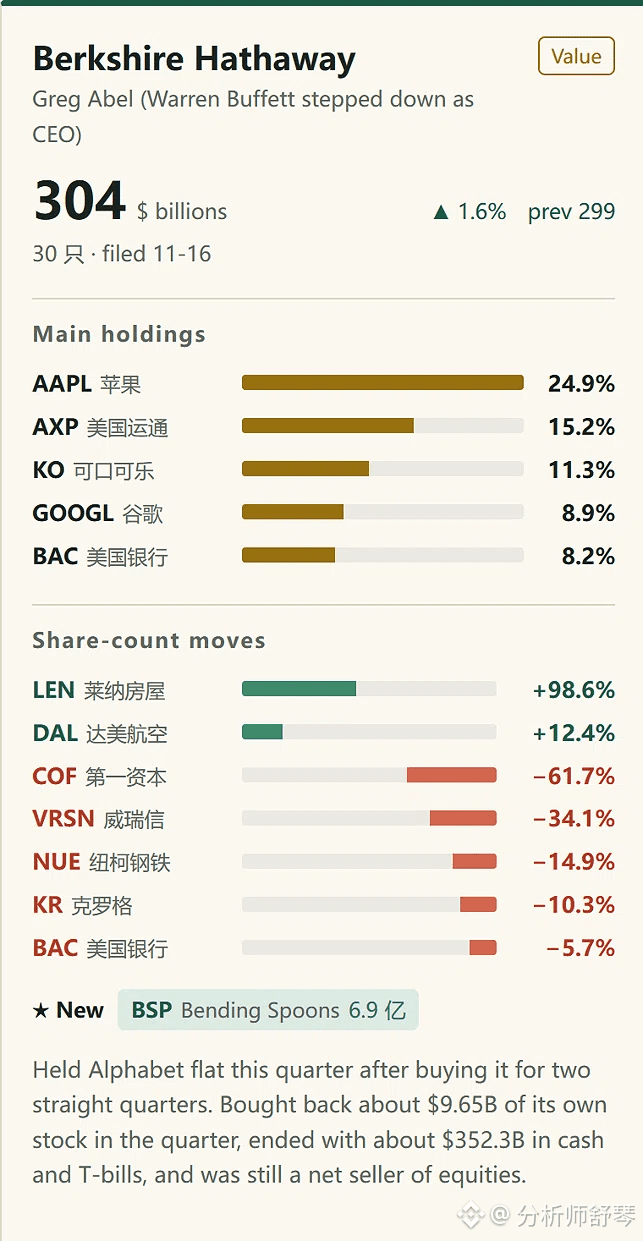
It’s aggressively adding to its real estate holdings while making deep cuts to financial stocks—and still sitting on more than $350 billion in cash!
Is this a move to buy the dip, or is it preparing for the next crisis?
Let’s start with the biggest trade.
In the third quarter, Berkshire Hathaway increased its stake in U.S. real estate giant Lennar (LEN) by a whopping 98.6%!
Nearly doubling its position!
Just how bad is the U.S. housing market right now?
High mortgage rates are weighing on demand, developers are cutting prices to boost sales, and profit margins on new homes are under increasing pressure.
Ordinary investors are steering clear, but Berkshire is going against the grain!
Has Wall Street’s most famous value-investing firm already started betting on a U.S. housing recovery? It really does look like a case of being greedy when others are fearful.
Even more interesting, Berkshire is buying real estate while selling financial stocks.
It cut its Capital One (COF) stake by a staggering 61.7%!
It trimmed its Bank of America (BAC) stake by another 5.7%!
Even Verizon, a long-term holding, was cut by 34.1%.
But that doesn’t mean it’s bearish on the entire U.S. stock market.
Google still makes up around 8.9% of its stock portfolio, while Apple remains its largest holding, at 24.9%.
Berkshire doesn’t think every asset is too expensive to buy.
Instead, it’s allocating capital selectively.
It’s willing to significantly increase its stake in companies it likes, while cutting holdings it’s no longer happy with—without hesitation.
Of course, based on the companies it’s been trading, Berkshire still seems to be leaning toward a defensive approach, with LEN seeing its largest increase.
And of course, these trades can’t all be attributed to Buffett himself. Greg Abel is now Berkshire’s CEO.
But at least this filing sends a signal: Berkshire is suggesting that real investment opportunities may not lie in the hot tech stocks everyone is chasing. They could also be found in traditional industries the market has left behind.
I’m Xiaoqin, and I share updates on the U.S. markets every day, so don’t forget to follow!