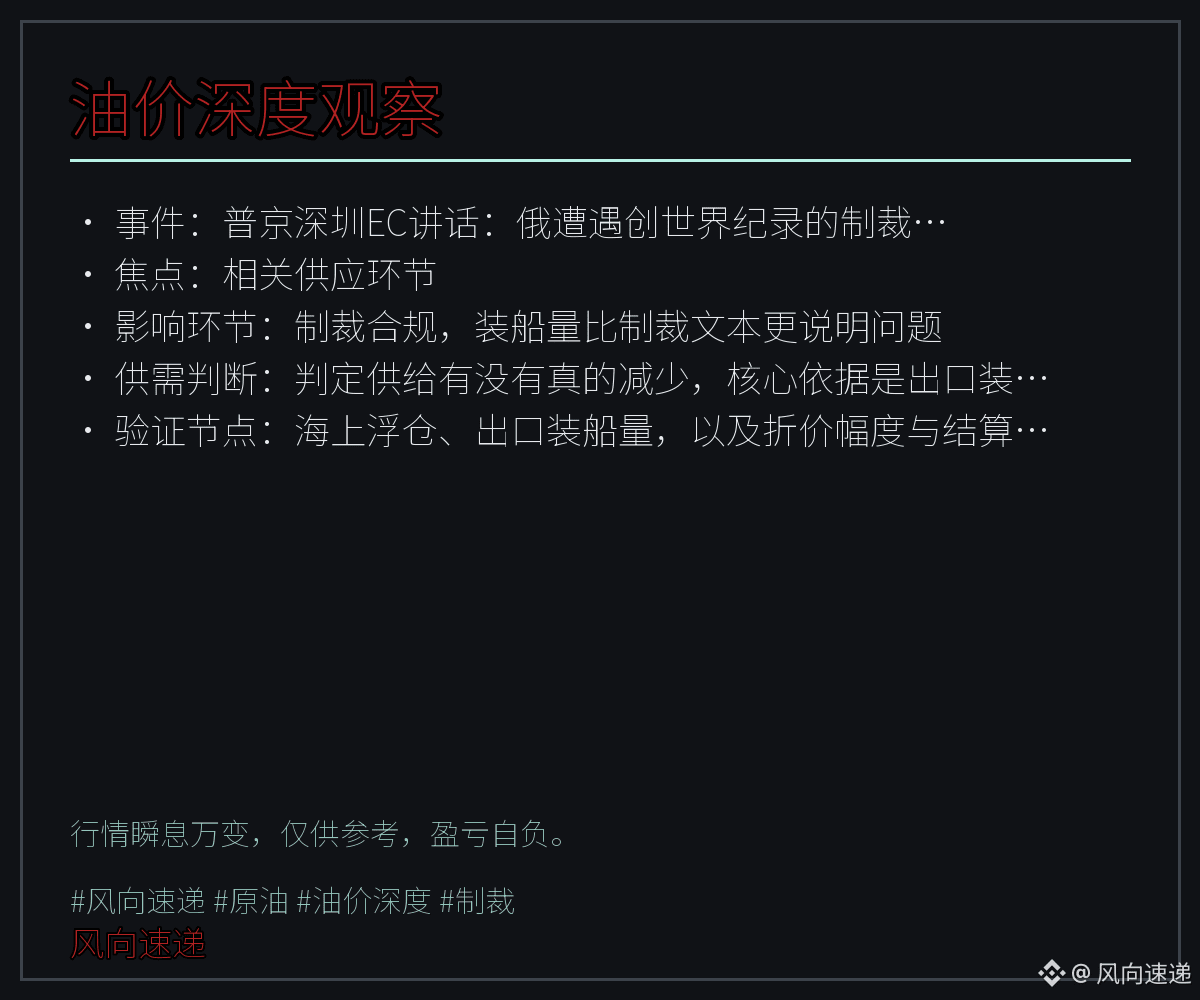
In-Depth Oil Price Watch
【Key Event】
Putin’s remarks at Shenzhen EC: Russia faced sanctions on a world-record scale, but weathered the test calmly (1 hour ago)
【What’s Influencing Oil Prices】
Russia is tightening its energy trade rules, with attention focused on the related supply channels. The sanctions affect whether crude can be settled, insured, and brought into port smoothly. Sanctioned production may not disappear, but its destination and discount will be reshaped.
【Transmission Mechanism】
When enforcement tightens, shadow fleet capacity, insurance, and payment channels are constrained first. Buyers turn to alternative supplies, pushing up the premium for compliant crude.
Sanctioned crude typically trades at a steeper discount, widening global price differentials and creating divergent feedstock costs for refineries.
【Supply, Demand, and Pricing】
The key indicator for determining whether supply has actually fallen is export loadings. The sanctions text itself only signals a change in the rules.
WTI is currently trading near $84.45, with a 24-hour change of -0.57%. Price fluctuations are limited, and the market’s response has so far been mild. Further data is needed to confirm how much of this news has been priced in. Sanctions news often triggers a one-off jump, after which the market recalibrates based on the actual level of enforcement.
【What to Watch Next】
Track floating storage at sea, export loadings, and changes in discount levels and settlement channels.
【What Would Invalidate This Outlook】
If exemptions are expanded or enforcement is relaxed, the compliance premium will fall and trade flows will adjust again.
Markets can change in an instant. For reference only; you are responsible for any gains or losses.
#风向速递 #原油 #油价深度 #Sanctions