


Iran opened Wednesday by sending drones at a US base in Kuwait and Bahrain. Its army said it hit US Patriot air-defense systems and drone and missile launch platforms at Ali Al Salem Air Base, which hosts American forces, while Kuwait’s military said its air defenses were fighting off hostile drones. Neither Kuwait nor Washington had confirmed any hits or damage by early Wednesday.
Bahrain’s air defenses were busy once more early Wednesday, intercepting several Iranian attacks, and its defense force accused Tehran of a “systematic hostile approach” toward the kingdom, home to the US Navy’s Fifth Fleet.
It appears to be Tehran’s response to the Qeshm Island strike. US jets had hit an Iranian missile launch site there late Tuesday, answering a run of Iranian drone attacks on US radar sites in Bahrain on Friday, Sunday and again on Tuesday.
A US military official said they used precision munitions on a Guards missile launch site in self-defense, answering aggression toward American personnel and assets, and added that Central Command stays on high alert and ready to protect Americans across the region.
Iran’s semi-official Mehr News Agency reported strikes on several locations on the island. It cited Hormozgan deputy governor Ahmad Nafisi, who said there were no casualties and no damage to critical or public-service infrastructure.
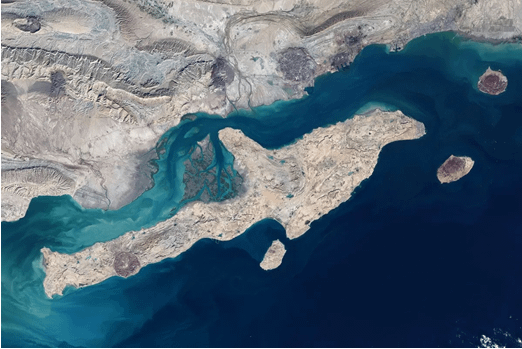
Qeshm sits off Iran’s southern coast, right at the strait that carried roughly a fifth of the world’s oil and liquefied natural gas before the war began in late February. This was at least the second publicly reported US strike on the island this month, and Washington has called its strikes around the strait defensive.
Iranian drones went after a US military radar system at Sheikh Isa Air Base in Bahrain, an attack that Bahrain and Washington said they intercepted. Sunday brought six drones, which the Guards said they aimed at a US air-defense radar at Riffa Air Base in Bahrain.
It started Friday. The Guards said they destroyed a US early-warning radar in Bahrain in retaliation for what they called an air attack on a telecommunications tower in southern Iran, while US Central Command said it intercepted two Iranian drones with no damage or casualties. Reuters reported it was the first time since early September that Iran had claimed an attack on US military assets in a Gulf country.
Bahrain said it intercepted several Iranian aerial attacks, and sirens sounded in the kingdom for the first time in months. Qatar, a mediator in the US-Iran effort, described it as a dangerous escalation. Separately, President Donald Trump said the US is looking into a CNN report that Iran is developing plans for a dirty-bomb attack in Washington. Tehran rejects the claim.
Crude barely noticed. On Wednesday, WTI traded at $84.85, down $1.16 or 1.35%, and Brent at $92.54, down 60 cents or 0.64%. Industry data showing a 5.28 million barrel build in US crude stocks last week gave sellers cover, while the strikes only limited the slide.
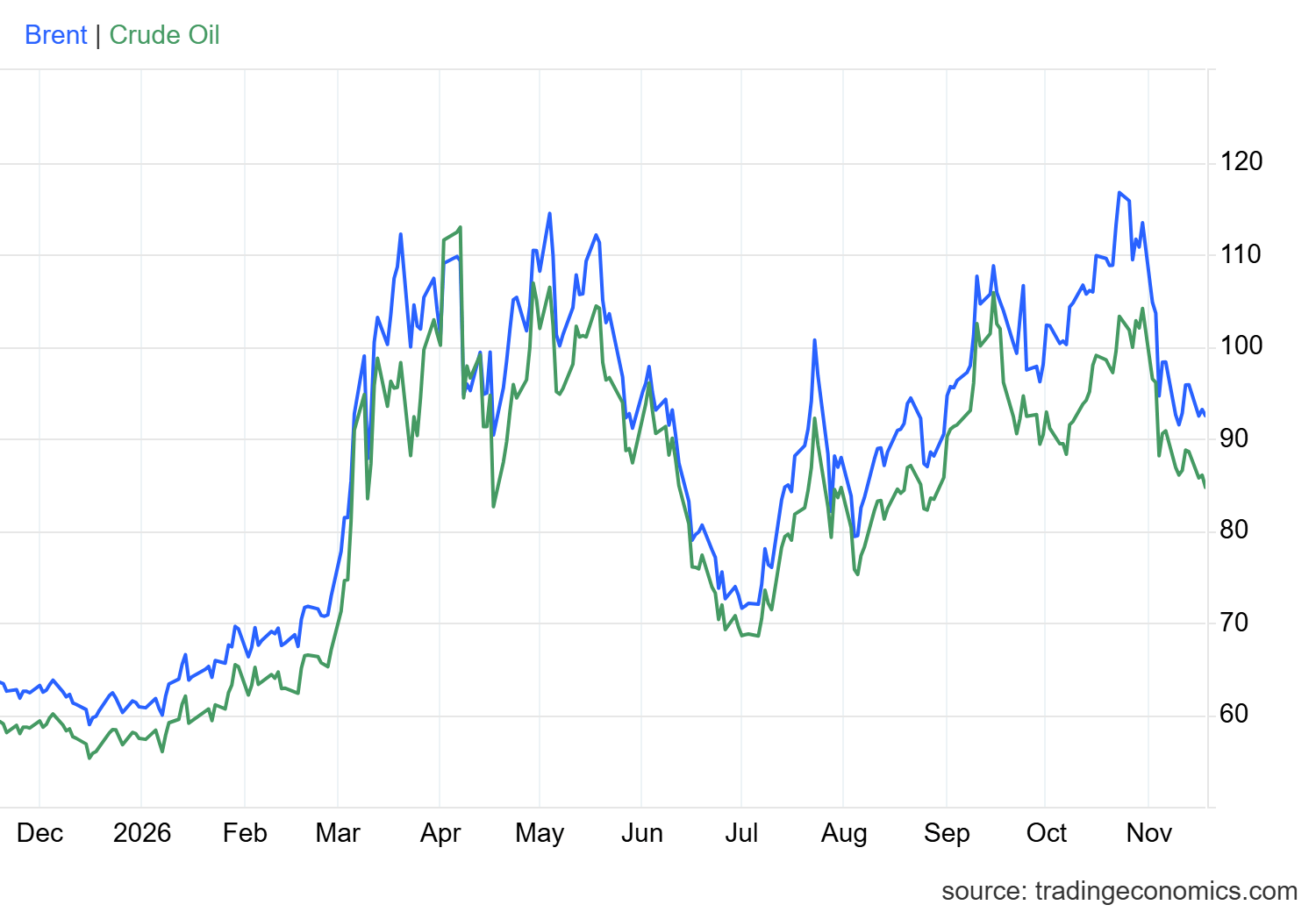
Tuesday’s close told the same story on a day of drones and burning tankers. Brent settled at $93.14, up 70 cents or 0.76%, and WTI at $86.01, up 29 cents or 0.34%. The month has been brutal: through Tuesday, Brent was down about 18% on a like-for-like January contract (closer to 21% measured from the expiring December), and WTI roughly 17%.
Attacks on Vessels Intensify
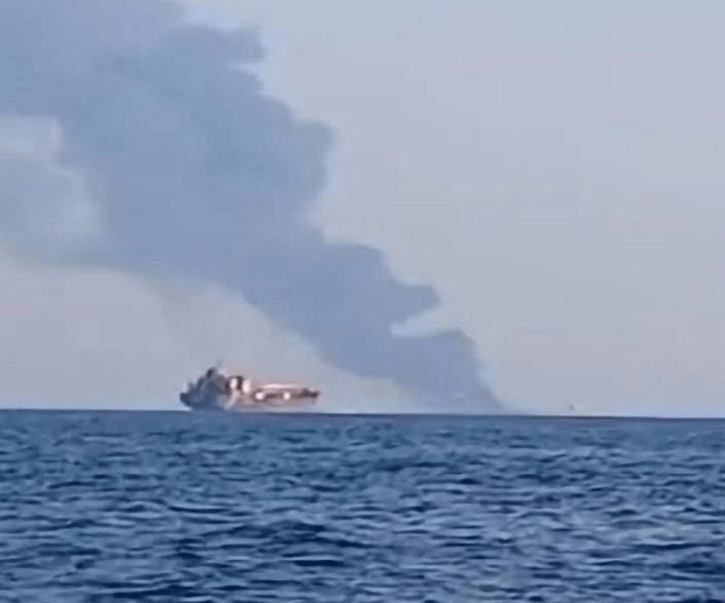
The tanker hit north of Khasab, Oman, on Monday was struck again on Tuesday. The crew abandoned the Panama-flagged LPG vessel, and India’s government said 24 of the 25 crew were accounted for, with one Indian seafarer missing and two others in hospital. Responsibility has not been independently established.
Iran’s navy added a claim of its own. State media said a third tanker since Tuesday morning had hit a sea mine and caught fire in the eastern Strait of Hormuz, on a route Tehran says is off limits. Independent confirmation was not available at the time of writing.
One alert that day belongs in a different story. UKMTO relayed a report from local authorities of a skiff carrying weapons and ladders closing on a cargo ship about 50 nautical miles southwest of Al Mukalla, Yemen. Armed guards fired a warning shot, and the skiff turned back toward its mothership. It fits the suspected piracy that maritime monitors say is rising in the Gulf of Aden, far from Hormuz.
Yemen Adds a Second Front
Yemen’s Houthis said Tuesday they launched five drones at two pumping stations on Saudi Arabia’s East-West pipeline near Riyadh, the route that lets Saudi crude bypass Hormuz. The Saudi-led coalition has been shooting down Houthi cruise missiles aimed at Riyadh repeatedly this month, and early Wednesday it reported destroying 60 Houthi targets across Yemen.
The Glut Traders Are Betting On
The International Energy Agency said on Friday that global oil supply has overtaken demand for the first time since the war began. It expects supply to exceed demand by about 1.7 million barrels a day this quarter, after previously forecasting a deficit. Goldman Sachs sees the surplus carrying into next year, building toward about 2 million barrels a day through 2027, with Brent averaging $88 in 2027 before sliding to $78 by December.
The surplus is recovering through workarounds rather than an open strait. Kpler counted confirmed Hormuz transits at about 4 million barrels a day in early November, against roughly 17 million before the war. Gulf exports are back near pre-war rates thanks to shuttle runs through the strait and bypass pipelines, which is why the market feels well supplied even with the channel contested.
Conclusion
Read from Friday forward, and the pattern is plain: each strike invites the next within a day or two, and each side calls its own move defensive. Talks to end the war, now in its ninth month, look stalled even though mediators from Oman and Qatar keep working. Oil is betting the rounds stay small, and the round that doesn’t is the one nobody has priced.