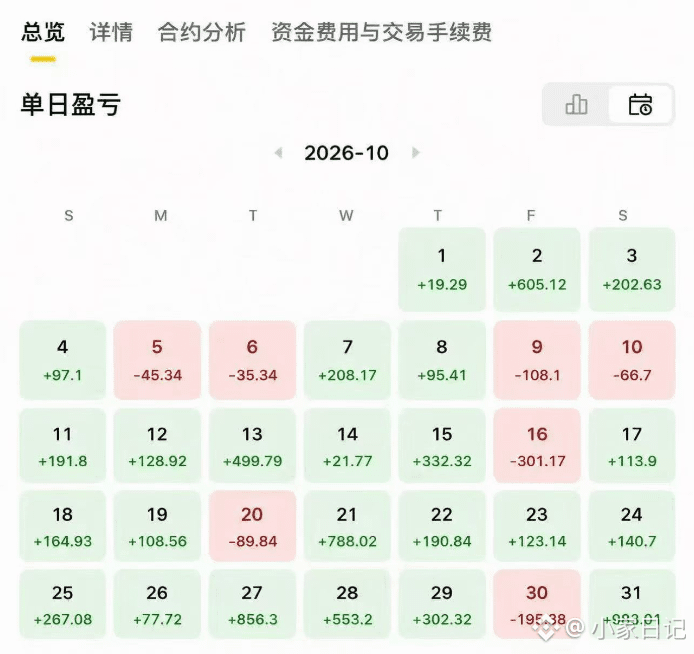
With less than 50,000 in capital, if you want to grow your account, don’t try to learn too many trading methods at once.
My student Xiaonan once lost 70,000 in two months. Then, over the course of a year, he went from being an ordinary retail trader to trading consistently, and even secured an institutional asset management account and a private trading office.
His biggest problem at first was having too many trading systems. He’d use one system today and switch to another tomorrow. Different signals made him hesitate, and the slightest market change would make him overturn his previous judgment. As a result, he learned plenty of methods, but his account kept losing money.
Eventually, he cut out most of his strategies and focused on just one trend-following pullback system.
It comes down to three steps:
1. Determine the direction using higher timeframes. Use the daily and 4-hour charts to identify the trend. Only trade when the direction is clear; don’t make random guesses in a ranging market.
2. Mark key levels in advance. Focus on support, resistance, and high-volume areas. Don’t rush into a trade before the price reaches these levels.
3. Wait for candlestick confirmation before placing an order. Once the price reaches the zone, look for signals such as engulfing patterns, morning stars, and evening stars. Enter only after confirmation, and set your stop-loss and take-profit levels in advance.
What really takes time isn’t learning these three steps, but reviewing trades over and over. He records every trade, tracks his win rate and risk-reward ratio, checks which signals work and which situations tend to lead to losses, then continually fine-tunes the details.
There’s a very practical lesson in Xiaonan’s experience: more trading methods aren’t necessarily better. When several systems conflict with one another, they can easily leave you confused.
If you want to grow a small account, instead of chasing new strategies every day, it’s better to thoroughly study one proven trading method first. Contract trading carries significant risk. The above is shared for informational purposes only and does not constitute investment advice.@小家日记 $BREV