
#cannvidia’sdatacentergrowthcontinue? NVIDIA’s AI Infrastructure Boom in 2026
1. Introduction: The AI Revolution Is Still Expanding
NVIDIA has become one of the most important companies in the global technology industry.
Its graphics processing units (GPUs), AI computing platforms, networking systems, and software ecosystem are powering a growing share of the world's artificial intelligence infrastructure.
As businesses, cloud providers, governments, and AI developers continue investing in advanced computing, demand for NVIDIA's data center products has reached extraordinary levels.
But one important question remains:
Can NVIDIA's data center growth continue at this pace, or will the AI infrastructure boom eventually slow down?
NVIDIA's latest financial results provide some important clues.
2. NVIDIA's Latest Financial Results: Record-Breaking Growth
On November 17, 2026, NVIDIA announced its third-quarter fiscal 2027 financial results.
The numbers were impressive:
Total revenue reached $115.8 billion, increasing 103% year over year.
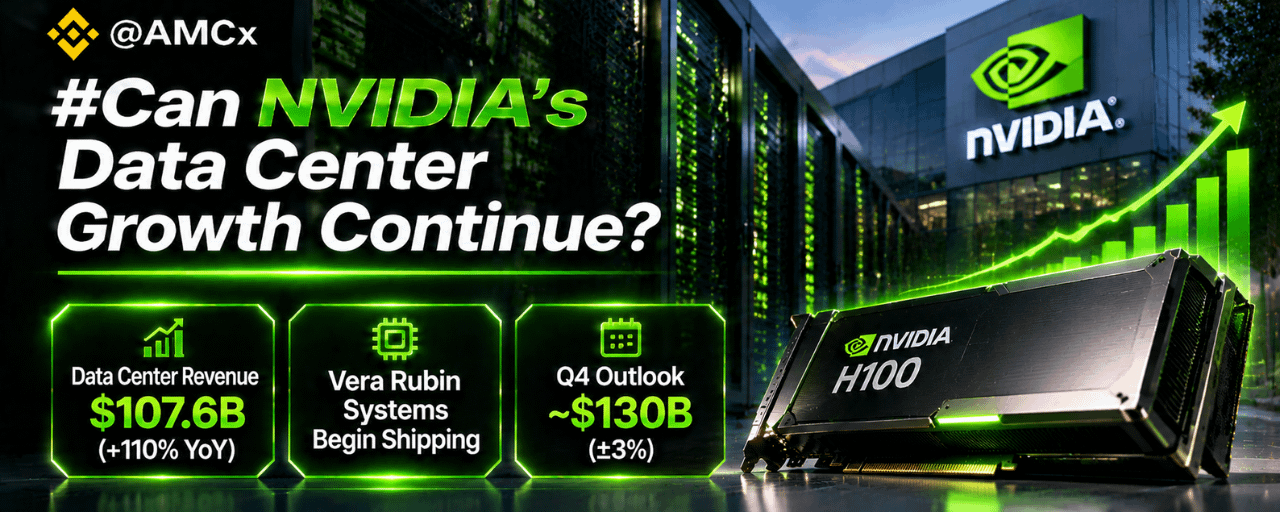
Data Center revenue reached $107.6 billion, increasing 110% year over year.
Total revenue increased 20% compared with the previous quarter.
GAAP diluted earnings per share reached $2.70.
The Data Center business contributed approximately 93% of NVIDIA's total quarterly revenue.
This confirms that AI infrastructure has become the central engine of NVIDIA's business.
Even more importantly, NVIDIA expects fourth-quarter fiscal 2027 revenue of approximately $130 billion, plus or minus 3%.
That outlook suggests the company expects its growth momentum to continue in the near term.
3. Why Is NVIDIA's Data Center Business Growing So Quickly?
Several major developments are driving this expansion.
A. Growing Demand for AI Computing
Modern AI models require enormous computing resources.
Training advanced models, operating AI assistants, processing enterprise data, and running AI agents all require powerful processors and high-performance computing infrastructure.
As AI adoption expands, companies need more computing capacity.
NVIDIA is positioned at the center of this demand through its GPUs, networking technology, software, and complete computing systems.
B. The Expansion of AI Data Centers
Major technology companies are investing heavily in AI infrastructure.
Cloud providers and AI developers are building large-scale data centers designed specifically for accelerated computing.
These facilities require more than individual GPUs. They also need networking equipment, storage, cooling systems, power infrastructure, and software.
NVIDIA's strategy of offering integrated AI computing platforms gives it an opportunity to participate in a larger part of this infrastructure market.
C. The Transition Toward Complete AI Systems
The market is increasingly moving beyond individual GPU purchases.
Customers are looking for complete computing systems that combine processors, networking, software, and optimized infrastructure.
This creates additional opportunities for NVIDIA to expand its revenue per deployment.
4. Vera Rubin: The Next Important Growth Driver
One of the biggest developments in NVIDIA's latest announcement is the progress of its next-generation Vera Rubin platform.
NVIDIA confirmed that Vera Rubin NVL72 systems have begun shipping.
The platform is designed to support increasingly demanding AI workloads and large-scale computing environments.
NVIDIA has also expanded its Vera Rubin cloud ecosystem, with deployments and availability involving major infrastructure partners.
This is important because NVIDIA's future growth will depend not only on Blackwell demand but also on its ability to deliver the next generation of AI computing products.
If Vera Rubin adoption continues successfully, it could become an important contributor to NVIDIA's future data center business.
5. What Could Happen in 2027?
Looking toward 2027, several factors could support NVIDIA's continued expansion.
1. Continued AI Infrastructure Investment
Demand for AI computing could remain strong as businesses move from experimentation toward large-scale commercial deployment.
2. Vera Rubin Adoption
The transition to Vera Rubin systems could create another product cycle and encourage customers to upgrade their AI infrastructure.
3. AI Agents and Inference
As AI applications become more widely used, inference demand could become an increasingly important source of computing consumption.
4. Cloud Provider Expansion
Large cloud providers may continue expanding their AI infrastructure to serve enterprise customers and AI developers.
5. Networking and Integrated Systems
NVIDIA's networking and complete-system strategy could help it capture more value from each AI data center deployment.
These developments provide potential growth opportunities, although actual results will depend on customer demand, product execution, and industry conditions.
6. The Biggest Risks NVIDIA Must Overcome
Despite its impressive performance, NVIDIA still faces several important challenges.
Supply Constraints
Advanced manufacturing, packaging capacity, and the availability of critical components can limit how quickly NVIDIA delivers products.
High Infrastructure Costs
Building AI data centers requires enormous capital investment. Customers must eventually generate enough revenue or productivity benefits to justify those expenses.
Competition
Other semiconductor companies and major technology firms are developing their own AI accelerators and computing platforms.
Export Restrictions
International trade restrictions and changing regulations may affect NVIDIA's access to certain markets. Its latest fourth-quarter outlook does not assume Data Center compute revenue from China.
Growth Expectations
When a company grows this quickly, investors may expect increasingly strong results. Even a slowdown in growth could influence market sentiment and valuation.
These risks do not necessarily mean NVIDIA's growth is ending, but they are important factors to monitor.
7. Final Thoughts: Can NVIDIA's Data Center Growth Continue?
Based on NVIDIA's latest financial results, the answer appears encouraging.
Data Center revenue has reached $107.6 billion in a single quarter, growing 110% year over year. The company's fourth-quarter revenue outlook of $130 billion also suggests that demand remains exceptionally strong.
The introduction of Vera Rubin adds another potential growth driver, while expanding AI applications could create further demand for accelerated computing.
However, maintaining triple-digit growth over the long term will become increasingly challenging as NVIDIA's revenue base grows.
The key question is no longer simply how many GPUs NVIDIA can sell.
It is whether the global AI industry can turn its massive infrastructure investments into sustainable economic value.
NVIDIA remains at the center of the AI infrastructure revolution. Its next chapter will depend on execution, innovation, supply capacity, and the real-world adoption of artificial intelligence.
This article is for educational and informational purposes only. It is not financial advice. Always conduct your own research before making investment decisions.
AMCx — Researching the Future of Technology and Finance. $NVDAB #AMCx