
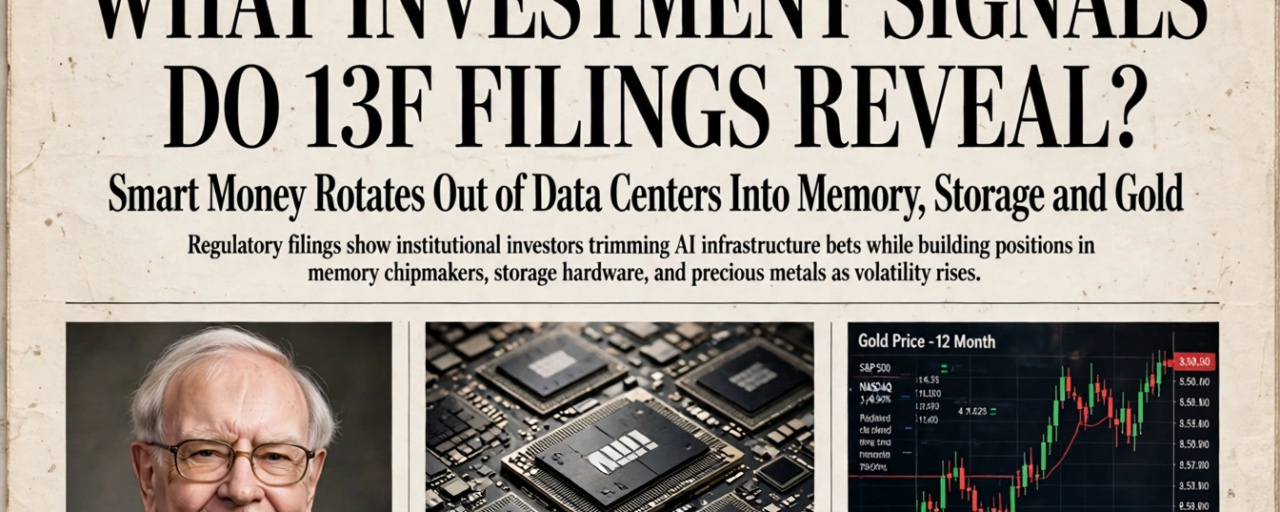

#WhatInvestmentSignalsDo13FFilingsReveal?
The deadline for Q3 2026 13F filings was November 16. Nearly 6,400 filings show what major funds held as of September 30.
And if you read them right, they tell you exactly where the money is moving.
FIRST: WHAT IS A 13F? FOR THOSE WHO DON'T KNOW
It's the form that ALL managers with more than $100M in U.S. stocks have to file with the SEC every quarter.
It shows you:
Which stocks they hold (long positions, U.S.)
How many
Whether they bought, sold, or exited
What it DOESN'T show you:
Shorts
Derivatives (only in part)
Why they bought
What they did AFTER September 30
In other words: it’s an old snapshot, with a 45-day delay. It’s not live.
But when 6,400 funds are moving in the same direction, it’s a signal you can’t ignore.
SIGNAL #1: SMART MONEY LEFT DATA CENTERS AND POWER
This is the strongest signal of the quarter.
According to Reuters’ analysis of nearly 6,400 filings:
Data Centers: 138 funds EXITED completely vs. 119 that entered. Net: -19 funds. The number of holders across the 8 largest data center companies fell from 3,411 to 3,392.
Power / Utilities: 212 funds EXITED vs. only 96 that entered. Net: -116 funds. More than twice as many exited as entered!
Why? Because utilities had surged on the thesis that "AI needs electricity." Now funds are saying: "Hey, what if data center construction slows down? What if costs are too high?"
As Reuters put it: "Concerns over AI's long-term prospects, a potential slowdown in development and broader macroeconomic pressures weighed on the sector."
Translation: they’re no longer buying the story that "everything AI touches goes up." Now they’re being selective.
And keep in mind: this was AS OF SEPTEMBER 30. Before the November selloff. In other words, some funds were already cutting positions BEFORE everything crashed.
SIGNAL #2: BUT THEY DIDN’T ABANDON AI — THEY CHANGED WHERE THEY’RE BUYING IT
Here’s the key. It’s not that they sold AI. They changed where they’re investing.
Semiconductors: 2,951 funds ADDED vs. 2,584 that cut positions. Net positive. 77 new entrants vs. 69 that exited.
AI stocks overall: +33 funds holding them vs. the previous quarter.
The rotation among the 5 big funds (Coatue, Tiger Global, Appaloosa, Duquesne, Situational Awareness) is crystal clear:
"Capital is moving away from some large technology platforms and competing chip architectures toward GPUs, memory, manufacturing equipment, cloud capacity and power infrastructure — areas where AI spending is more likely to translate directly into orders."
"AI investing is moving beyond buying the entire sector. Funds are becoming more selective, favoring companies with scarce capacity, pricing power and a clearer path from orders to cash flow."
Translation: Less "buy everything with AI in its name," more "buy the company selling the shovels."
The recurring pattern: NVDA + Memory + Equipment.
Coatue and Appaloosa increased their holdings in MU (Micron) and semiconductor equipment makers
Duquesne increased its STX (Seagate) position by 180% — from 122K to 341.8K shares
Bridgewater bought Applied Materials and Micron; Soros bought SK Hynix
Druckenmiller moved into Seagate and Western Digital
Why memory and storage? Because AI needs to store data. And there’s a shortage, prices are rising, and there’s real cash flow.
SIGNAL #3: NVIDIA — THE BIGGEST DIVERGENCE IN HISTORY
This is historic. We’ve never seen this much divergence in a single stock.
According to holdingsintel, among 497 institutions:
HEAVY SELLERS:
Sixth Street Partners: liquidated 160 MILLION shares of NVDA
Renaissance Technologies: cut its position by 99.7% — practically exited
Soros: cut NVDA by 19% to 859K shares
Citadel: cut its position by 1.31% (∼1.17M shares)
HEAVY BUYERS:
ARK: increased its position by 85%
DekaBank: increased its position by 648%
Tepper / Appaloosa: increased their position
Tiger Global, Coatue: continued adding NVDA
Third Point (Loeb): exited Amazon and ASML completely, cut Alphabet by 82.9%, and BOUGHT Nvidia and Microsoft
See? The quants and fast traders got out. Those who believe in AI’s long-term future bought more.
And here’s a crazy detail: Nvidia’s own 13F showed it sold its stake in Intel, going from 214.8M to 161.1M shares. It sold ∼$6.5 BILLION worth of Intel. And it increased its SpaceX stake to become its largest holding, at $19.68B.
SIGNAL #4: BERKSHIRE — BUFFETT ISN’T BUYING TECH, HE’S BUYING HOMEBUILDERS AND EUROPEAN SOFTWARE
Berkshire was a net seller: it sold $426M more than it bought. Total portfolio: $304.2B across 30 positions.
But the moves are very revealing:
BOUGHT:
Bending Spoons (BSP): NEW $689M position — 20.69M shares. It’s an Italian software company that buys struggling brands: AOL, Evernote, Vimeo, WeTransfer. Revenue of $1.31B in 2025, debt of $4.4B. And in October, Buffett put in another $330M, bringing the stake to ∼4%. It’s the ONLY new position of the quarter.
Lennar (LEN): DOUBLED. From 13.1M to 26.0M shares (+99%). $2.12B. And that’s after buying Taylor Morrison. Buffett is making a BIG bet on U.S. housing.
Delta Air Lines: +12% to 64.45M shares.
SOLD:
Bank of America: -6% to 455.9M shares. He’s still trimming banks, one after another.
Capital One: -62% — he practically wiped it out. Left with just 1.15M shares ($222M).
DIDN’T TOUCH: Apple (24.95% of the portfolio), American Express (15.16%), Coca-Cola (11.32%), Alphabet (8.91% + 3.05%). No changes.
Buffett’s signal is clear: fewer banks and less consumer credit, more housing, more stable cash flow, and a selective bet on software bought cheaply.
And Berkshire also bought back $9.6B of its own shares. When Buffett can’t find anything cheap, he buys Berkshire. That’s a signal too: he doesn’t see bargains in the market.
SIGNAL #5: DRUCKENMILLER — THE MOST BRUTAL TURN
Stanley Druckenmiller made the most aggressive rotation:
Portfolio fell from $5.21B to $4.47B, and from 95 positions to 65. More concentrated.
TSMC: cut by 94% — from 563K to just 32,700 ADS. He almost completely exited the world’s largest chipmaker.
Seagate: +180% to 341,790 shares
NEW: Western Digital
NEW: Gold miners — Newmont, Barrick, Agnico Eagle
Exited 4 ETF call positions
In other words: less foundry (TSMC), more storage (Seagate + WDC), more gold.
Why gold? Because if AI slows down and the macro picture gets worse, gold is a safe haven. Druckenmiller is hedging.
SIGNAL #6: THE MONEY WENT TO SPACEX
There’s a hidden story here that almost nobody noticed:
ARK, Druckenmiller, and Tepper ALL opened or increased a position in SpaceX in Q3.
In the Q3 Smart Money Bets ranking, SpaceX is #1:
18 buy signals, 5 new positions / 13 additions, $22.83B in total value.
Nvidia also has it as its #1 holding ($19.68B).
Why? Because SpaceX is no longer just rockets. It’s Starlink, data centers in space, and AI. And its IPO was a record-breaker: $75B in June.
Smart money is looking for the "next Nvidia" outside the traditional stock market.
SIGNAL #7: IN CRYPTO — THE MOST IMPORTANT SHIFT
This will blow your mind if you own BTC:
Q3 13F filings show that, among spot Bitcoin ETFs:
Advisors (RIAs) now hold 62% of the float, vs. 41% a year ago. They added a net +$7.2B in Q3.
Hedge fund holdings fell 18% QoQ to just 14% of the float. They pulled out -$3.1B.
Why? Advisors are adding BTC as a 1–3% diversifier in 60/40 portfolios, because with the 10-year yield at 5.19%, the traditional 60/40 portfolio is more vulnerable than ever.
Hedge funds are leaving because with high rates, borrowing to buy BTC costs 7–8% a year vs. 2–3% in 2021. It no longer makes sense.
And here’s a concrete example: Wells Fargo DOUBLED its IBIT position, from 24.39M to 49.57M shares, and from $812M to $2.34B (+189%). It also has another $663M in other crypto ETFs. Total: ∼$3.01B, 0.50% of its portfolio.
But keep in mind: that was as of September 30, when BTC was at $82,400 and had risen 41.5% for the quarter. BTC has now fallen 23.7% since then. The next 13F (Q4) will show whether Wells Fargo bought the dip or sold.
WHAT DOES ALL THIS MEAN FOR YOU?
To sum up, here are the 5 signals from the 13F filings:
1. No more "buy everything AI": They exited data centers and utilities. They moved into semis, memory, storage, and equipment. Total selectivity.
2. Nvidia is the battleground: Quants are getting out; long-term investors are buying. The biggest divergence in history.
3. Buffett doesn’t see bargains: Net seller, buying back his own shares, betting on housing and cheap software in Europe. Not expensive tech.
4. Druckenmiller is hedging: Less TSMC, more storage, more gold. He’s preparing for volatility.
5. In BTC, the "sticky" money won: Advisors are staying; hedge funds are leaving. That reduces volatility but leaves the market vulnerable to liquidity gaps.
MY TAKE:
The 13F filings show that smart money is NOT panicking. It’s rotating.
They didn’t sell AI. They sold the expensive, speculative side of AI (debt-heavy data centers, utilities that rose 200% without profits) and bought the parts with pricing power and cash flow (memory, storage, equipment, GPUs).
That’s what always happens in the middle of a cycle: from the "buy everything" phase to the "buy only what makes money" phase.
And the most important detail: this is as of September 30. Before the November selloff. Before Jensen Huang was fired. Before the Anthropic IPO.
In other words, Q4 will be even more interesting. Because if they were already cutting data centers in Q3, what did they do in Q4 when everything crashed?
That 13F comes out in February. Make a note of it.
Which signal stood out to you the most? The exit from data centers, the divergence in NVDA, or Buffett doubling his Lennar position?
I’m reading your replies 👇
This isn’t financial advice. DYOR. 13F filings are an outdated snapshot, not a recommendation.
Sources: SEC 13F, Reuters, CoinDesk, KuCoin, Kalkine, HoldingsHub, FinPulse
#13F #SmartMoney #Berkshire #Buffett
