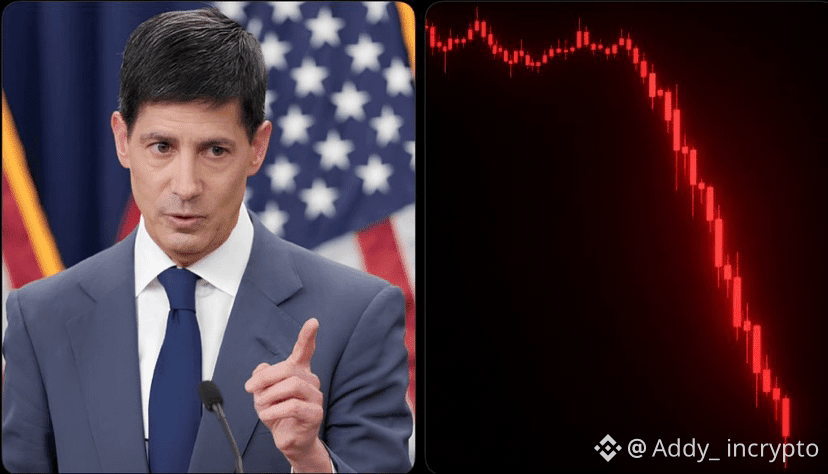
🚨Warsh warns: The AI boom could end with a stock-market slump and rising unemployment
Federal Reserve Chair Kevin Warsh said at a forum in San Francisco on Monday that artificial intelligence could accelerate economic growth but also trigger widespread job losses.
He described the technology as “superintelligence,” saying it had become “a new force in economic life and society.” The Fed is neither for nor against AI; it is assessing the scale and scope of its effects.
Two scenarios
In the optimistic scenario, AI boosts productivity and economic gains, actual GDP remains above its long-term average, and the United States maintains near-full employment.
In the pessimistic scenario, expected returns fall, stocks decline, the economy slows, and unemployment rises significantly. Warsh warned that companies have invested heavily in AI, but if returns disappoint, stock prices could fall and the economy could slow. Even if AI succeeds, automation could replace jobs on a large scale, pushing up unemployment even as the economy continues to grow. He described a possible situation in which “the economy recovers, but productivity does not improve.”
Other risks
Warsh also worries that “bad actors” could use AI to attack critical infrastructure, much like Houthi attacks on key facilities in the Middle East. In addition, the construction of AI infrastructure will increase demand for resources such as chips, electricity, and copper, indirectly driving up prices for consumer electronics.
Policy background and market implications
The Fed began focusing on AI after ChatGPT launched in 2022 and has established five special working groups covering AI, communications, data dependence, balance-sheet policy, and the inflation framework. Several officials are concerned that AI could push up unemployment. Markets currently expect at least three rate hikes next year.
Warsh’s warning also contains a policy paradox: if the economy slows and unemployment rises, the Fed may be forced to cut rates and launch quantitative easing, as it did in 2020–21. This could boost markets, but would conflict with current expectations of rate hikes.
Warsh’s central point is that AI is not an unqualified positive. The key questions are whether investment returns materialize, whether the impact on jobs can be absorbed, and whether infrastructure can be kept secure.
$QQQ $SPY