#英伟达财报夜!预期营收超千亿,AI股或迎大变盘
Nvidia’s biggest risk this time may not be an earnings blowup, but strong earnings that still fail to lift the stock.
What’s happened over the past few days is interesting when you look at it all together.
On November 16, the U.S. BIS introduced new rules bringing Singapore, Malaysia, Thailand, Indonesia, and Brazil under certain advanced-chip export licensing requirements.
Then, on November 18, the U.S. Congress called on Jensen Huang to attend a closed-door briefing to investigate Nvidia’s security measures and related chip exports to China.
And Nvidia is set to report earnings tonight.
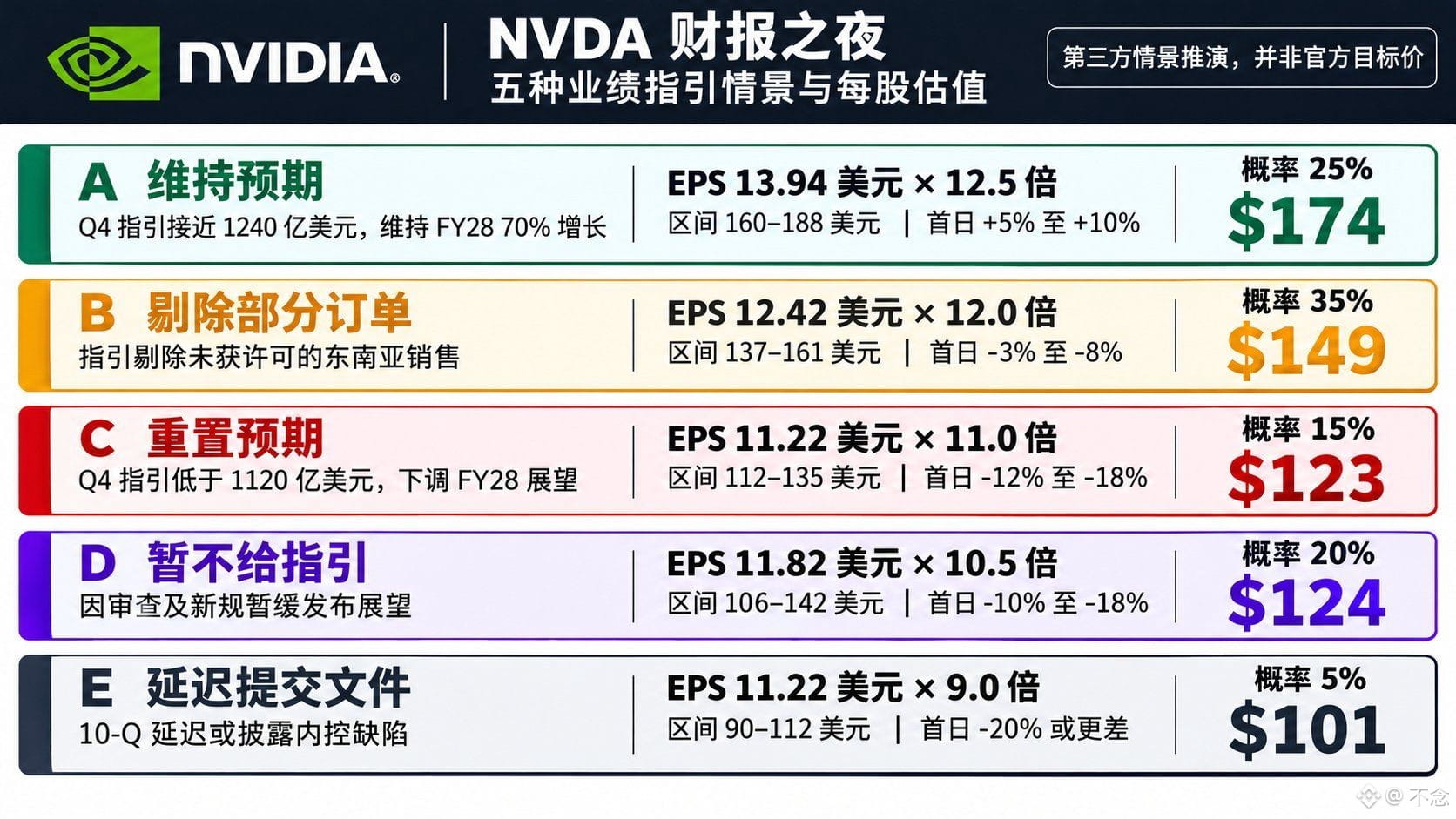
I looked at that valuation chart: five scenarios, ranging from $101 to $174.
The prices may not be accurate, but I think the market is overlooking a bigger issue.
The U.S. wants Nvidia to make money around the world, but it doesn’t want the whole world to have access to the most advanced American computing power.
That’s a contradiction in itself.
In the past, Nvidia only had to prove that demand for AI was strong enough, and the market was willing to assign it a higher valuation.
Things are different now.
Having customers with money, a full order book, and sufficient production capacity may not be enough.
How many chips can be exported? How much overseas revenue can actually be realized? How many more restrictions will Congress impose?
These issues, once treated as peripheral risks, are now becoming part of Nvidia’s core valuation logic.
I don’t think AI demand has peaked, and I don’t think Nvidia will suddenly lose its competitive edge.
But one thing is worth watching out for:
The market may pay a premium for growth, but it’s much harder to pay a premium for unpredictable policy risks.
Tonight’s earnings are about growth; tomorrow, Congress will be looking at the limits.
If earnings beat expectations but the stock still can’t gain ground, I don’t think that necessarily means the market is bearish on AI.
It may simply be that investors are starting to realize:
How much computing power Nvidia can produce is one thing; how much the U.S. is willing to let it sell is another.
$NVDA