


The worse Nvidia performs, the more favorable it may be for Jensen Huang’s return! This is another reflexive logic!
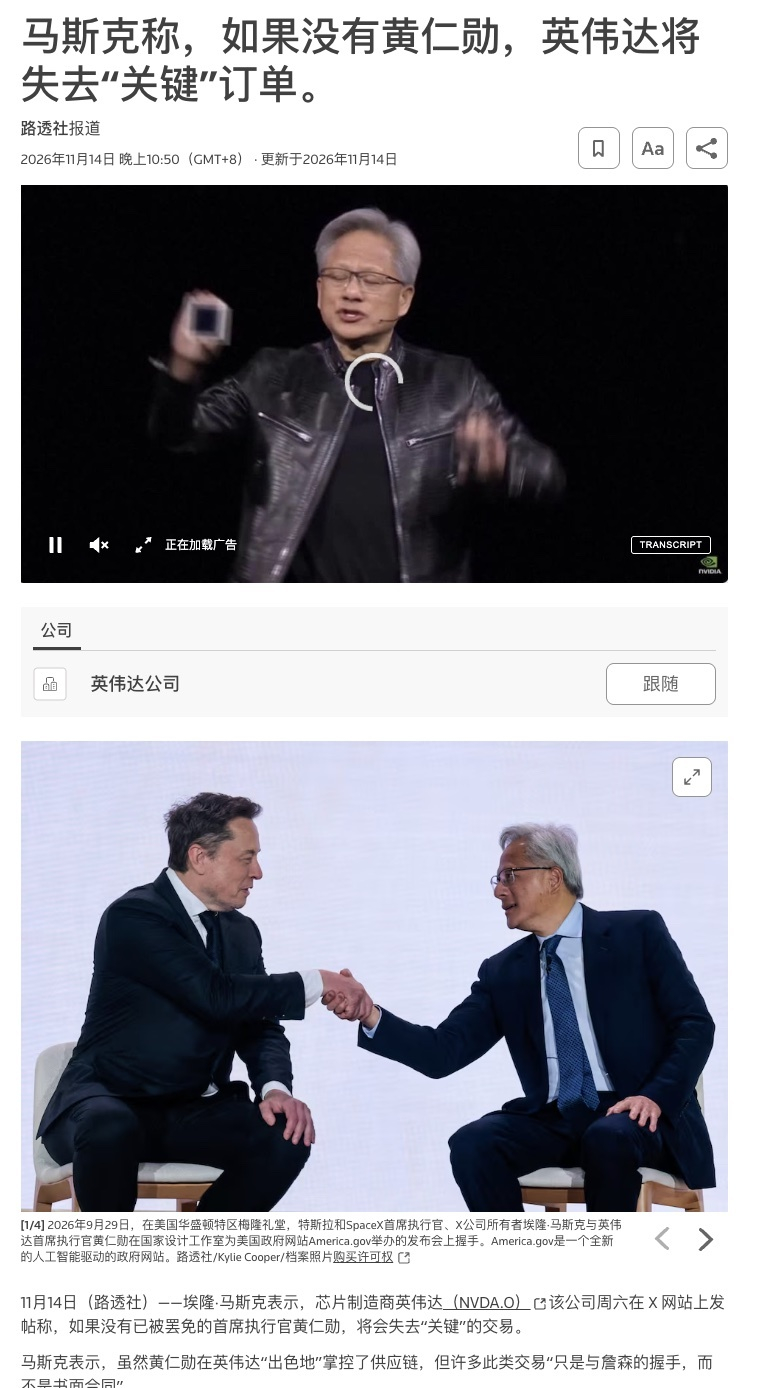
On November 14, Musk @elonmusk posted the following on X: “Jensen drove supply chain brilliantly at Nvidia, but many of those deals were a handshake with Jensen, not a written contract. Without Jensen, at least some of those critical deals will be lost”
The original text means that Musk believes Jensen Huang controls Nvidia’s core business, and that these partnerships are not formalized in contracts. So Huang’s departure could pose a certain threat to Nvidia’s performance.
Nvidia's earnings report comes out overnight, and the results could give the market a clear sense of just how much of a personal boost Jensen Huang provides!
Nvidia's earnings report is due out overnight. It will be the last “fig leaf” for the U.S. stock market's AI narrative. The market currently expects Nvidia to post revenue of over $100 billion, with net profit reaching as high as $60 billion. If the report meets expectations, that would be good news for the AI narrative across the whole third quarter and would boost confidence. #英伟达财报夜!预期营收超千亿,AI股或迎大变盘
However, investors may not be satisfied with this report—a blockbuster report expected to top $100 billion in revenue!
Because of the Jensen Huang situation, Nvidia's forward P/E has fallen to 11x, its lowest level since 2023. Among Philadelphia Semiconductor Index components, only Micron Technology is lower. That's a sharp valuation reset from the 40x P/E a month ago.
Looking at the valuation logic alone, after this valuation reset, earnings that simply meet expectations would generally give the share price a boost. And a report showing $100 billion in revenue could be even more likely to lift the stock and spark a rebound!
However, the valuation reset triggered by the Jensen Huang situation could lead to diverging outcomes. That's because the market's assessment of Nvidia's valuation is based not on past performance (its earnings report), but on its future capabilities. If Huang's departure could affect future orders and revenue, then the market may still be unwilling to pay the current valuation.
So Nvidia's earnings report overnight needs to be viewed from two angles!
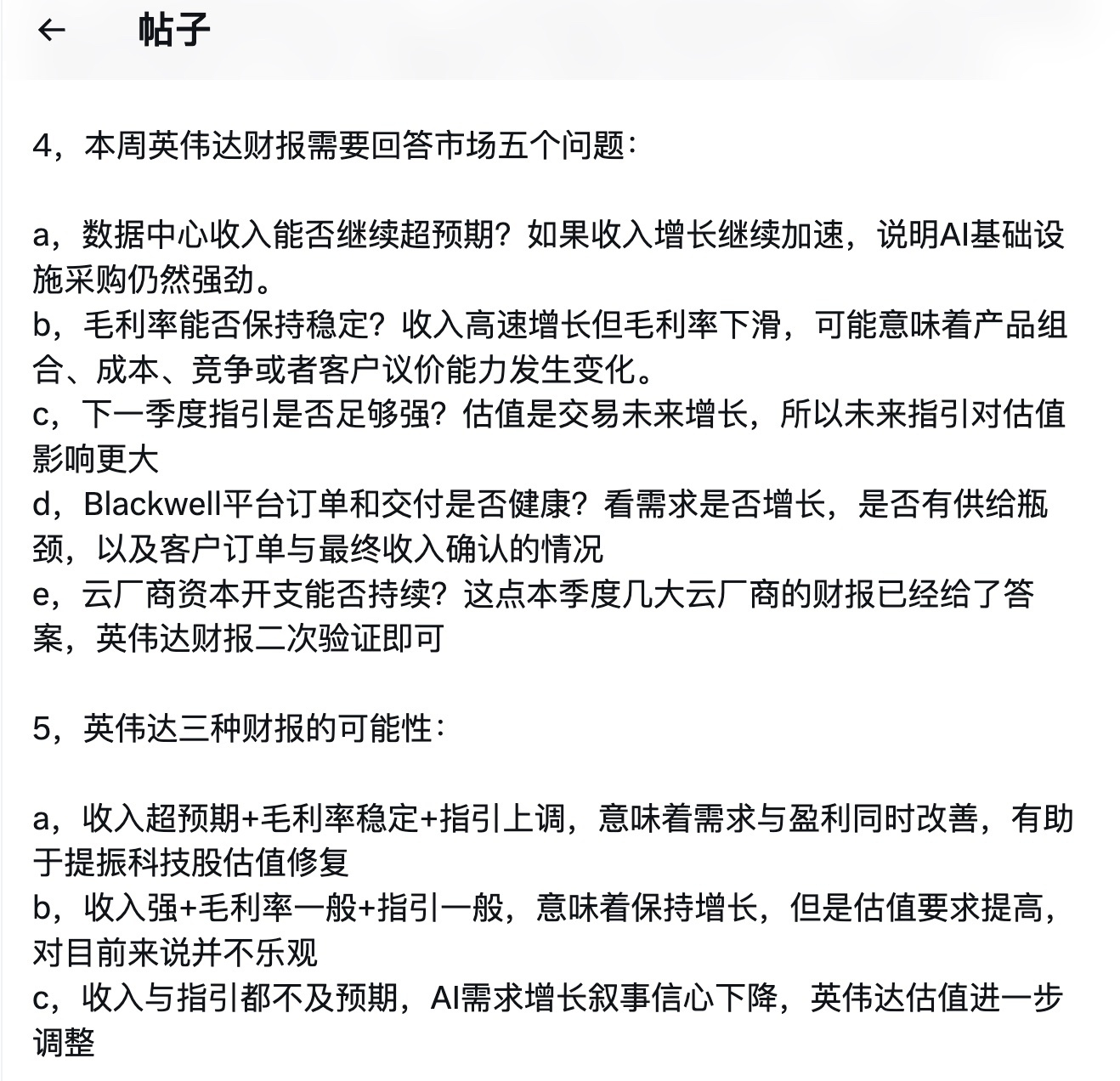
First, did the results meet or exceed expectations? For the earnings-report analysis, see the pinned post on my profile (Third Main Theme, sections 4/5), or take a look at the second image.
Revenue, gross margin, and future guidance all need to exceed expectations to have a meaningful positive effect on valuation recovery. Goldman Sachs recently said that, due to rising costs, Nvidia's product gross margin could be adjusted slightly from 74% to 73%. This kind of cost pressure on profits is really just a minor blemish, but under the shadow of the Jensen Huang situation, that small blemish could easily be magnified.
Second, will the market accept the outlook presented on the interim CEO's first earnings call? That's a major question. In particular, will Huang's departure directly affect orders and related businesses, and can the interim CEO give the market a satisfactory answer? If the answer disappoints, the market may continue to lower its expectations for the future, driving the valuation down further.
These two angles mean Nvidia needs to deliver more to win the market's confidence. If the market isn't convinced, then even after this strong earnings report, the valuation recovery in the share price could be muted—or the stock could even keep falling.
As for Huang's current situation, although he has received considerable public support, resistance within Nvidia and from political circles remains. But if Nvidia runs into business trouble, that will inevitably draw attention from U.S. officials and Nvidia's internal shareholders. That would provide solid grounds for bringing Huang back—and would be his greatest source of support!
A classic case of reflexivity: when Huang was at the helm, the better the earnings, the better it was for the company. But right now, for Nvidia to maintain its strength, Huang may need to return—and the biggest thing that could help bring him back may actually be a short-term deterioration in Nvidia's future results.
My personal expectation is that the earnings reports over the next two quarters could very well run into problems. Those two quarters will be the key window for Huang to return to Nvidia!