ZEC at $947: Essential privacy or the final shakeout?
The NU7 upgrade is live, blocks are 3x faster, and institutional holdings exceed 2% of circulating supply—yet ZEC has fallen from $1,300 to $947, down 20% in 7 days, before rebounding 7% in 24 hours. Is this a golden buying opportunity, or the final shakeout for the privacy narrative?
ZEC’s price action these past few days has been a reality check for the overconfident.
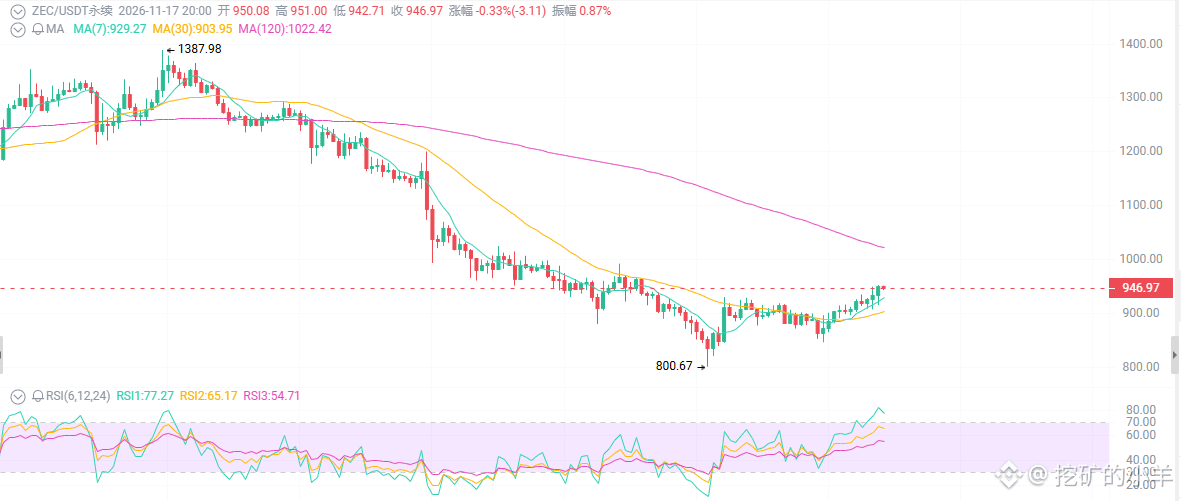
It was still above $1,300 in early November, then suddenly plunged to $846, down 18–22% in 7 days, while the chat was full of “privacy coins are finished.” And then? It bounced back to $947 in 24 hours, up 5–7%, and people started calling it a “reversal.”
First: NU7 really is live, but the market wasn’t impressed
NU7 was officially activated on November 6. Block times fell from 75 seconds to 25 seconds—3x faster. 60% of fees go into reserves, preserving the 21M hard cap. Transactions using the old Sprout privacy pool v4 were disabled, freezing about $16 million worth of ZEC that can no longer be spent.
In other words, ZEC took a major step toward making private settlement faster and more affordable. This wasn’t an upgrade on a PowerPoint slide—the mainnet really changed.
But what happened to the price? It plunged from $1,300 to $846.
Second: Institutions are buying, miners are consolidating, and ETFs are moving
Cypherpunk (backed by the Winklevoss twins) continued buying during the pullback, with holdings exceeding 340,000 ZEC—about 2%+ of circulating supply—and a target of at least 5%. Grayscale pledged $1 million in ecosystem support and also launched an advertising and investment platform. The number of developers has doubled in recent years, and research into quantum resistance has also begun.
But on the other hand: Some mining companies together control nearly 30% of the network’s hashrate, fueling debate over concentration; ETFs have seen some outflows; and holders are still discussing whether to withdraw 50,000 ZEC from the Grants treasury.
Third: The technical picture points to a relief rally, not a ticket to a reversal
ZEC bounced from $846 to around $950, and the RSI recovered from oversold territory. But the daily and 4-hour moving averages remain bearish or neutral-to-bearish, with heavy resistance overhead.
Support: 920–930 (short-term) → 880–900 (stronger demand zone) → 850 (recent low)
Resistance: 950–960 (intraday high) → 980–1,000 (psychological level + previous structure) → 1,050–1,100
1,000 is the dividing line. Only a sustained move above it on strong volume would justify talking about a bottom forming. If ZEC can’t break through, 947 is a pause in the rebound—not the bottom.