
This week marks a busy earnings period for Chinese stocks listed overseas. Baidu reported first, followed by JD.com, Tencent Music, Tencent, Alibaba, Pinduoduo, and NetEase, which are set to release their third-quarter results in succession.
Goldman Sachs expects adjusted net profit for China’s internet sector to grow by about 9% year over year in the third quarter, ending a decline that lasted for the previous two quarters.
I think one change worth watching this earnings season is that the market is increasingly differentiating how it values internet companies. In recent years, investors focused more on revenue growth, user numbers, and market share. Now, as AI capital expenditure continues to expand, improving profit margins, free cash flow, and returns on capital investment are becoming more important.
Let’s start with Baidu. The most valuable signal in this earnings report is that its AI business is already materially changing the company’s revenue mix.
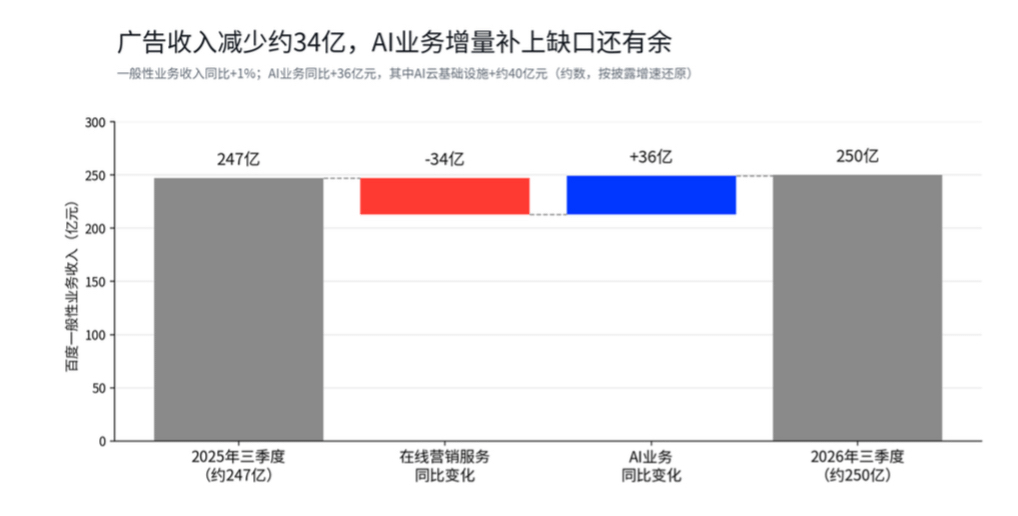
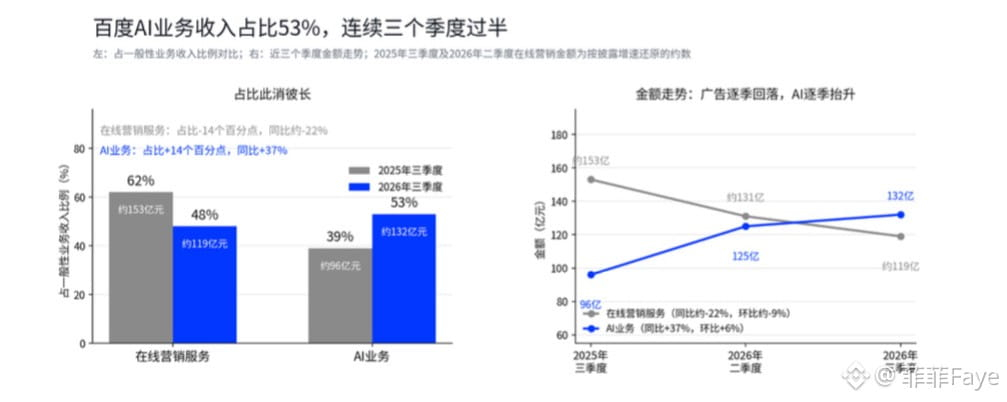
Baidu’s third-quarter revenue totaled RMB 30.8 billion, down 1% year over year. Traditional online marketing revenue was RMB 11.9 billion, down 22%.
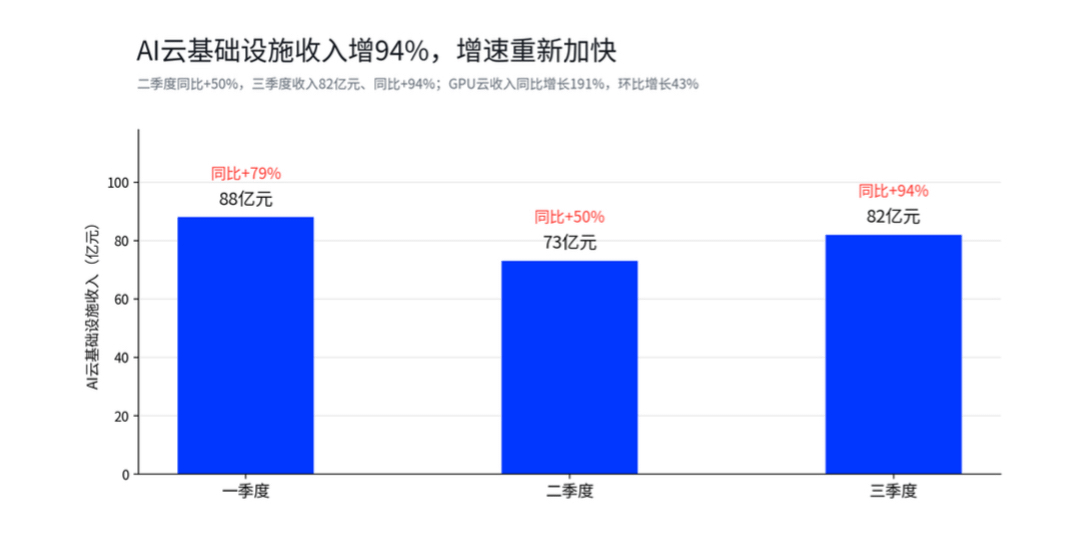
Meanwhile, AI business revenue reached RMB 13.2 billion, up 37% year over year and accounting for 53% of general business revenue. AI cloud infrastructure revenue was about RMB 8.2 billion, up 94% year over year—an acceleration from roughly 50% growth in the second quarter.
Breaking that down further, GPU cloud revenue grew 191% year over year, while revenue from external customers’ token usage on the Qianfan MaaS platform grew 1,159%.
These figures show that demand for AI commercialization is increasingly concentrating in computing infrastructure, cloud services, and model usage.
More notably, market segment data suggests that AI cloud infrastructure contributed approximately RMB 4 billion in incremental year-over-year revenue, already offsetting the roughly RMB 3.4 billion decline in traditional advertising revenue.
This means Baidu’s revenue mix is undergoing a material shift, with AI cloud beginning to contribute incremental growth as its traditional business slows.
However, when it comes to earnings quality, the market still needs further evidence that AI investment is generating attractive returns.
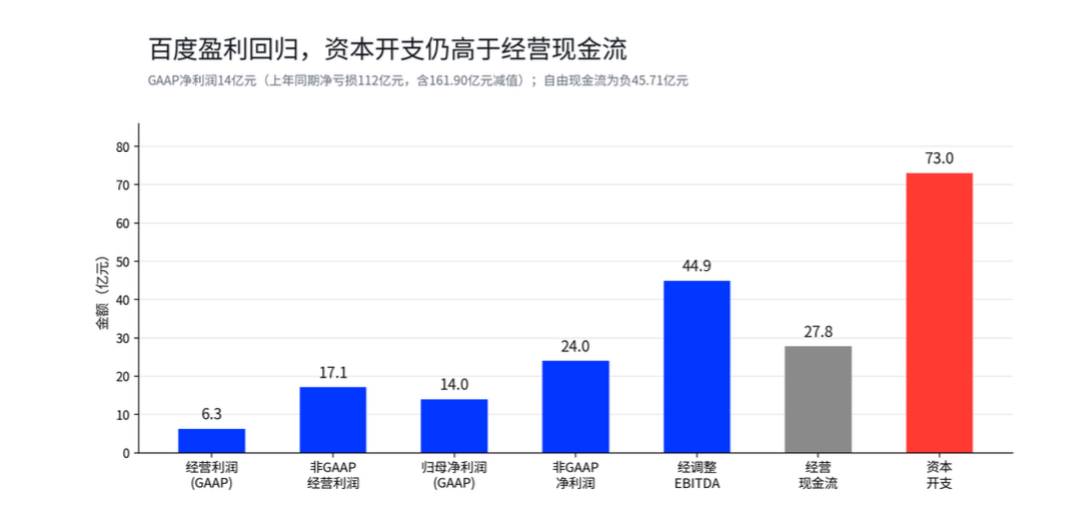
Baidu’s adjusted third-quarter earnings per ADS were RMB 6.78, above the market forecast of RMB 6.02. Adjusted EBITDA was approximately RMB 4.49 billion, also exceeding expectations.
Operating cash flow rose 121% year over year to RMB 2.778 billion, showing a marked improvement. However, capital expenditure remained high at RMB 7.3 billion, leaving free cash flow at negative RMB 4.571 billion.
Based on these figures, I believe Baidu faces two key variables going forward:
First, whether AI cloud revenue can sustain its rapid growth and gradually achieve economies of scale, driving an improvement in operating margins.
Second, as earlier investments in GPUs, servers, and data centers begin to contribute revenue, whether capital expenditure can normalize and when free cash flow can improve on a sustained basis.
The 94% growth in AI cloud has confirmed demand-side expansion. Over the next few quarters, the key question is whether these investments can generate sufficiently attractive returns on capital.
Next, let’s look at three other companies worth watching this week.
Alibaba $BABA
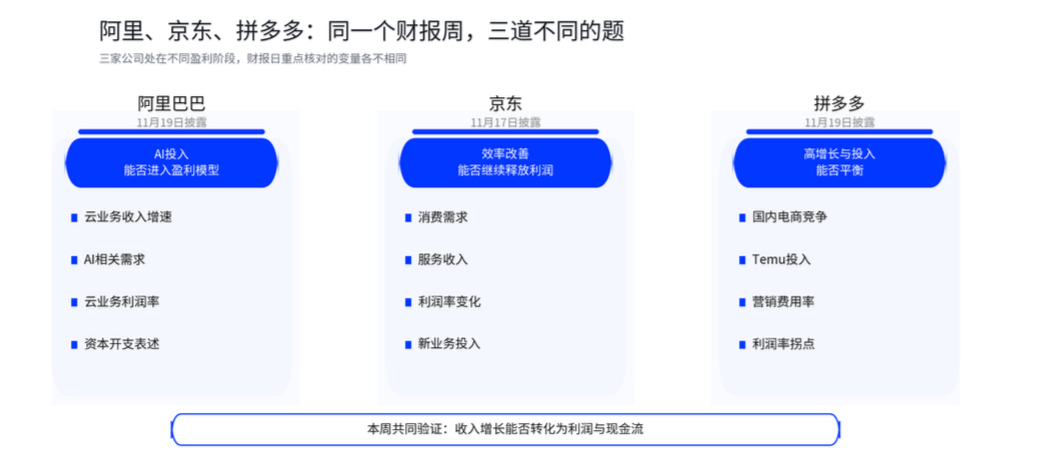
Alibaba Cloud will be a key focus this earnings season. Whether rising AI demand continues to accelerate cloud revenue growth, and whether cloud margins improve at the same time, will directly affect how the market assesses future earnings potential.
Especially as AI infrastructure continues to expand, investors need to weigh capital expenditure, depreciation costs, and cloud margins to assess the actual economic returns from revenue growth.
If cloud revenue growth and margins improve together, there may be room for the market to further raise its earnings forecasts for Alibaba’s AI business.
JD.com $JD
Operating efficiency is the key variable for JD.com.
Ongoing investment in businesses such as instant retail and logistics may weigh on profit growth in the short term. But if service revenue grows, economies of scale strengthen, and the expense ratio stabilizes, profit growth could continue to outpace revenue growth.
Goldman Sachs previously forecast that JD.com’s net profit would grow 39% year over year in the third quarter. Next, investors will need to watch actual profit performance and how investment in new businesses affects future margins.
PDD Holdings $PDD
For PDD Holdings, key areas to watch are domestic e-commerce competition and how its overseas expansion through Temu affects expenses.
As competition among domestic platforms continues and overseas business enters a new phase of development, the marketing expense ratio, fulfillment costs, and operating margin will be key metrics.
If revenue continues to grow while customer acquisition costs per unit decline and the expense ratio improves, earnings growth could gain further momentum.
Conversely, continued increases in marketing and operating investment could delay profit growth and weigh on market expectations for earnings growth.
My take on trading this earnings season:
Earnings reports show a company’s performance over the past quarter, but share prices often reflect the market’s expectations for earnings over the next several quarters in advance.
That is why some companies can report EPS well above expectations and still see their share prices fall, while others can deliver mediocre revenue results yet command higher valuations thanks to improving margins or upgraded forward guidance.
This comes down to the gap between expectations and results.
Earnings-driven trades should be assessed in light of current valuations, consensus expectations, actual results, and management’s forward guidance.
For companies whose shares have risen sharply and whose earnings expectations are already fully priced in, even an earnings beat may not drive further multiple expansion without stronger forward growth guidance.
For companies facing relatively cautious market expectations whose fundamentals are beginning to improve, a turning point in margins, stronger free cash flow, or upgraded earnings forecasts could deliver greater valuation upside.
From this perspective, I’ll be watching three key signals:
① Changes in revenue mix: Which businesses are driving incremental revenue, and is that growth sustainable?
② Improving earnings quality: Can gross margin, operating margin, and free cash flow all improve together? Is capital expenditure gradually generating returns?
③ Revisions to earnings expectations: Can actual results and management guidance prompt the market to raise its earnings forecasts for the next several quarters?
For AI-related companies in particular, revenue growth reflects only part of demand expansion. Long-term valuations still need to take profitability, capital efficiency, and future cash flow into account.
As a result, valuation divergence across Chinese internet stocks could widen further. As AI investment enters the commercialization payoff stage, companies that can sustainably improve earnings expectations and use capital more efficiently are better positioned to command a valuation premium.
This week, I’ll be watching Alibaba Cloud’s profitability, JD.com’s operating efficiency, and changes in PDD Holdings’ expense ratio.