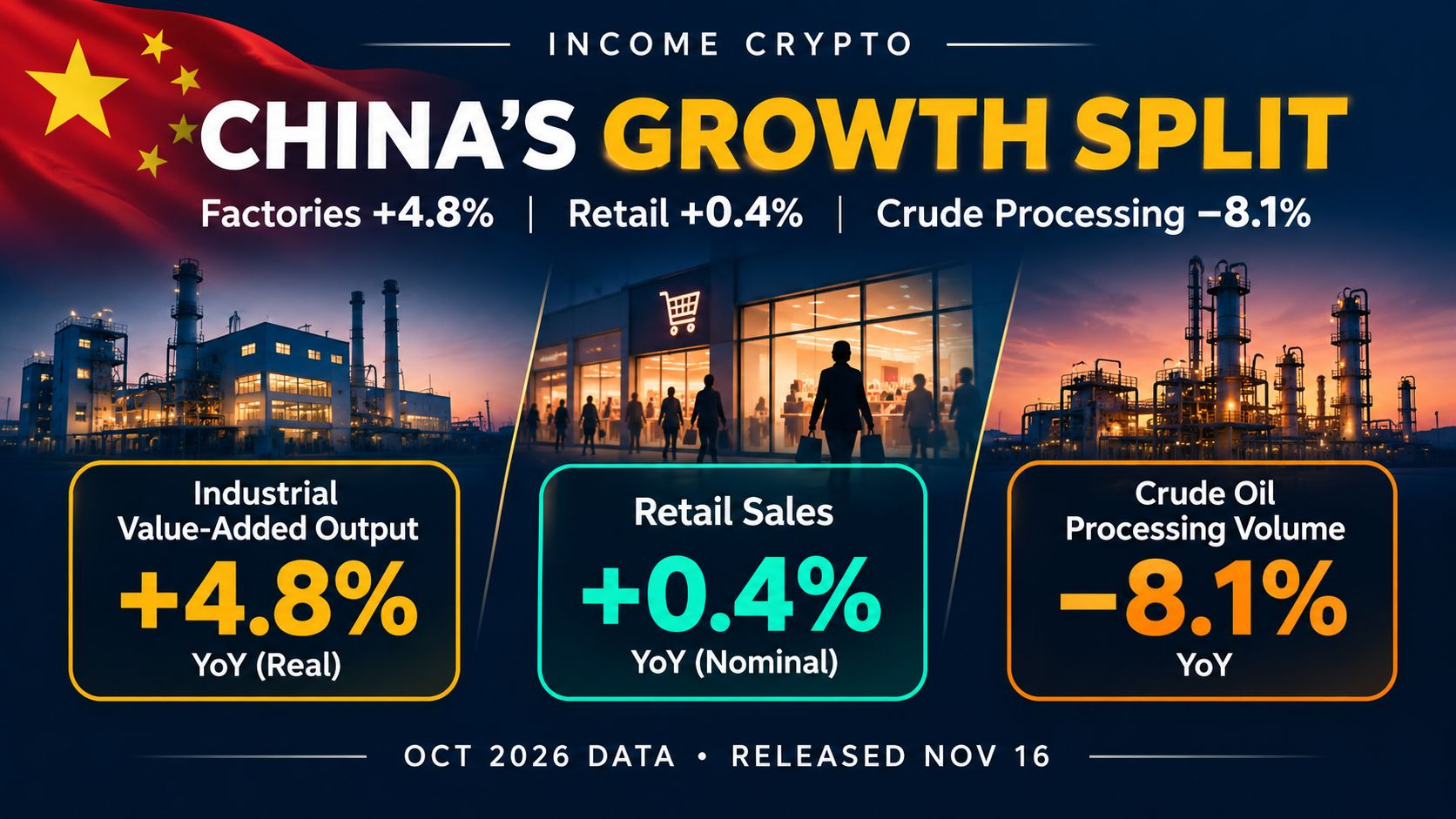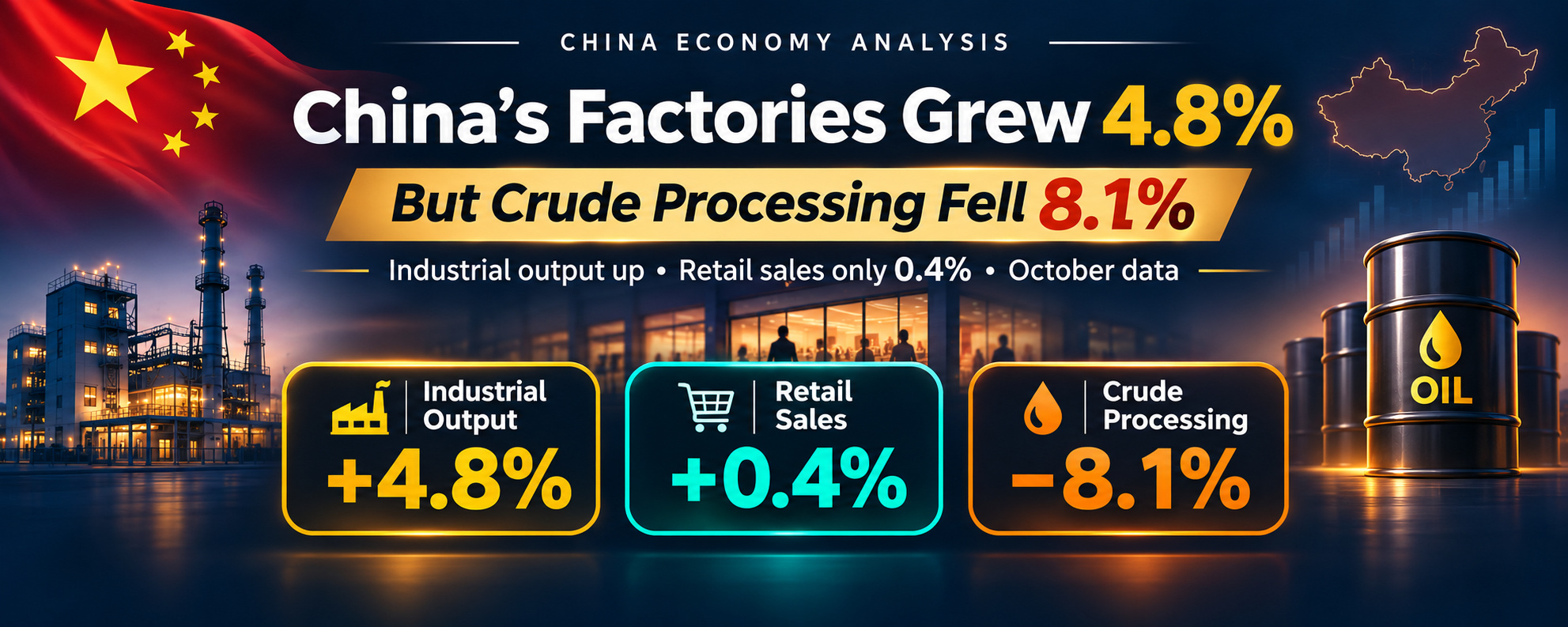

China's latest economic report presents a puzzle for anyone following crude oil. Industrial production rose 4.8% year over year in October, but retail sales grew just 0.4%, and the volume of crude processed by refineries fell 8.1%. The figures were released by China's National Bureau of Statistics on November 16. They describe different parts of the economy, yet together they challenge the easy assumption that rising factory output automatically means stronger demand for oil.
It is worth starting with what the factory number actually measures. The 4.8% increase is real value added at industrial firms above a defined size, not the amount of goods Chinese households bought. Manufacturing output grew 5.4%, and computer, communications and other electronic equipment manufacturing rose 19.4%. A country can expand production for export markets or business investment even while its domestic shoppers remain cautious. That is not a contradiction; production and final demand are related, but they are not the same statistic.
The retail figure tells another part of the story. October's 0.4% year-over-year growth measures nominal sales of consumer goods. Strip out automobiles, and the reported increase was 2.5%. That gap matters: weakness in a major category can make the headline look more subdued than spending across every category. It is also important not to compare nominal retail sales directly with inflation-adjusted industrial growth as though they measure the same kind of activity. Neither number on its own gives us total household consumption, particularly spending on services.
The oil-market complication
Refineries processed 58.30 million tonnes of crude in October, an 8.1% decline from a year earlier. This is much closer to physical petroleum activity than the factory-output headline, so it deserves attention from anyone interpreting China's demand for crude. But even here, the conclusion has limits. Lower refinery throughput can reflect weaker demand for refined products, refinery maintenance, changing margins, inventories or trade patterns. Without separating those influences, it would be premature to say that Chinese consumers alone caused the decline—or that global crude demand is collapsing.
That distinction matters for oil prices. China is a major participant in world commodity markets, but a single country's monthly processing figure cannot determine the direction of WTI futures. Crude imports, refinery runs, product inventories, domestic fuel use and changes in supply all affect the balance. Global prices also respond to producers outside China, shipping constraints and market expectations. The industrial figure is a useful macro signal; the processing figure is a useful oil-market signal. Neither should substitute for the full balance sheet.
What would make the story more convincing? If subsequent data show domestic retail spending improving alongside sustained increases in refinery runs and fuel demand, the argument for a broader demand recovery would strengthen. If factories keep expanding while retail spending and refinery activity remain weak, the economy may still be growing in a way that does not translate into equally strong domestic oil consumption.
The takeaway from the November 16 release is not simply that China's economy is strong or weak. It is that where growth comes from matters. For crude oil traders, a factory growth headline is only the beginning of the question, not the answer.
#ChinaEconomy #CrudeOil #MacroEconomics