LIT at $3: a golden buying opportunity or one last bounce before it goes to zero?
API keys stolen, $15 million drained, withdrawals paused, and the price crushed from $4 to $2.30 in a day—only to claw its way back to $3 two days later. Is this a golden buying opportunity handed to us by hackers, or the project team’s final performance?
November 16. Some people posted screenshots saying, “I can’t withdraw,” while others shouted, “It’s going to zero—get out!” When that wick plunged to $2.30, plenty of leveraged longs were wiped out on the spot. Then it bounced back to $3. And now you’re stuck in the most uncomfortable position: sell and risk missing out, or hold and risk another crash.
First: It wasn’t the contracts that were stolen—it was people’s trust
This attack wasn’t caused by a smart contract vulnerability. API keys were leaked, and about $15 million was drained from a market maker’s account.
ZK proofs, a verifiable order book, self-custody, and a forced-exit channel—the technical architecture is sound. But users don’t care about that. They remember just four words: withdrawals paused.
The hackers stole $15 million; the project lost trust. And trust is worth a hundred times more than TVL.
Second: The story is still there, but its momentum has been disrupted
The team plans to apply for DCM and DCO registration with the CFTC in November, aiming to become the first on-chain perpetuals exchange to obtain U.S. regulatory approval.
There’s an integration narrative with Robinhood (which really did invest real money before).
Institutions like Founders Fund and Ribbit are backing it.
The token has a buyback-and-burn mechanism.
It’s a compelling story—but first, you have to open the doors so users can withdraw their money. If the doors stay shut, it’s a ghost story.
And there’s another sword hanging overhead: team and investor unlocks are approaching at year-end, followed by linear vesting after the cliff.
Third: $3 is the line separating bulls from bears
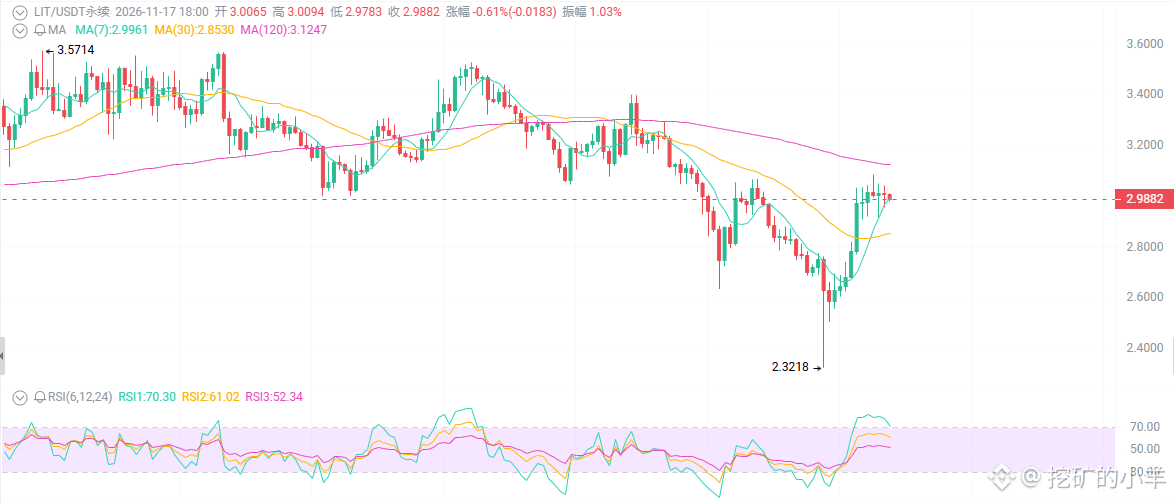
Key support: $2.80–$2.90 (the foundation for a rebound) → $2.50–$2.60 (the event low; a break below calls for caution about a deeper pullback) → $2.00–$2.30 (a strong demand zone)
Resistance: $3.20–$3.30 (short term) → $3.50–$3.60 (VWAP/prior structure) → $4.00–$4.30 → $5+
Trading volume increased after the incident, and the RSI rebounded from oversold territory. Moving averages are still bearishly aligned, but signs of convergence are emerging. A sustained move above $3.20–$3.30 on higher volume would open up room for a rebound; a break below $2.80 would likely bring another test of $2.50 or even lower.