

Original author: Santisa
Translated by: Chopper, Foresight News
Crypto market-neutral strategies are the niche I’ve devoted all my energy to over the past decade.
Historically, crypto market-neutral strategies have centered on one type of trade: the probability of default is low, but when a default does happen, the losses are catastrophic. Anyone involved has to stay alert at all times, because when the final whistle blows, the ones who pull the trigger first (that is, exit first) survive. And interestingly, pulling the trigger is almost always cost-free. Those left behind can only listen forever to the project’s empty promises: “We’ll make it right.”
It's a highly stressful way to live. But crypto offers you the chance to earn a risk premium wildly out of proportion to the underlying risk. Few would deny that a 70% return on Binance Bitcoin basis trading in 2021, or 100% annualized returns from leveraging PTs (principal tokens) at a tokenized hedge fund you liked in 2024, were exceptionally high returns. But high returns don't mean an investment is right for every portfolio. The reality is that DeFi markets are unforgiving, and the sword of Damocles could fall on any position at any moment. That means keeping your eyes on the thread suspending that sword at all times, and setting up a whole array of alerts that can be triggered by false alarms, waking you and your partner in the middle of the night just to check whether the thread has actually snapped—so you can get clear of the blast radius.
DeFi premiums were outrageously high at first, partly because the risks really were high, but more importantly because large institutional allocators couldn't touch these opportunities due to their investment mandates. They faced enormous reputational risk and had almost no relevant expertise. On one side were cash-rich, VC-backed projects desperate for deposits; on the other were individual investors drawn in by the risk and novelty, who would move into stablecoins to de-risk once they'd made money on-chain. Together, these factors allowed people with at least some risk-management skills to access some of the highest-yielding strategies in the world over the past two decades.
I was fortunate not only to participate in it firsthand, but also to build my own business around it. Economies of scale make things more efficient; there is strength in numbers, and having more resources is an advantage. I realized there was enormous on-chain demand for stablecoins, but very little supply. A bit of financial literacy and technical knowledge were enough to earn handsome returns. And this wasn't a small mismatch: there was a structural chasm between serious institutional allocators and DeFi, which was considered "toxic trash" at the time. Personally, back then I was a homebody keyboard warrior, researching DeFi and blockchain technology—very different from the person some of you are fortunate enough to know today. I met a future business partner who persuaded me to package all this into a product. He told me there was real demand in the market, and that if we explained the risks clearly and transparently, we could build a good business through his client network. He was right.
We brought in some brave LPs (limited partners, or investors) only after making sure they fully understood that "in a stress scenario, losses really could be 100%." Then we sacrificed sleep and well-being to be on the front lines of the "yield farming" frenzy and other projects that, in retrospect, feel like fever dreams. The business did extremely well in the crazy bull markets of 2020 and 2021. We checked forked projects one by one, farmed with the same stablecoin across multiple protocols, monitored a huge number of addresses for signs of stress and opportunity, and had to work with the terrible tools available in the industry at the time.
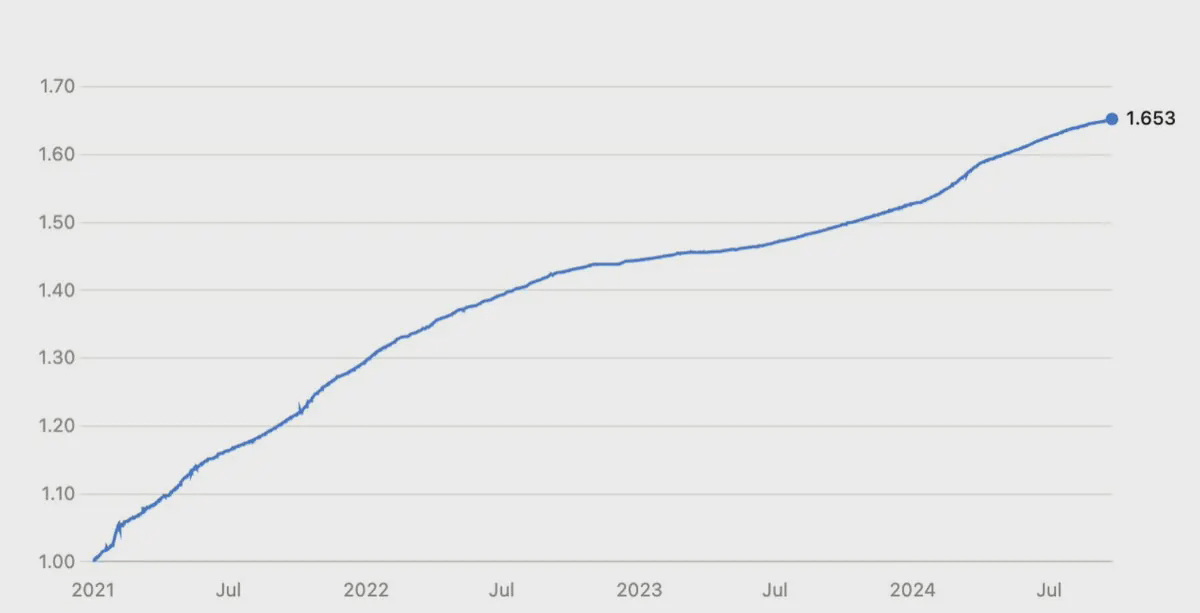
Returns from crypto market-neutral funds, 2021–2024
Some might say those returns aren't sexy enough for a raging bull market. But look closely at this chart: there were no monthly drawdowns during this period. The collapses of FTX, BlockFi, Celsius, and Terra, as well as USDC depegging, had no impact on our returns.
Yes, the sword of Damocles hung over our heads throughout those years, but I'm proud that we achieved these returns with zero losses in that kind of environment.
Over the years, these returns came at the cost of several "minor heart attacks": trades inexplicably disappearing from a cross-chain bridge, only to reappear four hours later; USDT frequently depegging; USDC briefly falling to $0.88; tens of billions of dollars in UST going to zero; and many protocols we'd worked with being destroyed by smart contract vulnerabilities or operational security failures.
Operational alpha comes down to three things: 1) being skilled in finance; 2) having a moderate understanding of technology and smart contracts; 3) not being a gambler in a space built for gamblers, but lending them money instead.
This isn't a field for the faint of heart, but the returns were enough to justify the toll on our health. The kind of leveraged trades we did deserved the returns we earned. It was a once-in-a-generation opportunity that we seized with both hands. I'll always be grateful for that period, and to the partner who pushed me to take the risk and scale it up.
Over the next few years, returns gradually thinned out. We started buying U.S. Treasuries and doing nothing, while watching operating costs steadily bleed the company dry. The returns were gone, and our mandate was very strict: if perceived risk exceeded returns, we wouldn't invest. We fought to the bitter end, through plenty of heated arguments and LP redemptions, to keep our analysis objective and to measure and assess the various risks each position faced at every layer of the tech stack. Sometimes the risk stack went seven layers deep, spanning financial, custody, mismanagement, regulatory, operational, opacity, and smart contract risks. Naturally, this made many investments impossible to execute. The projects whose yields had fallen below SOFR (the Secured Overnight Financing Rate) were taken up by people who couldn't do without DeFi; for them, some yield was better than none.
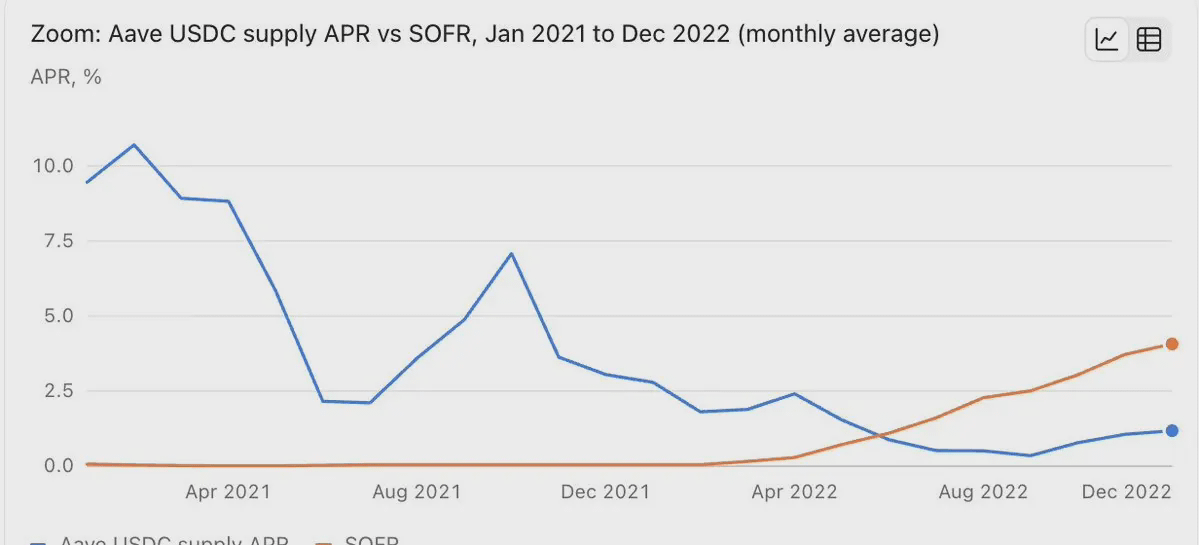
USDC rates on AAVE vs. SOFR
As the bull market slowly returned in 2023, the space had changed a lot. There were now professional, well-capitalized players whose approaches to DeFi lending, farming, arbitrage, and market-neutral strategies in general had surpassed ours. We could still find some smaller opportunities that could absorb capital, but risk-adjusted returns had compressed sharply. And for me, the responsibility to LPs came with a significant psychological cost. No matter how clearly you spell out your risk mandate and disclaimers, if people don't read them and simply trust you, you carry a heavy responsibility—and that's not what "real money management" means to me. The returns no longer made up for the stress I was under.
So in 2024 I shifted to offering non-custodial yield strategies, focusing on family offices and crypto exchanges whose clients understood the risks of the strategies. But it was still a very labor-intensive approach. Communication between clients (who held the assets in custody) and us was poor, and after fees, the strategies we proposed and monitored generated almost no returns.
It was then that I saw a new paradigm for managing market-neutral strategies in crypto. The firms in this space manage their own books intensively, pursue the best returns, and manage risk, with employees spread across time zones, a full suite of expensive monitoring tools, and highly sophisticated key-management infrastructure. I found myself in an awkward position: I wanted to maximize alpha, but lacked the infrastructure and capital to do it efficiently. That left me with two options:
Raise capital for a market-neutral GP (general partner / fund manager), then raise it all over again from LPs—in other words, go back to square one;
Join established players who were already efficiently harvesting on-chain premiums with large-scale infrastructure and security budgets.
At heart, I'm a fund manager. The only reason I got into management, fundraising, and team-building was that I had no other choice. There weren't many truly reputable market-neutral funds around at the time, so I had to start one myself. The crypto market in 2025 is very different, and I've been fortunate to meet some talented people who happen to be deploying substantial capital on-chain.
My Spark journey began in July 2025. By the time I wrote this, Spark had deployed around $3.3 billion on-chain, primarily in overcollateralized blue-chip lending, both in Spark's own on-chain lending market and against Bitcoin held with qualified custodians. It was also the largest stablecoin market maker in the space and operated the best USDT product. Being "the market itself" and operating "in the market" are entirely different things.
I've mastered the art of watching the thread; it's what my life's work depends on. I'll keep watching it diligently, trying to blink as little as possible, with my neck still beneath the sword. I'll rest only after I move my neck out of the way.