NVIDIA is in for a tough time!
On the eve of its earnings report, renowned semiconductor research firm SemiAnalysis suddenly dropped a bombshell on Wall Street!
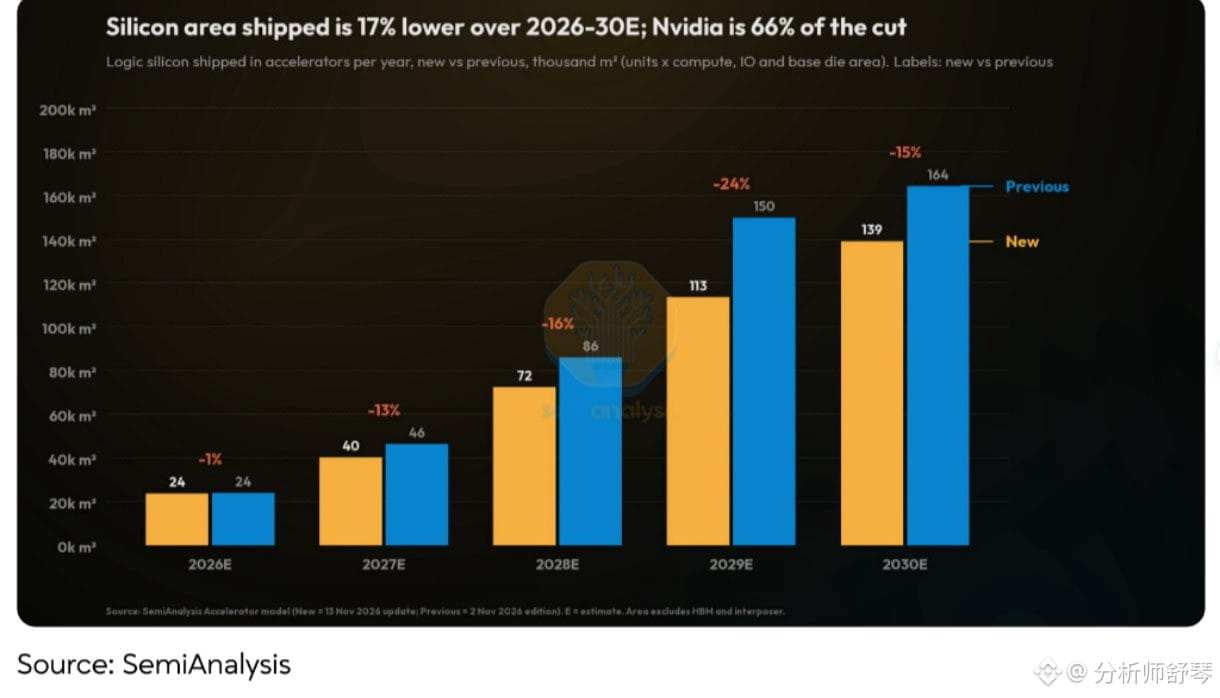
Its forecast for NVIDIA’s shipments in 2030 was slashed by a whopping 66% all at once.
Even more astonishingly, its forecast for global capital spending on AI accelerators in 2030 was cut straight from $1.531 trillion to $923 billion!
And it’s not just NVIDIA’s sales outlook that’s been cut—the projected selling prices of its future chips have also been sharply reduced.
The projected price of Feynman has fallen from $110,000 to $78,000. Feynman Ultra has fared even worse, dropping straight from $175,000 to $98,000!
Of course, these figures come from the research firm SemiAnalysis; they’re not my personal views.
Even if NVIDIA’s revenue really does decline in the future, its share price has also fallen 40%, so some of the bad news has already been priced in.
And these figures are mainly about the next two years—they’re long-term projections. For the short-term impact, we still need to look at the earnings results coming soon.
But there’s an even more surprising twist to this story.
Have you ever considered that if NVIDIA’s chips keep getting cheaper, that could actually be fantastic news for other companies?
That’s because lower computing costs mean lower costs for more businesses!
For example, Anthropic, which is expected to go public soon, spends most of its money on computing. The same is true of OpenAI, whose launch is expected early next year.
Then there are smaller-scale applications like Palantir, whose revenue surged 96% year over year in the third quarter of 2026. It’s showing strong momentum, too.
If computing costs fall over the next two years, companies that rely heavily on computing power will benefit.
So in the first half of this story, tech giants paid a premium to snap up chips, and semiconductor companies made a fortune.
In the second half, as computing gets cheaper over the next few years, the companies that may really make big money are the ones building AI applications.
Could the biggest wealth opportunities in U.S. stocks over the next two years lie in this great shift in profits? Let’s wait and see!