The Megaspeed case has escalated: the U.S. Department of Justice has formally launched a criminal investigation. Behind it lies a power struggle in Washington.
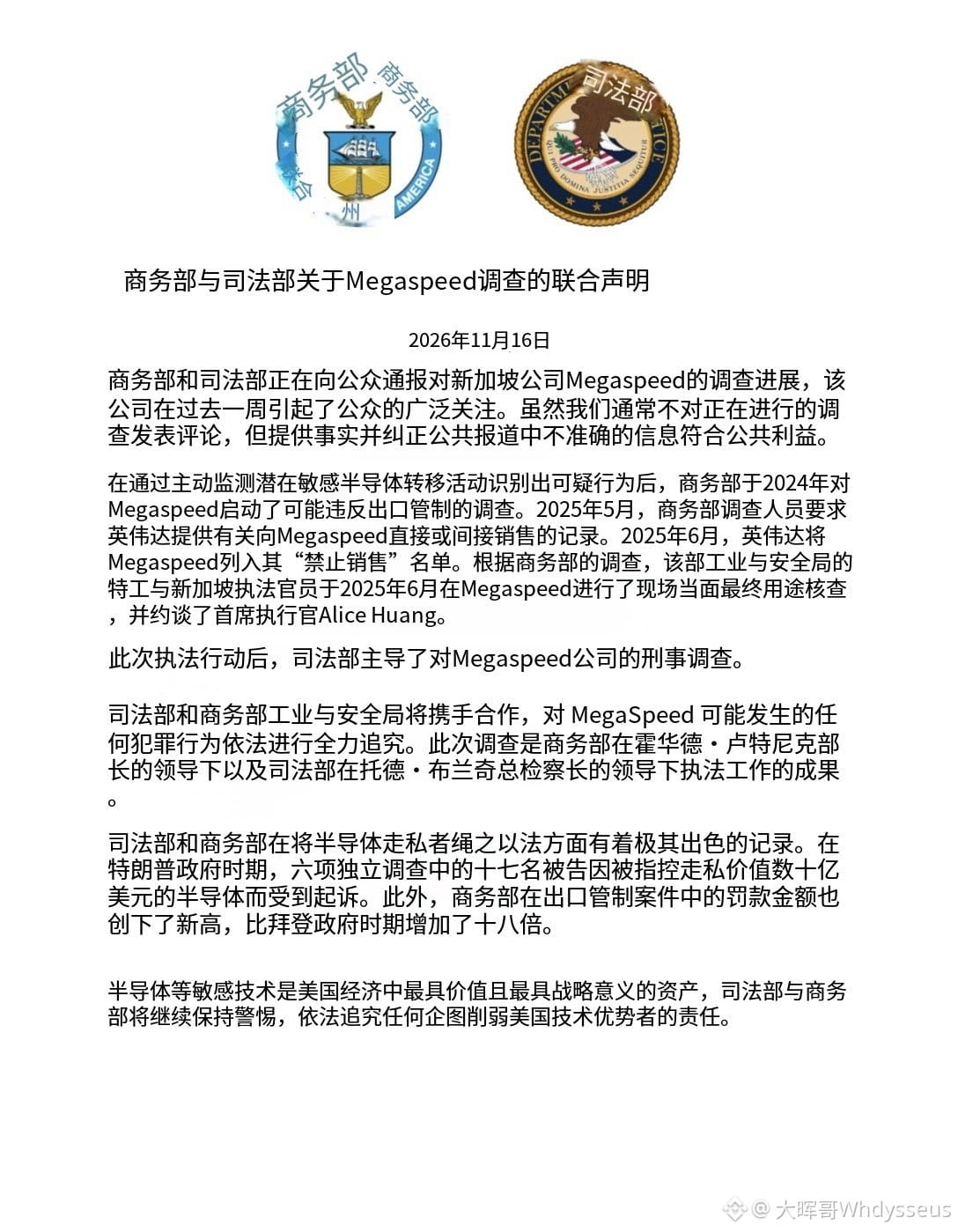
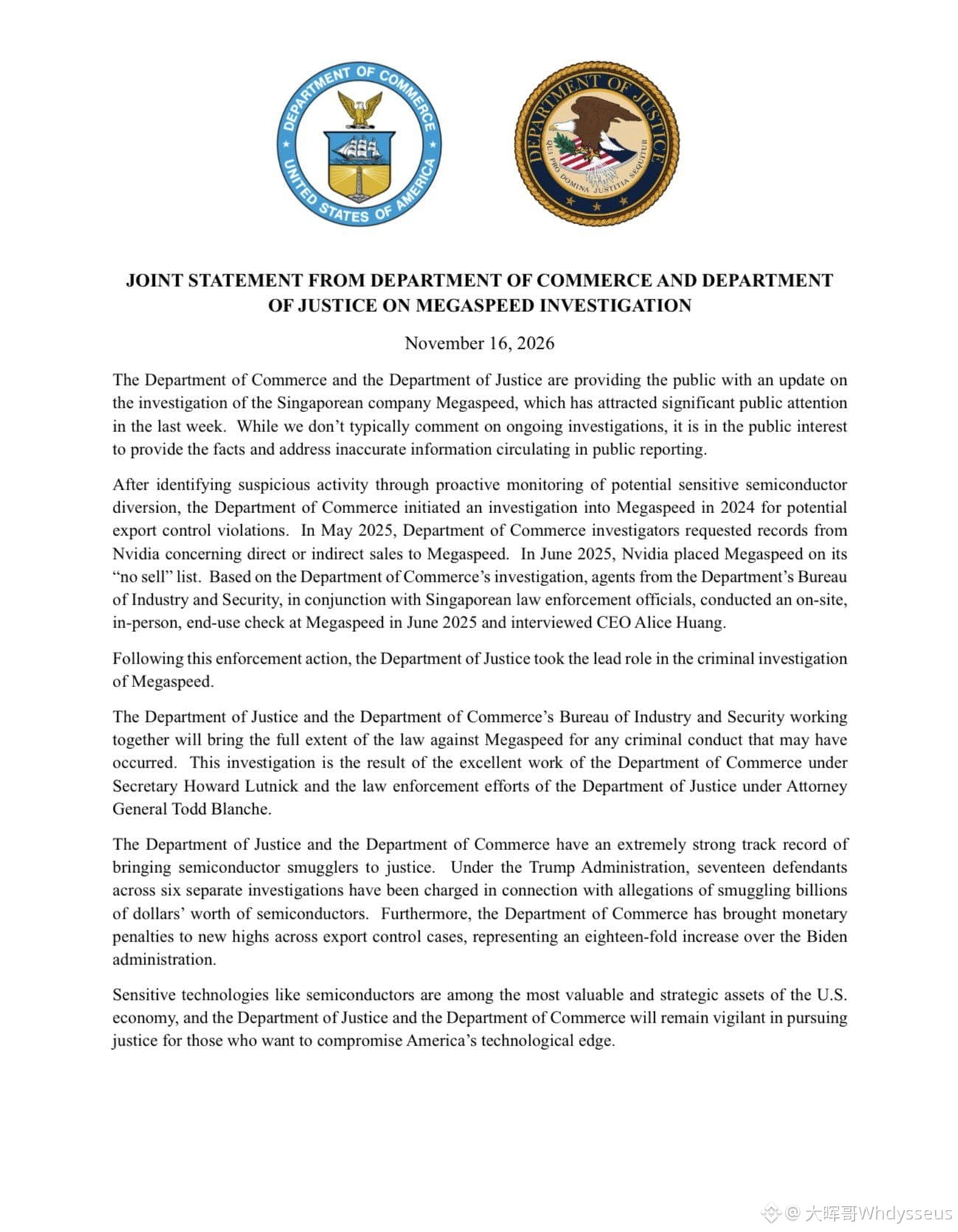
On November 16, the U.S. Departments of Commerce and Justice issued a rare joint statement, revealing new details about their investigation into Megaspeed, a Singapore-based GPU computing company.
A few details are worth noting:
1. Legal: The case has escalated from an export control investigation to a criminal investigation.
The U.S. Department of Commerce began investigating Megaspeed in 2024. In May 2025, it asked Nvidia to provide sales records; in June, Nvidia added Megaspeed to its internal no-sale list.
The Department of Justice subsequently took over and led the criminal investigation.
Note that a criminal investigation does not mean a crime has been established. But this is clearly no longer an ordinary commercial compliance dispute.
2. Political: A subtle power struggle between Bessent and Lutnick.
Previously, U.S. Treasury Secretary Bessent publicly questioned why the Department of Commerce had taken so long to put Megaspeed on a trade blacklist.
Now, the Departments of Commerce and Justice have issued a joint statement, laying out a detailed timeline of the investigation and stressing that it proceeded under Commerce Secretary Lutnick's leadership.
Interestingly, the two accounts are not entirely contradictory: investigating a company does not mean putting it on a blacklist.
But who knew what, and when? Who took action? Who did not?
The debate within Washington over regulatory responsibility is probably far from over.
3. Industry: The Southeast Asian GPU arbitrage business may have to rethink its numbers.
In the past, the GPU business revolved around price, distribution channel, and supply-and-demand differences between China and the U.S.
The U.S. is now paying attention not only to who buys chips and where they are shipped, but increasingly to who ultimately uses them—and who ultimately receives the computing power supplied by data centers overseas.
This could have far-reaching effects on B300 and H200 traders, Southeast Asian data centers, and GPU rental platforms.
In the past, the most important thing in GPU arbitrage was finding the inventory. Going forward, it may be proving who the inventory ultimately serves.
On the surface, the Megaspeed case is an export control investigation. Behind it, however, are disagreements over regulatory oversight among U.S. government agencies, as well as changing rules for the global AI computing business.
On one side is a power struggle in Washington; on the other, a GPU supply chain worth tens of billions of dollars.
What may truly matter is not the fate of Megaspeed alone, but who gets to decide where the world's most advanced computing power goes.