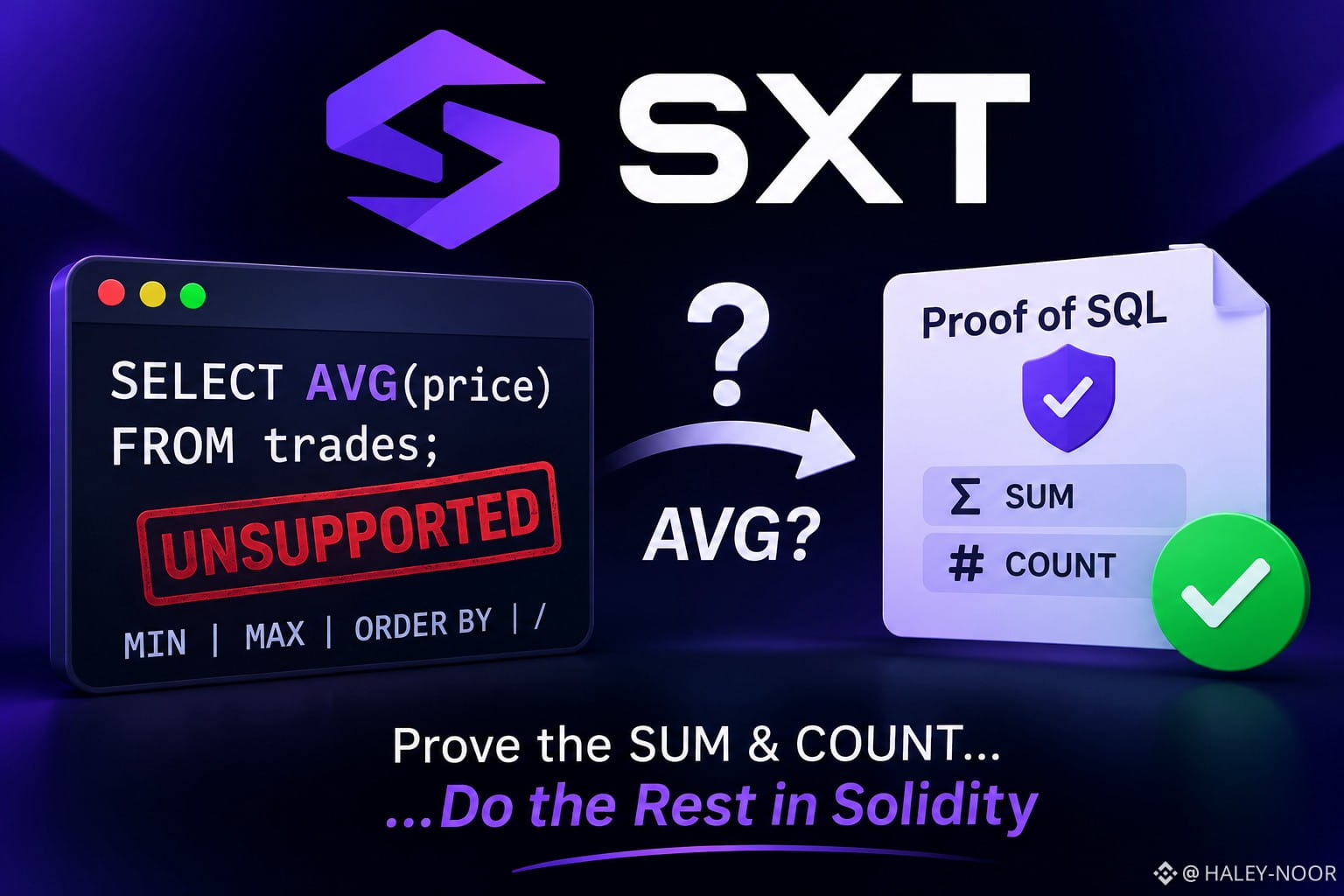

Scrolling through the SXT SQL syntax reference, one row stopped me: AVG is marked as unsupported.
It changed how I read Proof of SQL. The reference also lists MIN, MAX, ORDER BY and division as unsupported, and says the EVM verifier only validates one equality join key. Yet averages, like volume-weighted prices, are exactly what data-driven contracts would ask for. My interpretation, not the team's claim: the contract asks for a proven SUM and COUNT, then does the last step itself. So part of the question lives outside the proof.
Hypothetical: a lending contract wants a borrower's average repayment. It gets a proven sum and count, divides in Solidity. The proof verifies. If the filter or rounding was wrong, it still verifies.
The Nov 9 enterprise launch shows the same boundary. Coverage says it proves the computation was correct but doesn't guarantee the source data is authentic, and the enterprise product can run in a company's own environment, so it doesn't automatically create SXT token demand.
I'm not calling that a flaw. Every verifier has an edge. But I'd like to know who audits the step where intent becomes provable SQL. The SXT docs also describe the proof planner as centralized, and I'd want that explained.
Strong cryptography, narrower edges than the headlines. Still watching SXT.
#sxt $SXT @SpaceandTime
It changed how I read Proof of SQL. The reference also lists MIN, MAX, ORDER BY and division as unsupported, and says the EVM verifier only validates one equality join key. Yet averages, like volume-weighted prices, are exactly what data-driven contracts would ask for. My interpretation, not the team's claim: the contract asks for a proven SUM and COUNT, then does the last step itself. So part of the question lives outside the proof.
Hypothetical: a lending contract wants a borrower's average repayment. It gets a proven sum and count, divides in Solidity. The proof verifies. If the filter or rounding was wrong, it still verifies.
The Nov 9 enterprise launch shows the same boundary. Coverage says it proves the computation was correct but doesn't guarantee the source data is authentic, and the enterprise product can run in a company's own environment, so it doesn't automatically create SXT token demand.
I'm not calling that a flaw. Every verifier has an edge. But I'd like to know who audits the step where intent becomes provable SQL. The SXT docs also describe the proof planner as centralized, and I'd want that explained.
Strong cryptography, narrower edges than the headlines. Still watching SXT.
#sxt $SXT @SpaceandTime