

Goldman Sachs confirms there will be a large oil surplus in 2027, although Europe will face fuel shortages as its refineries undergo maintenance
Goldman Sachs recommends betting that gasoline prices in Europe will rise in 2027
European refineries are facing a backlog of deferred maintenance work
The refining industry is prioritizing diesel production over gasoline
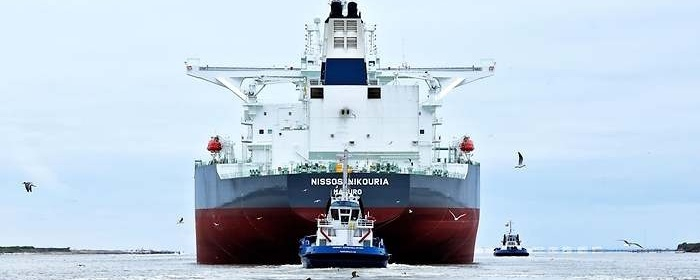
The oil tanker Nissos Nikoria, Majuro, is maneuvering in a canal.
From Commerzbank to ING and the International Energy Agency (IEA), and now Goldman Sachs. Practically all major banks and organizations expect the oil market to see a significant surplus in 2027. This means that more oil will be produced each day than is consumed, allowing inventories to be rebuilt and oil prices to fall. That is how clearly all these organizations put it: they see crude prices at between $75 and $85 by the end of 2027, compared with the $95 at which global benchmark Brent crude is trading today. However, these forecasts also contain a recurring warning. There will be a surplus of oil, but the outlook for diesel and gasoline (and other fuels) is more uncertain. Global refining capacity has been weakened by temporary factors (attacks on refineries), but growth in this industry was already expected to be limited in 2027, even before the armed conflicts (few were willing to invest in a sector tied to a ‘dirty’ energy source such as crude oil). This will coincide with essential maintenance work at many European refineries, which have been operating at full capacity without a break for months to keep the Old Continent supplied. This trend is unsustainable.
As for oil, the price of global benchmark Brent crude fell around 2% on Monday to $93.7 a barrel. This decline is due in part to market expectations of a supply glut that has already begun to become visible in spot markets (where already-extracted crude oil is traded). Although fuel prices may not reflect this correction in the same way, the oil market is seeing a relatively sharp price drop, especially considering that Brent was trading at $118 a barrel just a few weeks ago.
Nevertheless, Goldman Sachs experts say the world is preparing to move from a historic oil shortage to a significant crude oil glut, but this does not guarantee that gasoline and diesel prices will return to their levels before the outbreak of the war in Iran. What is more, Europe faces a particular problem that could keep fuel prices high for much of 2027. Western refineries, which have been working flat out for months to make up for lost production in the Middle East and Russia, have been postponing maintenance at their facilities. Now these refineries will have to go into the 'workshop' at a time when the fuel market remains extremely vulnerable.
Goldman Sachs economists, led by Daan Struyven, have just published their forecasts for the oil market in 2027. The US bank estimates that global oil production will exceed final demand by around two million barrels a day next year, even allowing for possible supply disruptions of one million barrels a day. The IEA, for its part, said there would be a surplus of 3.8 million barrels a day in 2027, an even more 'optimistic' forecast from the perspective of producer countries. Although these predictions should be taken into account (they are almost always in line with what ultimately happens), they should be treated with caution in the current geopolitical climate and context. In fact, for 2026, the initial forecast was for a historic oil surplus, whereas reality has been quite the opposite following the outbreak of the war in Iran, an event that was not easy to foresee.
There is too much oil and not enough refineries
Goldman is now betting on a new glut, but with important caveats in the fuel market. In the crude oil market, the recovery in production by Persian Gulf countries and China's structurally weak demand will be key to creating this surplus, which will bring Brent to $78 a barrel by the end of 2027, compared with around $96 currently. Goldman Sachs' bearish scenario even allows for crude to fall below $60, while its bullish one puts it at $104.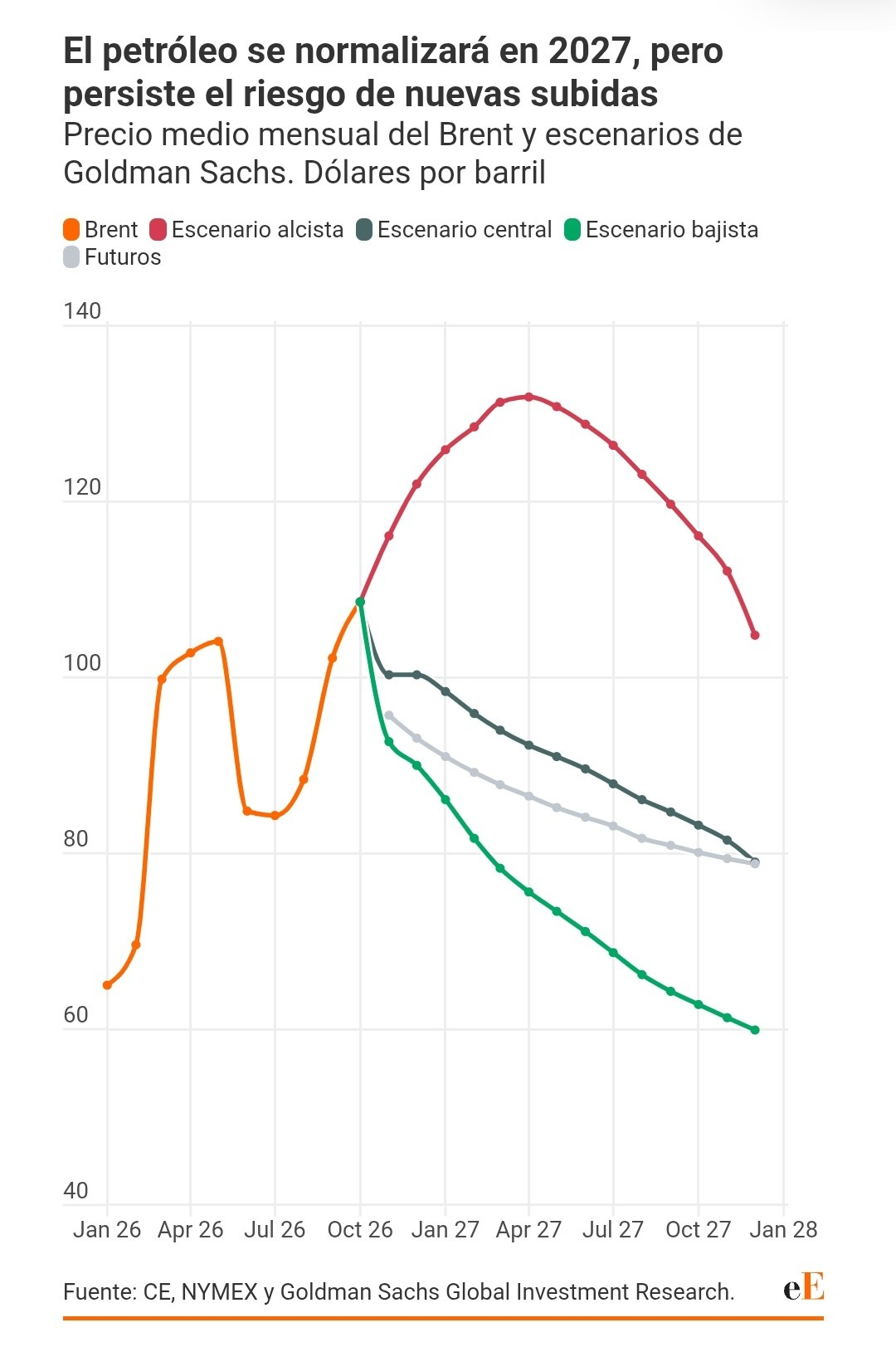
However, Goldman Sachs experts are issuing a warning that may be especially relevant to European consumers: "While we expect crude oil prices to normalize, we expect refined product prices to gradually decline, but remain well above their seasonal averages, given the greater structural tightness in the refining market and the double blow caused by reduced refinery activity in the Middle East and Russia." In Europe, they also face a wave of refinery maintenance operations that will take place during the first half of 2027.
Oil is flowing freely again. Global crude oil exports are now 12% above their average 2025 levels, while exports of refined products remain 6% lower. Much of what is happening with fuel is related to the Persian Gulf, where fuel exports are still 60% below last year's levels. Damage to Middle Eastern refineries, difficulties transporting flammable products through waters where attacks on ships have become a recurring threat, and the greater complexity of transferring fuel between vessels are all making it harder for these flows to recover.
"Adjusting supply to the Middle East shock is more complicated and costly for refined products than for crude oil," the bank's economists conclude. Producer countries are managing to get more and more oil out of the Middle East, but they are finding it much harder to do the same with gasoline, diesel, or kerosene.
Refineries can't keep up
This situation has forced refineries not directly affected by the war to increase activity and, in many cases, postpone maintenance that had been scheduled for this year. These facilities are taking advantage of extraordinarily high refining margins (the difference between the price of the fuel they sell and the price of the crude oil they buy) to produce as much fuel as possible.
However, refinery maintenance cannot be postponed indefinitely. "Deferred refinery maintenance imposes implicit costs on refiners through greater maintenance needs in the future and a higher risk of unplanned outages," Goldman Sachs experts warn. According to the bank's calculations, maintenance scheduled for this autumn has affected two million fewer barrels a day of refining capacity than is typical. The problem is that some of this maintenance has been pushed into 2027, when the fuel market may still be far from having returned to normal.
The schedule for European refineries
Next April is shaping up to be one of the most challenging periods for the fuel market. Goldman Sachs reports that refinery maintenance scheduled worldwide for that month already exceeds typical levels for that time of year by one million barrels a day of affected capacity. "Heavy maintenance will likely weigh on refined product supply during the first half of 2027, when Middle Eastern refineries may still be operating below capacity," the bank's economists say.
This situation is especially concerning for Europe, which has already lost some of its refining capacity in recent years and relies on imports to meet part of its diesel needs. This is compounded by the lack of new refining capacity worldwide, which will increase by just 400,000 barrels a day net in 2027 and a further 300,000 in 2028—insufficient figures to offset the loss of fuel production in Russia if global demand returns to its pre-war trend.
Gasoline could rise much further
In addition, Goldman analysts insist (they have warned about this before) that diesel problems could eventually spread to the gasoline market, a fuel that has so far been less affected by the energy crisis. The high margins refineries are earning from producing diesel and kerosene are incentivizing these facilities to adjust their production mix, within their technical capabilities, to produce more of these fuels at the expense of gasoline. This situation, combined with maintenance scheduled for the spring, could create tensions in the European gasoline market just before summer, when millions of people get in their cars to go on vacation.
In fact, Goldman Sachs recommends that investors take bullish positions in European gasoline for the summer of 2027 as a hedge against a possible geopolitical escalation. These positions could benefit from "lower gasoline production as a result of new attacks on refineries, heavy maintenance scheduled for spring 2027, and refineries shifting production from gasoline to diesel and kerosene."
Goldman Sachs' forecasts give an idea of just how much longer the fuel crisis could last than the oil crisis. Even if oil prices fall considerably over the coming months, a significant part of that reduction could be offset by the high cost of turning crude oil into fuel and the problems that continue to affect its transportation.
#GoldManSachs #Europe #Asia #OrienteMedio #petróleo $GS $BZ $CL