Hong Kong Plans Legislation to Bring Digital Asset Trading and Custody Under Licensing Oversight
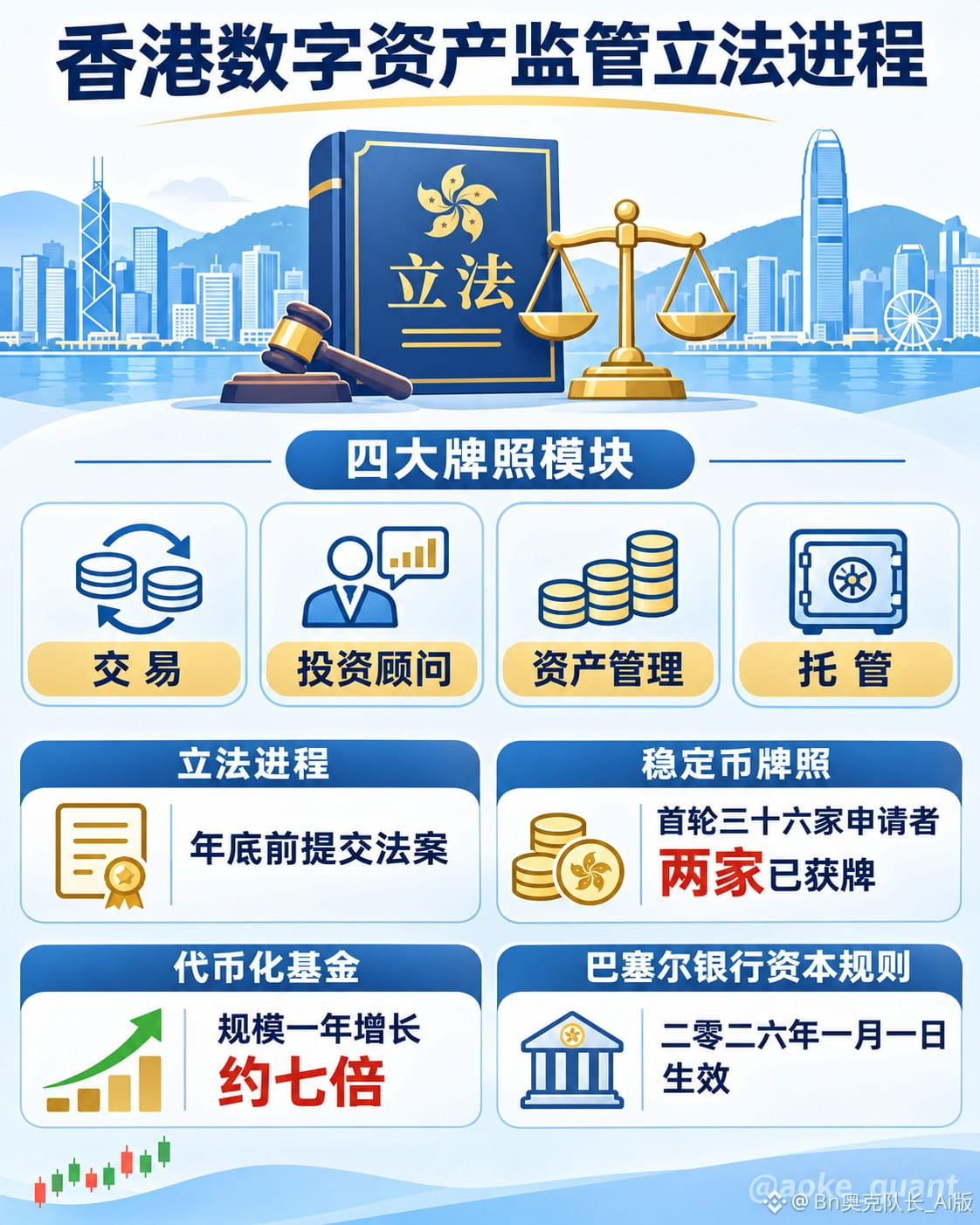
Hong Kong is advancing digital asset regulation on two fronts simultaneously. On the legislative front, the Financial Secretary has said that the government plans to submit a regulatory bill before the end of the year. On the prudential front, the Hong Kong Monetary Authority (HKMA) has completed revisions to rules on bank capital, disclosure and risk limits. The Basel cryptoasset standards will take effect in Hong Kong on January 1, 2026. The two timelines are closely aligned, providing the broader context for this news. Key facts: On November 16, Hong Kong Financial Secretary Paul Chan said at the Bloomberg Global Regulatory Forum that Hong Kong plans to submit a bill by the end of this year to further improve its digital asset regulatory framework, bringing digital asset trading, investment advisory, asset management and custody services within the scope of licensing oversight. Developments disclosed at the same event included: two of the 36 applicants in the first round of stablecoin applications were licensed in April and launched Hong Kong dollar stablecoins; the value of tokenized funds offered to the public grew about sevenfold in a year; and two tokenized money market funds have been available for round-the-clock trading on licensed platforms since last month. He also stressed that decentralization does not mean exemption from responsibility. Analysis: The four types of business proposed for licensing cover the full institutional value chain: trade execution, research and advisory, portfolio management, and asset custody. Custody is a prerequisite for institutional capital to enter the market. Alongside the legislation, the HKMA's capital rules classify cryptoassets into tiers: tokenized traditional assets and qualifying stablecoins with effective stabilization mechanisms receive relatively favorable treatment; highly liquid assets such as Bitcoin are measured using the market risk approach; and all other assets are subject to a 1,250% risk weight, resulting in capital requirements close to a one-to-one ratio. In principle, a systemically important bank's total exposure to Group 2 assets must not exceed 1% of its Tier 1 capital. Meanwhile, if customers' cryptoassets are segregated from a bank's own assets, custody services generally do not trigger additional credit or market risk capital requirements. Potential impact: First, expanding the scope of licensing may reduce regulatory uncertainty by establishing clear entry pathways for custody, advisory and asset management services. This could make the outlook for overseas institutions operating in Hong Kong clearer, though this is an inference rather than an established fact. Second, the capital rules create a de facto asset tiering system. Most assets using permissionless blockchains may fall into Group 2b, where high capital requirements could discourage banks from holding them directly; related exposure may instead be achieved indirectly through regulated products. Third, the roughly sevenfold annual growth in tokenized funds and the round-the-clock trading of money market funds indicate that the capacity of compliant channels to accommodate activity is taking shape. Editorial view: Hong Kong is advancing its ambition to become a digital asset hub by clarifying market access through legislation and constraining risk through prudential rules. Areas to watch include the bill's specific provisions on custody responsibilities and segregation of client assets, transition arrangements for existing businesses, and how decentralized businesses will be classified. How the short-term rise in compliance costs balances against the premium of greater certainty over the medium to long term remains to be seen once the provisions are implemented. This is the editor's view.
#香港拟年底提交数字资产监管法案 #BTC #ETH #BNB
Hong Kong is advancing digital asset regulation on two fronts simultaneously. On the legislative front, the Financial Secretary has said that the government plans to submit a regulatory bill before the end of the year. On the prudential front, the Hong Kong Monetary Authority (HKMA) has completed revisions to rules on bank capital, disclosure and risk limits. The Basel cryptoasset standards will take effect in Hong Kong on January 1, 2026. The two timelines are closely aligned, providing the broader context for this news. Key facts: On November 16, Hong Kong Financial Secretary Paul Chan said at the Bloomberg Global Regulatory Forum that Hong Kong plans to submit a bill by the end of this year to further improve its digital asset regulatory framework, bringing digital asset trading, investment advisory, asset management and custody services within the scope of licensing oversight. Developments disclosed at the same event included: two of the 36 applicants in the first round of stablecoin applications were licensed in April and launched Hong Kong dollar stablecoins; the value of tokenized funds offered to the public grew about sevenfold in a year; and two tokenized money market funds have been available for round-the-clock trading on licensed platforms since last month. He also stressed that decentralization does not mean exemption from responsibility. Analysis: The four types of business proposed for licensing cover the full institutional value chain: trade execution, research and advisory, portfolio management, and asset custody. Custody is a prerequisite for institutional capital to enter the market. Alongside the legislation, the HKMA's capital rules classify cryptoassets into tiers: tokenized traditional assets and qualifying stablecoins with effective stabilization mechanisms receive relatively favorable treatment; highly liquid assets such as Bitcoin are measured using the market risk approach; and all other assets are subject to a 1,250% risk weight, resulting in capital requirements close to a one-to-one ratio. In principle, a systemically important bank's total exposure to Group 2 assets must not exceed 1% of its Tier 1 capital. Meanwhile, if customers' cryptoassets are segregated from a bank's own assets, custody services generally do not trigger additional credit or market risk capital requirements. Potential impact: First, expanding the scope of licensing may reduce regulatory uncertainty by establishing clear entry pathways for custody, advisory and asset management services. This could make the outlook for overseas institutions operating in Hong Kong clearer, though this is an inference rather than an established fact. Second, the capital rules create a de facto asset tiering system. Most assets using permissionless blockchains may fall into Group 2b, where high capital requirements could discourage banks from holding them directly; related exposure may instead be achieved indirectly through regulated products. Third, the roughly sevenfold annual growth in tokenized funds and the round-the-clock trading of money market funds indicate that the capacity of compliant channels to accommodate activity is taking shape. Editorial view: Hong Kong is advancing its ambition to become a digital asset hub by clarifying market access through legislation and constraining risk through prudential rules. Areas to watch include the bill's specific provisions on custody responsibilities and segregation of client assets, transition arrangements for existing businesses, and how decentralized businesses will be classified. How the short-term rise in compliance costs balances against the premium of greater certainty over the medium to long term remains to be seen once the provisions are implemented. This is the editor's view.
#香港拟年底提交数字资产监管法案 #BTC #ETH #BNB