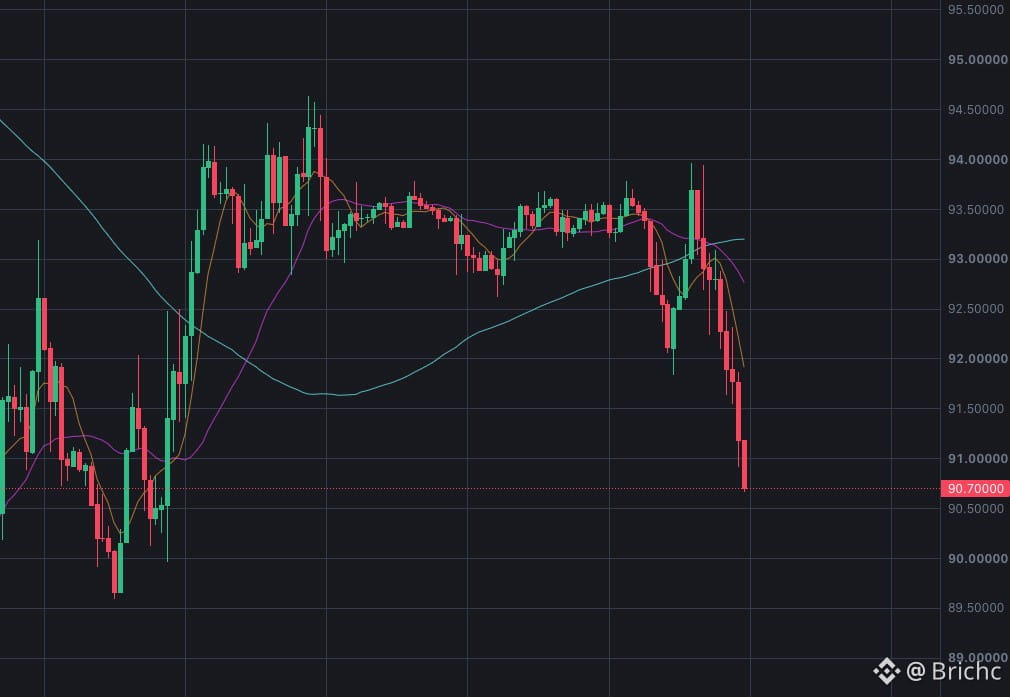
【Crude oil losses deepen as market shifts from supply disruption fears to oversupply concerns】
The biggest change behind this latest pullback in crude oil is the market’s shifting expectations for supply and demand. On November 16, WTI $CL and Brent $BZ both weakened, reflecting more than just short-term profit-taking. The conflict in the Middle East had previously raised fears that shipping through the Strait of Hormuz would be disrupted. Now, as crude exports from the Gulf region gradually recover, the premium driven by supply disruptions is beginning to fade.
The International Energy Agency’s (IEA) November 13 report gave the market a more direct reason to bet on falling prices: it expects global crude oil supply to reach 105 million barrels per day in the fourth quarter, exceeding demand by 1.7 million barrels per day and returning the market to a surplus. Saudi Arabia’s daily crude production also rose to 10.56 million barrels in October, while China’s refinery throughput fell 8.1% year over year that month. Supply recovery and weakening demand are occurring at the same time.
The IEA expects the global supply surplus could widen further by 2027. Although risks to shipping through the Strait of Hormuz and the situation in Iran remain, the market has begun pricing in a recovery in supply rather than simply paying for the risk of war.
In the short term, the biggest pressure on crude oil has shifted from geopolitical risks to supply-and-demand fundamentals. As long as exports from the Middle East continue to recover, it will be difficult for oil prices to regain the risk premium they previously enjoyed. However, the next phase of the market’s direction will ultimately depend on whether the supply recovery can be sustained and whether global demand deteriorates further.
The biggest change behind this latest pullback in crude oil is the market’s shifting expectations for supply and demand. On November 16, WTI $CL and Brent $BZ both weakened, reflecting more than just short-term profit-taking. The conflict in the Middle East had previously raised fears that shipping through the Strait of Hormuz would be disrupted. Now, as crude exports from the Gulf region gradually recover, the premium driven by supply disruptions is beginning to fade.
The International Energy Agency’s (IEA) November 13 report gave the market a more direct reason to bet on falling prices: it expects global crude oil supply to reach 105 million barrels per day in the fourth quarter, exceeding demand by 1.7 million barrels per day and returning the market to a surplus. Saudi Arabia’s daily crude production also rose to 10.56 million barrels in October, while China’s refinery throughput fell 8.1% year over year that month. Supply recovery and weakening demand are occurring at the same time.
The IEA expects the global supply surplus could widen further by 2027. Although risks to shipping through the Strait of Hormuz and the situation in Iran remain, the market has begun pricing in a recovery in supply rather than simply paying for the risk of war.
In the short term, the biggest pressure on crude oil has shifted from geopolitical risks to supply-and-demand fundamentals. As long as exports from the Middle East continue to recover, it will be difficult for oil prices to regain the risk premium they previously enjoyed. However, the next phase of the market’s direction will ultimately depend on whether the supply recovery can be sustained and whether global demand deteriorates further.