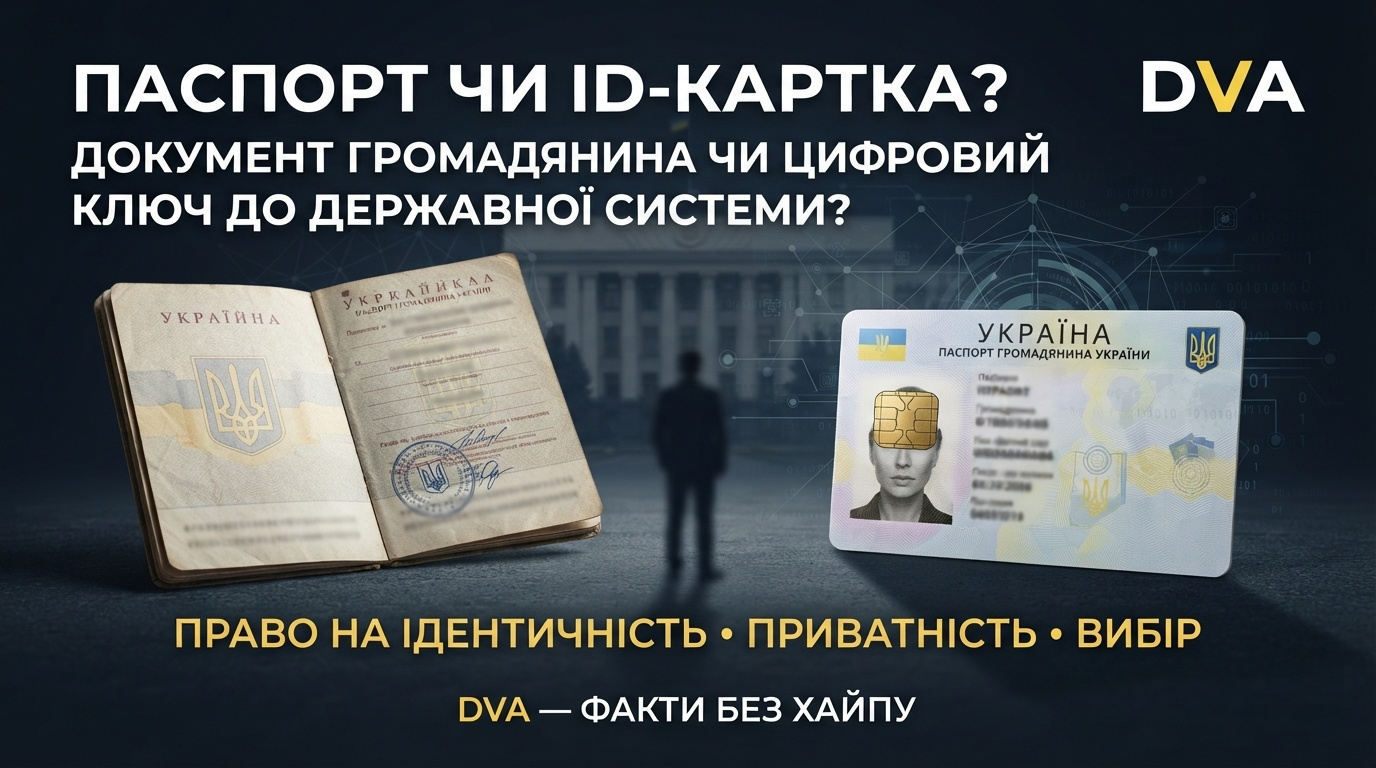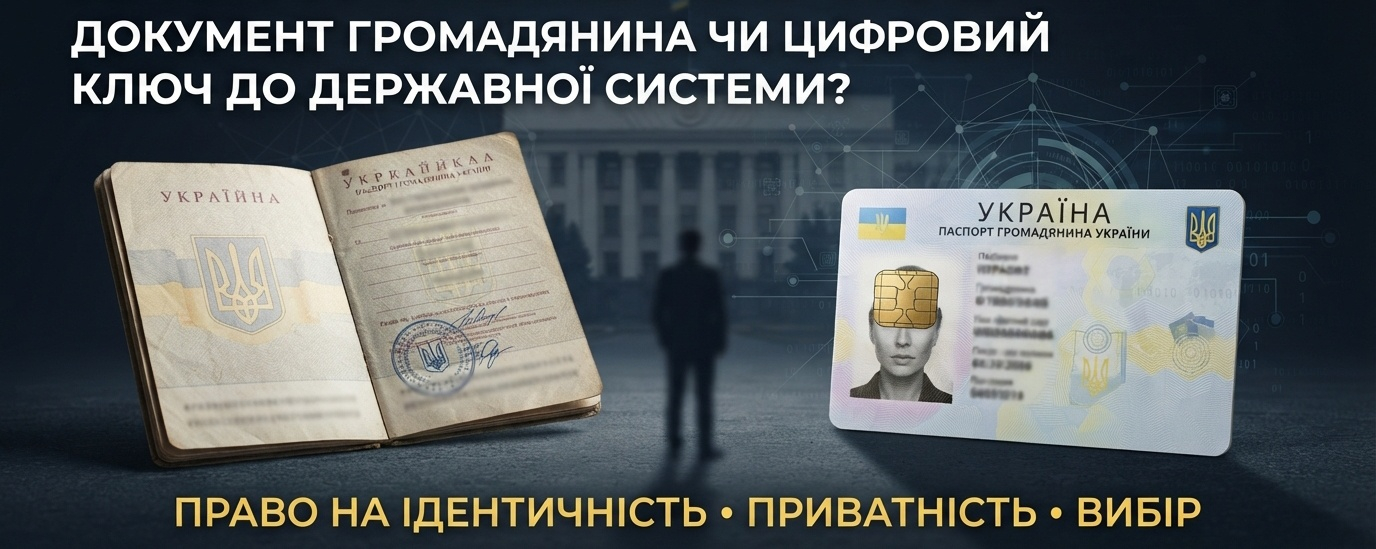

Passport or ID card: a citizen’s document or a digital key to the state system?
DVA — facts without hype
FACT • LAW • DIGITALIZATION • PRIVACY • DECISIONS
“An ID card is proof of identity, while a passport is a passport of a country’s citizen.” This is how the difference between the documents is often explained. There is some logic to this position, but Ukrainian law uses different terminology. And behind it lies a much more interesting question: does a citizen have the right to choose how the state certifies their identity?
1. The name of a document is not the whole story
In Ukraine, the ID card is officially called a passport of a citizen of Ukraine. Under Article 21 of Law No. 5492-VI, a passport of a citizen of Ukraine is a document that identifies a person and confirms their citizenship of Ukraine.
The 1994-model passport booklet served the same legal purpose. In other words, under the law, these are not two documents with fundamentally different statuses, but two forms of the internal passport of a citizen of Ukraine.
However, the format matters. A booklet is a paper document with printed pages and information. An ID card is a plastic document with a contactless electronic chip, linked to the state’s digital infrastructure.
And this raises a fundamental question: is the transition from a paper document to an electronic one merely a technical upgrade, or does it change the very model of interaction between citizens and the state?
2. Passport booklet: a physical document without an electronic chip
The 1994-model passport had an important practical feature: the key identifying information was printed directly on its pages. Presenting the document did not require reading an electronic chip or accessing a government digital service.
But this did not mean complete independence from government record-keeping. Information about citizens, document issuance, and registration actions was also processed by government agencies and record-keeping systems.
Thus, the booklet was not a document outside government registries. Its main difference lay elsewhere: the physical document itself did not contain a contactless electronic chip.
For the holder, this meant being able to prove their identity using the original paper document without having to use a smartphone, NFC, or a digital app.
3. ID card: a passport and an element of digital infrastructure
An ID card contains a contactless electronic chip and is linked to the Unified State Demographic Register.
This enables the state to use digital identification mechanisms, while citizens can access electronic services.
The advantages are clear: modern anti-forgery features, automated data verification, convenient electronic interactions, and the ability to use digital documents in Diia.
But digitalization also has another side.
The physical document remains with its holder, but some processes for checking and using it depend on electronic systems, the accuracy of registry entries, technical infrastructure, and the availability of the relevant services.
This does not mean that an ID card is dangerous or that government registries will necessarily be used unlawfully. However, it does mean that the protection of personal data, cybersecurity, access to information, and oversight of its use become especially important.
4. Why the American model is not quite the same as the Ukrainian one
A comparison with the United States helps clarify the difference, but requires some qualification.
The United States has a passport book, a passport card, as well as state-issued ID cards and driver’s licenses.
A passport book allows international travel by air, sea, and land. A passport card confirms identity and U.S. citizenship, but has a limited purpose: it can be used for certain international land and sea trips, including to Canada and Mexico. It is not valid for international air travel.
A State ID, meanwhile, is an identity document issued at the state level. It is not a U.S. passport and does not, by itself, prove citizenship.
The American model therefore does demonstrate an important distinction: passport documents and domestic identity documents serve different functions.
In Ukraine, by contrast, an ID card legally remains a passport of a citizen of Ukraine, even though its format and manner of use resemble those of a plastic identity card.
5. The most important question: is there a right to an alternative?
This is not merely a theoretical debate.
On September 19, 2018, the Grand Chamber of the Supreme Court issued a ruling in exemplary case No. 806/3265/17. The Court found that the migration service had acted unlawfully by refusing to issue a passport booklet to a citizen because she did not consent to the processing of her personal data in the proposed ID card format.
In its ruling, the Grand Chamber drew attention to the disproportionate interference with private life and the need to respect human rights.
This is an important legal precedent. It shows that the form of a passport is connected not only with convenience, but also with the right to privacy and freedom of belief.
The practice did not remain merely a story from 2018. On September 18, 2026, the Supreme Court reported on a decision by the Rivne District Administrative Court, which ordered the migration service to issue a passport booklet to a 16-year-old girl who refused an ID card on religious grounds.
At the same time, it is important to understand that this does not mean every citizen can simply go to the State Migration Service and demand a passport booklet without following additional procedures. In practice, obtaining such a document may still require legal protection through the courts.
6. Is a digital passport a complete replacement for a physical one?
The Diia app allows people to use digital passport documents in many everyday situations. Digital documents have legal force in cases specified by law.
However, there is a technical peculiarity: the 1994-model passport booklet does not appear in Diia because its information is stored in card files, not in the digital format of registry data used to create an electronic document.
This creates unequal access to digital services depending on the form of the document.
It is also important not to confuse an internal passport with an international passport. For international travel, Ukraine uses a separate passport for travel abroad. An internal passport—whether a booklet or an ID card—is not a universal document for international travel.
7. The main problem is not plastic, but the limits of state control
The state has a legitimate interest in reliably identifying citizens, combating fraud, protecting documents from forgery, and developing electronic services.
Citizens, in turn, have the right to expect that their personal data will be protected, processed lawfully, and used only for a specified purpose.
Therefore, the issue should not be reduced to a conflict between “old paper” and “new plastic.”
The true measure of a digital state is not the number of electronic services, but the quality of the safeguards it provides for people.
Can a citizen obtain a document without an electronic chip? Do they have a genuine choice? Is there an accessible procedure for correcting errors in the registries? Can a person prove their identity when a digital service is unavailable? Who is responsible for a data breach or the unlawful use of personal data?
This is not a question of rejecting progress. It is about ensuring that progress does not turn into mandatory dependence on a single technological system.
DVA’s conclusion
It is possible to support digitalization while also defending the right to a paper document. It is possible to use Diia and demand proper protection of personal data. It is possible to recognize the advantages of an ID card without agreeing that it should be the only acceptable format for every citizen.
Perhaps the main loss for some people is not that they exchanged their booklet for a plastic card, but that, with the transition to the new system, they felt their freedom of choice diminish.
The state must have tools to identify citizens. But citizens should not lose their right to privacy, dignity, and a genuine alternative.
DVA — Preserving values and time.
FACT • VERIFICATION • DECISION
Not legal advice. Preserving values and time.