

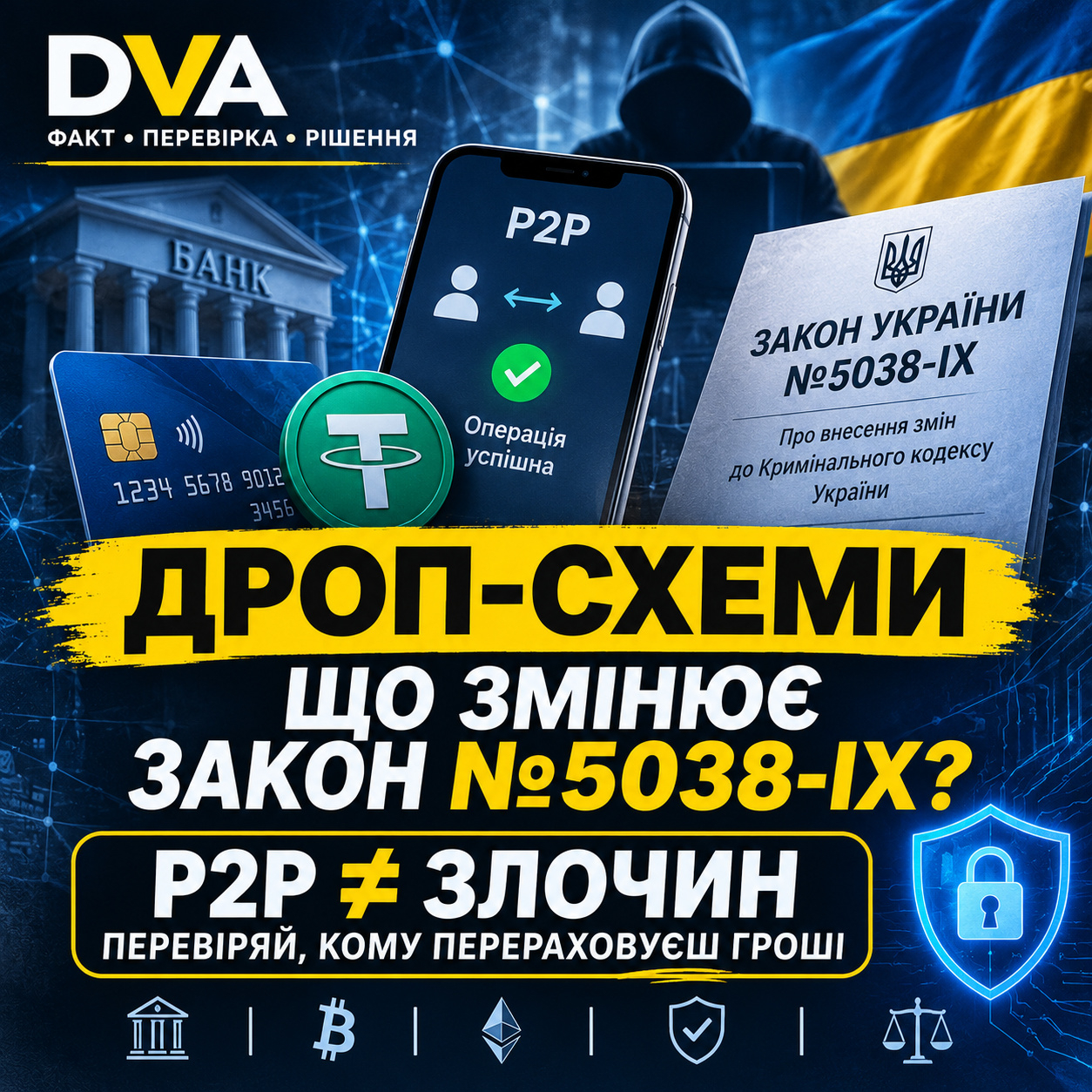
🚨 Drop schemes: what Law No. 5038-IX actually changes and what P2P/USDT has to do with it
Ukraine has tightened criminal liability for illegal transactions involving payment instruments and account access. Initiative No. 16013 became Law No. 5038-IX.
But it’s important not to panic or oversimplify.
What is prohibited?
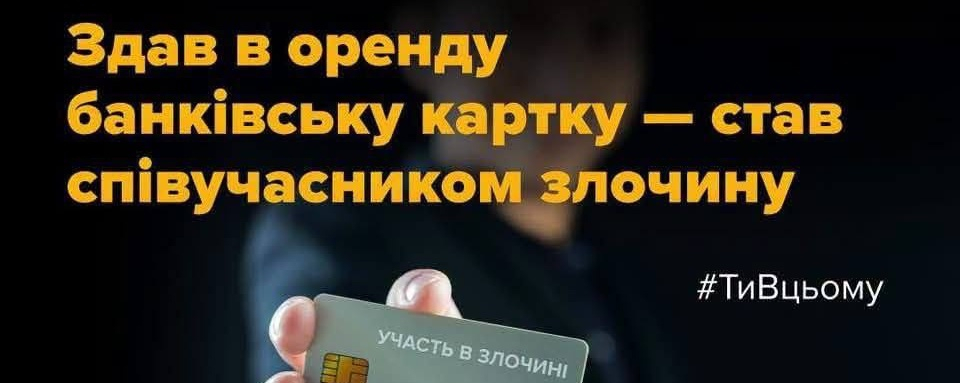
Not the transfer of a card itself, but the transfer/acquisition/possession of payment instruments, credentials, or account access for the purpose of committing fraud or another criminal offense.
Penalties:
· transferring your own instrument for an unlawful purpose — a fine of UAH 5,100–17,000;
· actions involving someone else’s payment instruments — a fine of UAH 51,000–85,000, restriction of liberty for up to 3 years, or imprisonment for 2–4 years;
· repeatedly or as part of an organized group — a fine of UAH 85,000–170,000 or imprisonment for 4–6 years.
Does this apply to Wise/Revolut?
If it’s a payment instrument/account/wallet and it’s transferred for a fraudulent purpose, the service’s foreign name offers no protection. But the claim that “all Wise/Revolut services are banned” is simply false.
What about P2P and USDT?
P2P cryptocurrency exchange itself is not prohibited. The risk arises when:
· payment comes from a third party;
· someone else’s cards/accounts are used;
· the counterparty is linked to fraudulent schemes;
· the source of the funds is unclear.
The most dangerous scenario: you sell USDT, but receive hryvnias not from the buyer, but from some “random” person. If their account was involved in fraud, you could face account blocks, checks, and requests to explain the situation to your bank.
Basic precautions:
1. Don’t hand over cards, passwords, codes, or seed phrases.
2. Don’t accept payments from third parties.
3. Keep records of your P2P transactions.
4. Don’t “run” money through your card in exchange for a fee.
5. Don’t use relatives’ accounts to get around limits.
The key point: the law does not ban crypto, P2P, or non-custodial wallets. It targets specific actions involving payment access carried out for an unlawful purpose. But for P2P, this is a warning: checking your counterparty and the source of funds is no longer optional—it’s part of staying safe.
Not financial advice. Not legal advice.
#DVAnews #Ukraine #Cryptocurrency #P2P #USDT #BTC #ETH #aml #DVA