
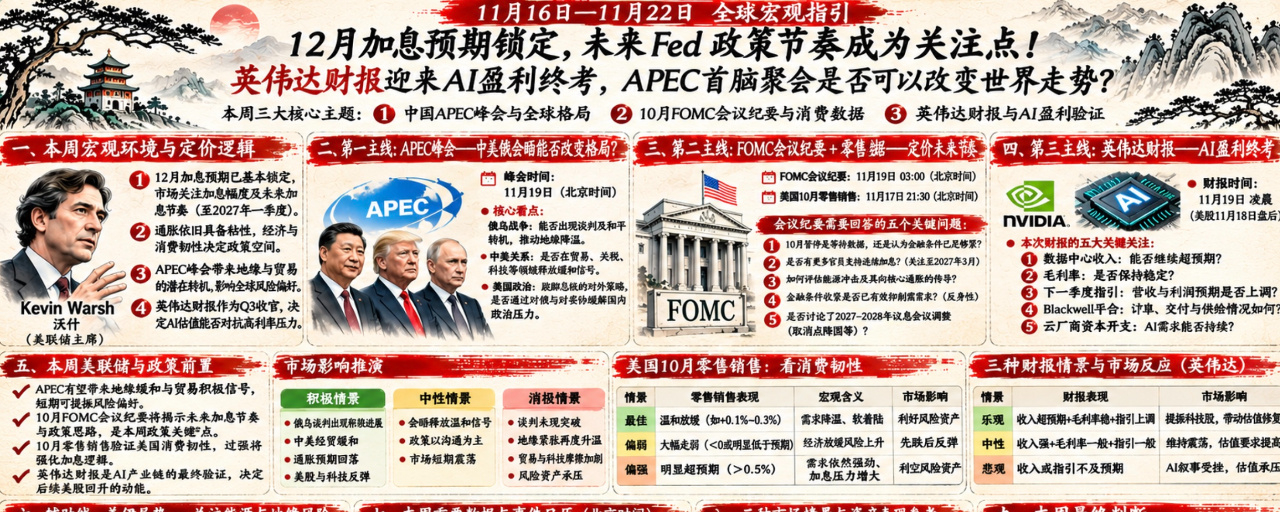

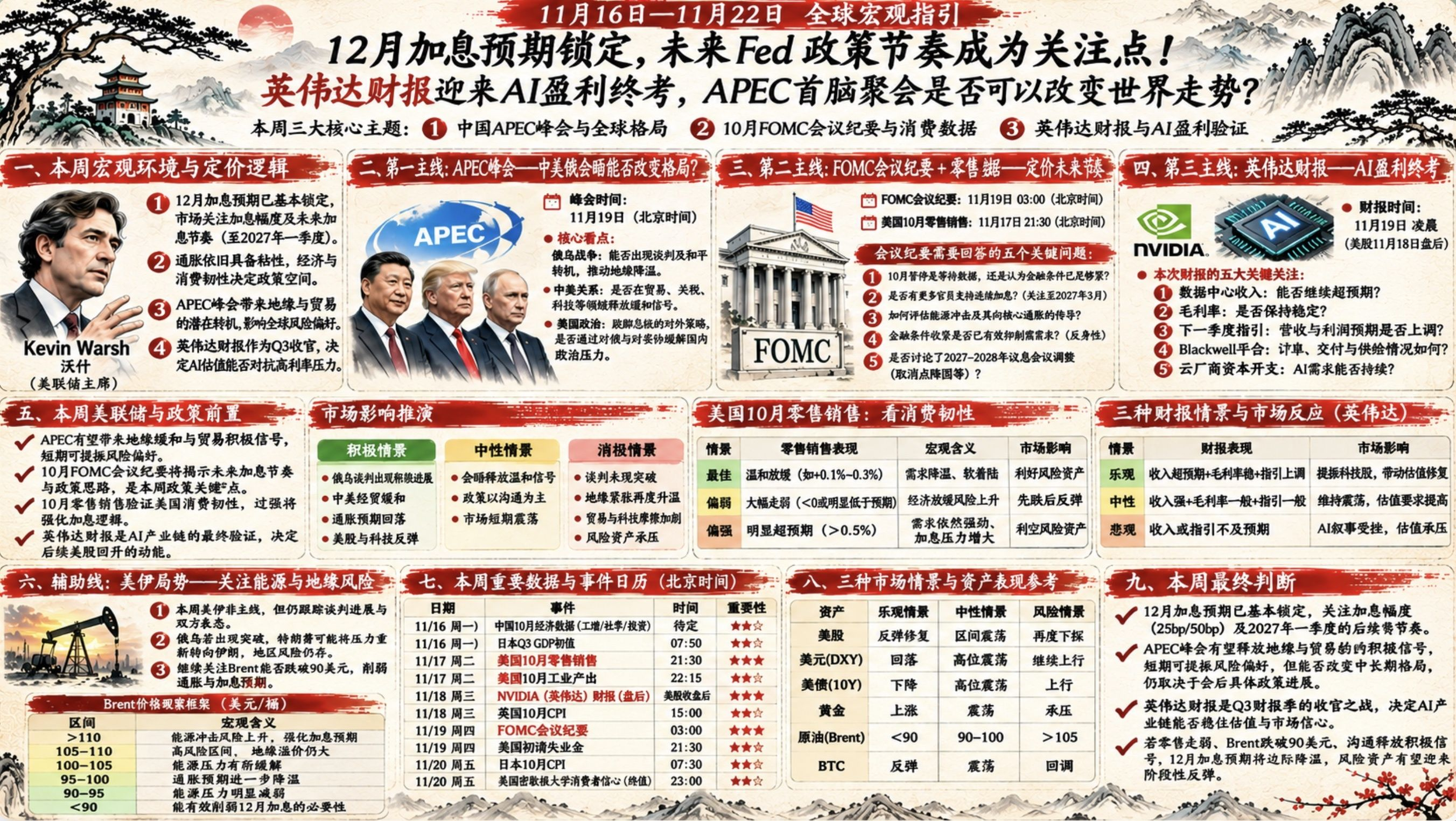
Global macro outlook for November 16–22: Expectations for a December rate hike are locked in, and the pace of future Fed policy is in focus! Nvidia’s earnings report will be the final test of AI profitability. Can the APEC leaders’ gathering change the course of the world!?
This week’s three key themes:
China’s APEC Summit: Can the gathering of three major leaders reshape the global order once again? (Geopolitics, trade and the economy are all in play, with implications for energy, gold and risk assets.)
Macroeconomic pricing: Expectations for a December rate hike are locked in. Minutes from October’s policy meeting will be released this week, and markets will use them, along with recent Fed officials’ remarks, to gauge the pace of future Fed policy! #本周财报与宏观事件密集,市场再迎波动考验
Q3 earnings season wraps up: Nvidia is scheduled to report in the early hours of the 18th this week, bringing this quarter’s earnings season to a close. Overall, the Q3 U.S. earnings season has been quite turbulent. Although industry fundamentals remain healthy, political and interest-rate uncertainty have weighed on valuations, causing a significant correction. As an industry leader, Nvidia’s report will also determine market confidence: can it withstand macroeconomic pressure and reverse the trend?
Next, let’s take a closer look at the three main themes:
Main theme 1 — China’s APEC summit and a meeting between the leaders of China, the U.S., and Russia: could it reshape the world order? November 19, Beijing time.
1. Geopolitical landscape: The biggest hope for this summit is that it could move the Russia–Ukraine war, now in its third year, toward negotiations and peace. This would help stabilize the global economy, trade, and geopolitical situation.
2. U.S.–Iran relations: If there is a major breakthrough toward peace in Russia–Ukraine, the outlook for U.S.–Iran relations may actually worsen. With no Russia–Ukraine conflict to occupy America’s attention, Trump may well redirect pressure toward Iran.
3. A lame-duck president: Having lost both chambers of Congress, Trump will inevitably be a lame duck on policy over the next two years. From the confidence of his early days in office to his current weakened position, the question is whether domestic political pressure will lead him to make concessions abroad—especially by easing sanctions on Russia and relaxing trade hostilities with China—to boost his support at home.
4. From a geopolitical, economic, and trade perspective, a successful trilateral meeting could at least lift stock markets in the short term. Optimism about key policies could provide some confidence to risk markets, especially in China and the U.S. But whether it can reverse the trend will depend on whether the Chinese and U.S. governments announce positive policy signals after the summit.
5. The trajectory of Chinese and U.S. stocks during the summit: a rebound may begin beforehand; watch for optimistic signals that could accelerate it during the summit; then a pullback afterward, followed by markets waiting for clear policy signals to set prices.
Main theme 2 — Macroeconomic pricing: the October FOMC meeting minutes at 3:00 a.m. on November 19 (Beijing time), along with retail sales data!
1. So far, a December rate hike is all but certain. The market is no longer focused on whether rates will be raised in December, but is using additional information to gauge the size of the hike and the pace of rate hikes through March 2027.
2. The October meeting minutes are an important point of reference for policy. At the October rate decision, two governors supported a 50-basis-point hike. The market will therefore look to the minutes to understand Fed officials’ views on inflation and interest rates at the time, then combine them with recent comments from several officials and macroeconomic data to reprice expectations for future policy.
3. The minutes need to address five key questions:
a. Was the October pause intended to wait for more data, or did officials believe financial conditions were already restrictive enough? If most believe conditions are not tight enough, expectations for further rate hikes will inevitably rise.
b. Are more officials in favor of consecutive rate hikes? Bank of America expects three hikes by March 2027, and current data support that view. If the minutes show that more officials favor consecutive hikes, expectations for a series of hikes will strengthen further.
c. How does the Fed assess the energy shock? If the Fed believes the shock has spread to core goods, wages, and service prices, a drop in Brent crude alone may not be enough to change the policy direction.
d. The “reflexivity” of Fed policy: if high long-term yields, widening credit spreads, and falling risk assets have already significantly dampened demand, the marginal need for further Fed rate hikes may decrease.
e. The Fed has adjusted the timing and cadence of its 2027 and 2028 policy meetings. Do the October meeting minutes reflect any discussion of this? That could help gauge whether Waller’s future policy plans can be implemented, particularly proposals to reduce the number of policy meetings and eliminate the dot plot.
4. U.S. October retail sales are due at 9:30 p.m. on November 17 (Beijing time). Retail sales will carry more weight this week. If the data are too strong, it would mean current interest rates are not restraining demand, potentially giving the Fed more room to raise rates. This week, the key figures to watch are headline retail sales, sales excluding autos, the Control Group, and consumers’ real spending power.
A moderate weakening in retail sales would be most favorable for risk assets and rate-hike expectations. An overly strong reading would increase the risk of rate hikes, while an overly weak one would raise recession risks; both of the latter outcomes would be negative for risk assets.
Main theme 3 — Nvidia’s earnings report is a key test for the AI supply chain: can it ease valuation pressure in a high-interest-rate environment?
1. Nvidia will report early Wednesday morning this week, bringing this quarter’s earnings season to a close. Overall, Q3 earnings from U.S. companies show that industry fundamentals remain stable. However, macroeconomic and political uncertainty have disrupted the picture, while rapid corporate capex growth and weak profitability have become the main drivers of valuation adjustments.
2. Nvidia’s earnings report also wraps up the season, and as an industry leader, it is crucial to confidence in the sector. This week, the key figures to watch are data center revenue, demand for the Blackwell platform, gross margin, order fulfillment, next-quarter guidance, and the sustainability of customer capital expenditures.
3. To reiterate, after the Q3 earnings season, the framework for evaluating U.S. companies has shifted to: AI capex growth → order conversion → revenue growth → profit growth → improved free cash flow → validated investment returns. Nvidia’s earnings can show whether computing-power suppliers are making money, but they cannot by themselves prove that all cloud providers buying GPUs are earning satisfactory returns on their AI investments. This distinction is important.
4. Nvidia’s earnings report this week needs to answer five questions for the market:
a. Can data center revenue continue to beat expectations? If revenue growth continues to accelerate, it would indicate that purchases of AI infrastructure remain strong.
b. Can gross margin remain stable? Rapid revenue growth alongside declining gross margins could point to changes in product mix, costs, competition, or customers’ bargaining power.
c. Is next-quarter guidance strong enough? Valuations are based on future growth, so forward guidance has a greater impact on valuation.
d. Are orders and deliveries for the Blackwell platform healthy? Watch whether demand is growing, whether there are supply bottlenecks, and how customer orders translate into recognized revenue.
e. Can cloud providers sustain their capital spending? The earnings reports from several major cloud providers this quarter have already answered this question; Nvidia’s report will provide a second confirmation.
5. Three possible outcomes for Nvidia’s earnings report:
a. Revenue beats expectations + stable gross margins + raised guidance: this would mean demand and profitability are improving simultaneously, helping lift technology stock valuations.
b. Strong revenue + mediocre gross margins + middling guidance: this would mean growth is holding up, but valuation expectations are rising—a less favorable outcome at present.
c. Revenue and guidance both miss expectations: confidence in the narrative of growing AI demand would weaken, leading to a further adjustment in Nvidia’s valuation.
6. Nvidia’s sudden change of CEO has led to a valuation adjustment in advance. Especially after losing the boost from Jensen Huang, an ordinary earnings report may not be enough to reassure the market about its valuation. If there is a possibility that Huang will return, some shortcomings in the earnings report could be overlooked.
Secondary focus — U.S.–Iran relations
U.S.–Iran relations are not a focus this week. Based on last week’s reasoning, Trump is likely to concentrate on resolving the Russia–Ukraine issue at the trilateral leaders’ meeting. If prospects for Russia–Ukraine peace improve, expectations for peace between the U.S. and Iran may worsen. If Trump cannot broker Russia–Ukraine peace talks, however, he may adopt a more conciliatory stance toward Iran.
Overall summary:
This week will be an important test for both U.S. stocks and crypto. Confidence is weak as the market falls, and positioning is becoming less stable. If global tensions, geopolitical risks, and trade uncertainty continue to increase—and the AI narrative encounters another major setback—the result could be disastrous for the market. That said, I still believe the outlook is optimistic!