
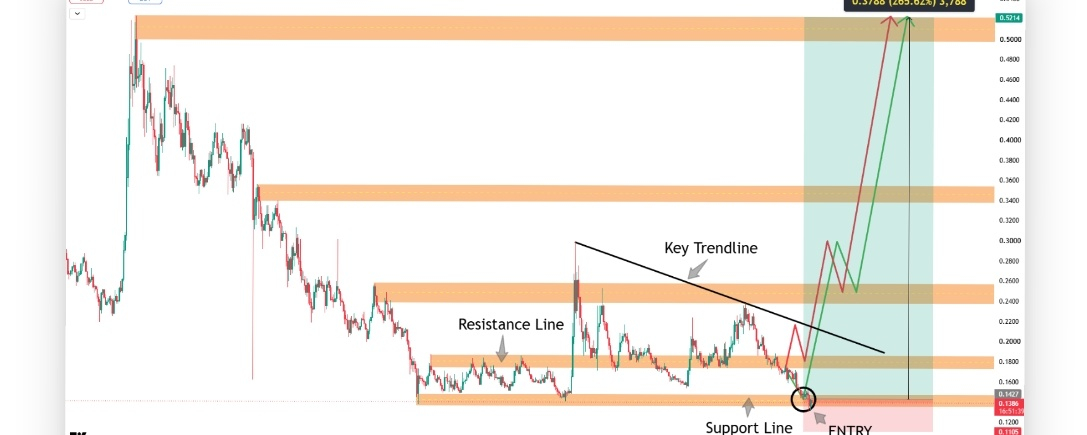

A roughly $4.9 BILLION cryptocurrency.
⠀
More than 35 BILLION tokens circulating.
⠀
A network supporting stablecoins, payments, and tokenized financial assets.
⠀
And a token trading approximately 84% below its all-time high.
⠀
But here's the contradiction.
⠀
Stellar can move more money without requiring users to hold proportionally more XLM.
⠀
Low transaction costs strengthen the network's appeal.
⠀
They also make the token's value-capture equation more demanding.
⠀
Is $XLM an overlooked investment in global financial infrastructure?
⠀
Or can Stellar succeed while its native token captures relatively little economic value?
⠀
Let's examine the numbers.
⠀
01 | WHAT IS STELLAR?
⠀
Stellar is a blockchain designed to support asset issuance and financial transfers.
⠀
Its network can carry digital representations of currencies and other assets.
⠀
XLM, also called the lumen, is its native token.
⠀
It supports transaction fees and minimum account balances.
⠀
Potential applications include:
⠀
• Cross-border payments
• Stablecoin transfers
• Tokenized funds
• Currency exchange
• Savings and lending applications
• Programmable financial services
⠀
The investment thesis is that accessible settlement infrastructure can attract sustained financial activity.
⠀
The token thesis requires an additional step:
⠀
That activity must create meaningful demand for XLM.
⠀
02 | THE NUMBERS THAT MATTER
⠀
November 16, 2026 research snapshot:
⠀
XLM Price: ~$0.1384
Market Cap: ~$4.90B
FDV: ~$6.92B
Circulating Supply: ~35.408B XLM
Total Supply: ~50.002B XLM
Circulating / Total Supply: ~70.8%
24H Trading Volume: ~$152.8M
All-Time High: ~$0.8756
Decline From ATH: ~84.2%.
⠀
NETWORK FUNDAMENTALS:
⠀
DeFi TVL: ~$193.18M
Stablecoin Market Cap: ~$419.93M
Tracked RWA Active AUM: ~$3.96B
24H DEX Volume: ~$2.47M
24H Chain Fees: ~$976.
⠀
These metrics measure different activities.
⠀
They should not be added together as a single measure of network value.
⠀
03 | THE PAYMENT OPPORTUNITY
⠀
Moving money internationally involves more than sending a blockchain transaction.
⠀
Users need:
⠀
Reliable access.
⠀
Liquidity between currencies.
⠀
Compliant service providers.
⠀
And convenient ways to enter and exit the network.
⠀
Stellar's opportunity is to support those financial workflows.
⠀
However, a transfer denominated in a stablecoin is demand for that stablecoin.
⠀
It creates some XLM demand through network requirements.
⠀
It does not mean the full transfer amount must be purchased or held in XLM.
⠀
That distinction is central to the investment case.
⠀
04 | THE TOKENIZATION OPPORTUNITY
⠀
Allium's report with the Stellar Development Foundation puts Stellar's tokenized asset market at approximately $4.12 billion through September 30, 2026.
⠀
It reports approximately 6.1× growth over the preceding year.
⠀
That supports the argument that Stellar hosts meaningful financial assets.
⠀
But tokenized asset balances are not XLM revenue.
⠀
They are not assets owned by XLM holders.
⠀
And they do not establish how frequently those assets trade.
⠀
Different dashboards also use different dates and definitions.
⠀
The September report and today's tracked RWA AUM should not be treated as identical series.
⠀
Watch issuance, recurring transfers, liquidity, and collateral usage separately.
⠀
05 | HOW XLM CAPTURES DEMAND
⠀
XLM has concrete network functions.
⠀
Fees are paid in XLM.
⠀
Accounts also require minimum reserves.
⠀
The current base reserve is 0.5 XLM.
⠀
A basic account requires two base reserves, or 1 XLM, with additional requirements for relevant ledger entries.
⠀
This creates functional demand.
⠀
But the amounts matter.
⠀
Ten million additional basic accounts would require approximately 10 million XLM before additional entries and other adjustments.
⠀
That is only around 0.03% of today's circulating supply.
⠀
Account growth alone therefore does not establish a large supply constraint.
⠀
06 | THE LOW-FEE CONTRADICTION
⠀
Stellar's current minimum inclusion fee is 100 stroops, equivalent to 0.00001 XLM.
⠀
Actual costs depend on transaction structure, congestion, and smart-contract resource requirements.
⠀
For illustration:
⠀
One million classic operations at the minimum base fee would consume just 10 XLM.
⠀
At the snapshot price, that is approximately $1.38.
⠀
This is an illustration of base fees, not an estimate of total network costs.
⠀
It explains the economic tension.
⠀
Cheap settlement is attractive to customers.
⠀
But enormous activity may still produce modest direct fee demand.
⠀
A high-volume network does not automatically become a high-revenue network.
⠀
07 | FEES ARE NOT HOLDER INCOME
⠀
DefiLlama labels approximately $976 as both daily chain fees and daily chain revenue.
⠀
Those labels do not mean XLM holders receive that amount.
⠀
Stellar states that fees enter a fee pool rather than being paid to the Foundation or network validators.
⠀
Its validators are not financially compensated for approving transactions.
⠀
There is no direct proportional fee dividend for simply holding XLM.
⠀
Likewise, application fees belong to the applications' economic models.
⠀
They should not automatically be attributed to the native token.
⠀
Network activity, application earnings, and holder returns are separate measurements.
⠀
08 | THE SUPPLY AND DISTRIBUTION QUESTION
⠀
Stellar ended its inflation mechanism in October 2019.
⠀
Its official documentation states that approximately 50 billion lumens exist and no more will be created under the current framework.
⠀
But fixed total supply does not mean fixed circulating supply.
⠀
Approximately 14.59 billion XLM sits outside the reported circulating figure.
⠀
That gap is not a confirmed upcoming unlock.
⠀
The Foundation's mandate describes using and distributing XLM to develop the ecosystem, with quarterly reporting on usage.
⠀
Distributions can support development and adoption.
⠀
They can also increase liquid supply.
⠀
Track actual disbursements and recipient behavior rather than assuming every distribution becomes an immediate sale.
⠀
09 | THE COMPETITIVE CHALLENGE
⠀
Stellar competes for payments, asset issuance, liquidity, and developer attention.
⠀
Its alternatives include other public blockchains and conventional financial infrastructure.
⠀
The competitive variables include:
⠀
• Transaction reliability
• Total operating costs
• Liquidity
• Wallet distribution
• Regulatory compatibility
• Access to financial counterparties
⠀
Low fees alone are unlikely to be sufficient differentiation.
⠀
Tokenized assets also introduce issuer and custody risks.
⠀
A blockchain can process a transfer correctly while the underlying asset still depends on legal rights and offchain institutions.
⠀
Investors need to assess both layers.
⠀
10 | THE VALUATION QUESTION
⠀
Using approximately 35.408 billion circulating XLM:
⠀
$0.25 implies ~$8.85B market capitalization.
⠀
$0.50 implies ~$17.70B.
⠀
$1.00 implies ~$35.41B.
⠀
$2.00 implies ~$70.82B.
⠀
Using approximately 50 billion total XLM:
⠀
$0.50 implies ~$25B FDV.
⠀
$1.00 implies ~$50B.
⠀
$2.00 implies ~$100B.
⠀
These are valuation illustrations, not price targets.
⠀
Annualizing one day's $976 chain-fee figure produces roughly $356,000.
⠀
That is a narrow snapshot, not a forecast or corporate earnings measure.
⠀
It shows why today's direct fee activity cannot, by itself, explain a multibillion-dollar valuation.
⠀
Investors are anticipating broader future utility and monetary demand.
⠀
11 | THE BULL AND BEAR CASE
⠀
THE BULL CASE:
⠀
Stablecoin payments expand.
⠀
Tokenized assets attract recurring financial activity.
⠀
Applications deepen liquidity.
⠀
More businesses maintain operational XLM balances.
⠀
And incremental demand absorbs additional circulating supply.
⠀
THE BEAR CASE:
⠀
Stablecoin and asset activity creates limited native-token demand.
⠀
Low fees keep direct value capture modest.
⠀
Competitors offer stronger distribution or liquidity.
⠀
Foundation distributions expand available supply.
⠀
And adoption headlines exceed measurable economic benefits for holders.
⠀
Stellar's success and XLM's investment performance can diverge.
⠀
That possibility belongs at the center of the analysis.
⠀
12 | THE FINAL VERDICT
⠀
Stellar has a credible financial infrastructure thesis.
⠀
It supports meaningful stablecoin balances and tokenized assets.
⠀
XLM also has genuine utility through fees and account reserves.
⠀
But genuine utility does not automatically justify any valuation.
⠀
The central question is whether network growth creates sufficiently large and persistent XLM demand.
⠀
Watch recurring payment activity.
⠀
Watch asset liquidity and application usage.
⠀
Watch operational XLM balances.
⠀
And watch circulating-supply growth.
⠀
An 84% decline does not establish undervaluation.
⠀
Billions in tokenized assets do not equal billions in demand for the native token.
⠀
XLM's investment case strengthens when adoption creates measurable token demand beyond minimal transaction requirements.
⠀
Bookmark this analysis before the next payments and tokenization rotation.
⠀
Which has the strongest long-term settlement thesis?
⠀
⠀
Drop your view below.