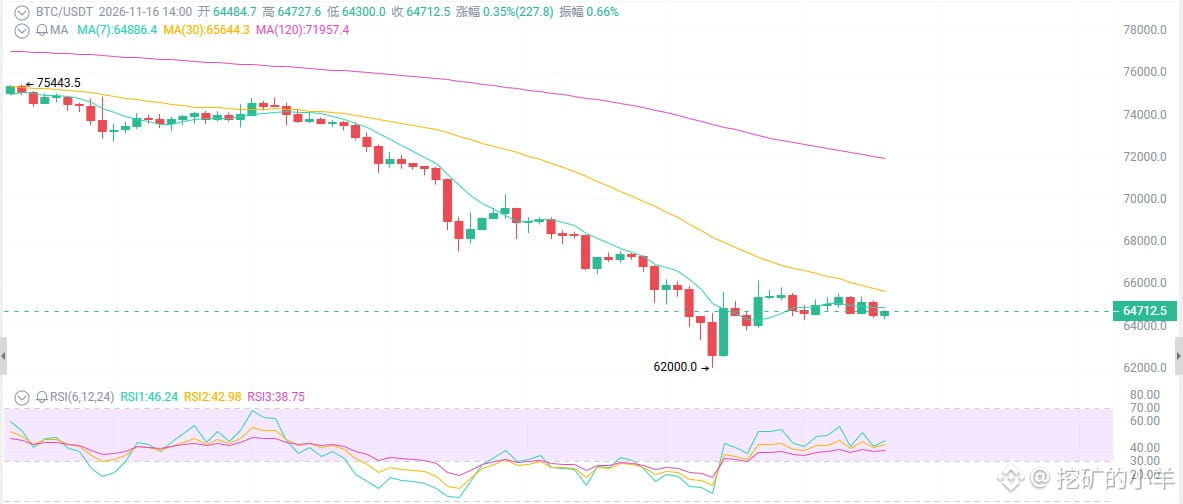
BTC at $64,700—are you selling at a loss?
From $126,000 down to $64,700—a 48% plunge. The Fear & Greed Index has crashed to 10, and everyone is shouting, “The bull market is over.” But after $62,000 was just smashed through over the weekend, the price clawed its way back to $65,000 within hours. Is this the final leg down, or are market manipulators using ETF outflows and rate-hike fears to shake out the last retail investors?
First, the surface picture: bad news is piling up, but the price just won’t fall any further.
Bitcoin fell 12–15% over the past week and 20% over the past month, closing lower for several consecutive weeks as its market cap shrank to $1.3 trillion. ETFs have seen net outflows for multiple days in a row, with $2–2.5 billion pulled out over two weeks. Stablecoin supply has contracted by more than $10 billion, and liquidity is tightening. The Crypto Fear & Greed Index has plunged to 10—extreme fear, even colder than during the 2022 Luna collapse.
First thing: ETFs are seeing outflows, but if you follow them out the door, you lose.
U.S. spot Bitcoin ETFs have seen net outflows for several consecutive days, at one point exceeding $1 billion in a single week. Institutional buying has weakened, which is the key factor weighing on the price.
But ETF outflows are driven by macroeconomic fears, not because Bitcoin has stopped working. October CPI came in hot, with core inflation at 0.3%. Expectations for a December rate hike have surged to above 25 basis points, the 10-year Treasury yield has topped 5%, the dollar is strengthening, and risk assets across the board are under pressure.
This isn’t BTC’s fault—it’s the macro environment.
Second thing: on-chain data is sending a signal you need to understand.
About 20.11 million BTC are in circulation, close to the supply cap. Miners are selling, the cost basis for short-term holders has been breached, and selling pressure is indeed increasing.
The 200-week moving average around $68,000 has been tested. This line is Bitcoin’s historical “iron-floor reference” during every bear market. In 2015, 2018, and 2022, after falling below the 200-week moving average, Bitcoin reclaimed it within six months at most.
Some analysts say Bitcoin has already entered a “deep value zone,” with characteristics similar to those seen near the bottom of previous cycles.
Third thing: the charts are showing a signal you absolutely need to watch.
The daily chart clearly shows a medium-term downtrend, with a series of lower highs and lower lows, and a break below levels associated with the 50-day and 200-day moving averages. The RSI bounced after entering oversold territory, but a trend reversal hasn’t been confirmed. Trading volume rose on the way down, while the rebound has been tentative.
Strong support: $62,000–$63,000 → $60,000 → $58,000
Strong resistance: $66,000–$68,000 → $70,000–$73,000 → $75,000+
At $62,000, if the level holds and a high-volume rebound follows, a short-term bottom structure will be in place. If it breaks and the breakdown is confirmed, $60,000—and even $58,000—will be the next stop.