
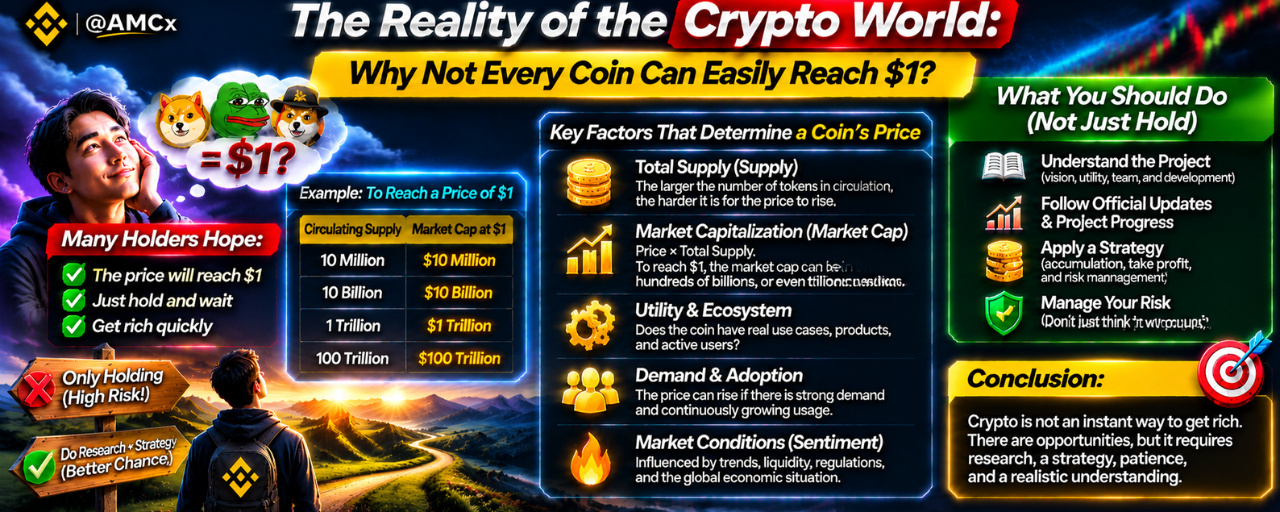

In the world of cryptocurrency, we often see meme coin holders hoping that the coins they own will reach $1 someday.
Some say DOGE could reach $1, SHIB could reach $1, and even various new meme coins share the same hope.
But have we ever asked ourselves: are those price targets realistic given the number of tokens in circulation?
One thing every crypto investor should understand is that a coin’s price can’t be judged solely by its price per token. We also need to look at its supply and market capitalization.
Let’s look at a simple example.
1. Why is the supply amount so important?
In cryptocurrency, the term Circulating Supply refers to the number of tokens currently in circulation on the market.
There is also Max Supply, which is the maximum number of tokens that can be created if the project has a supply cap.
Both matter because the greater the number of tokens in circulation, the larger the market capitalization required to reach a given price.
The simple formula is:
Market Cap = Token Price × Circulating Supply
For example:
1 million tokens in supply × $1 = $1 million market cap.
1 billion tokens in supply × $1 = $1 billion market cap.
1 trillion tokens in supply × $1 = $1 trillion market cap.
100 trillion tokens in supply × $1 = $100 trillion market cap.
Imagine a meme coin with 100 trillion tokens in circulation. To reach a price of $1, its market capitalization would have to reach $100 trillion.
That’s why we shouldn’t casually claim that every coin can reach $1.
2. A low price doesn’t mean greater upside potential
Many beginner investors look at tokens with very low prices, for example:
$0.000001
$0.00001
$0.0001
They think that if the token’s price rises to $1, the profit will be enormous.
The percentage gain may look attractive. But the more important question is: how large a market capitalization would be needed to reach that target?
Don’t just look at the number of zeros after the decimal point. Check the supply and market cap too.
3. A simple example: Is a $1 target realistic?
Imagine three fictional crypto projects:
ProjectCirculating supplyMarket cap at $1Coin A10 million$10 millionCoin B10 billion$10 billionCoin C100 trillion$100 trillion
All three have the same price target: $1.
However, their market capitalization requirements are very different.
This example shows that a price target must be calculated based on the supply, not just community expectations.
4. Don’t forget to look at FDV and token unlocks
Besides circulating supply, investors also need to understand two important terms:
FDV (Fully Diluted Valuation)
FDV represents a token’s valuation if its entire maximum supply or relevant total supply were in circulation, calculated using the current price.
Token Unlock
A token unlock is the process by which previously locked tokens become available for distribution or sale according to the project’s schedule.
If the number of tokens in circulation continues to increase, selling pressure may rise if demand does not grow proportionally.
So, don’t look only at today’s supply. Also study the unlock schedule and future token distribution.
5. Can token burns make the price reach $1?
A burn is the process of removing tokens from circulation, usually by sending them to an address that cannot be used again.
Burning tokens can reduce the supply. However, that doesn’t mean every burn automatically makes the price go up.
The price is still affected by:
Market demand.
The number of tokens actually in circulation.
Liquidity and trading activity.
Investor confidence.
The project’s utility and development.
Overall cryptocurrency market conditions.
If there is no demand, a reduction in supply alone may not be enough to increase the price.
6. Being a holder alone doesn’t guarantee profit
This is something some investors often overlook.
Holding a token for a long time doesn’t automatically mean we’ll make a profit.
An investor should understand:
What are the project’s goals and utility?
Who is on the development team?
How are the tokens distributed?
Is the number of users growing?
Are trading volume and liquidity healthy?
What are the risks if the project loses market attention?
A large community can certainly help a meme coin become popular, but popularity does not guarantee long-term value.
7. What should crypto investors do?
Rather than simply hoping a coin reaches $1, it’s better to start building good analysis habits.
Before buying a token, consider:
Circulating Supply.
Total Supply and Max Supply.
Market Cap.
Fully Diluted Valuation (FDV).
Token Unlock Schedule.
Trading volume and liquidity.
The project’s utility and development.
By understanding these factors, we can assess whether the price target being discussed by the community is reasonable or just wishful thinking.
AMCx’s Perspective
I’m not saying that meme coins can’t rise significantly. Throughout cryptocurrency history, some meme coins have seen extraordinary gains.
However, we must distinguish between possibility and reality.
Don’t buy a token just because someone says its price will reach $1.
And don’t assume that the more people hold a coin, the more certain it is that its price will rise.
Smart investors don’t just ask, "When will my coin reach $1?" They also ask, "What market cap would be needed to reach that target?"
The crypto world isn’t just about holding and waiting for prices to rise. It also requires knowledge, calculations, strategy, patience, and risk management.
Conclusion
A $1 price target isn’t impossible for every token, but its feasibility depends heavily on supply, demand, market capitalization, liquidity, and the project’s condition.
Don’t let hope override the math.
Understand the numbers before buying. Do your research before getting your hopes up.
What do you think? Is a $1 target for the meme coin you hold really realistic when calculated based on its circulating supply?
Share your thoughts in the comments.
AMCx — Don’t Just Follow the Hype; Understand the Numbers Behind Crypto.
This article is intended for educational purposes, not as financial advice or a recommendation to buy or sell crypto assets. Always do your own research (DYOR).
#CryptoEducation #memecoin #MarketCap #TokenSupplyRisk #Bitcoin #CryptoInvestor #DYOR #AMCx