On the eve of NVIDIA’s earnings report, the chart no longer offers the bargain of “it’s fallen so much it has to bounce.” There’s only one question left: can tomorrow’s after-hours third-quarter results restore confidence after the shock of the founder’s resignation?
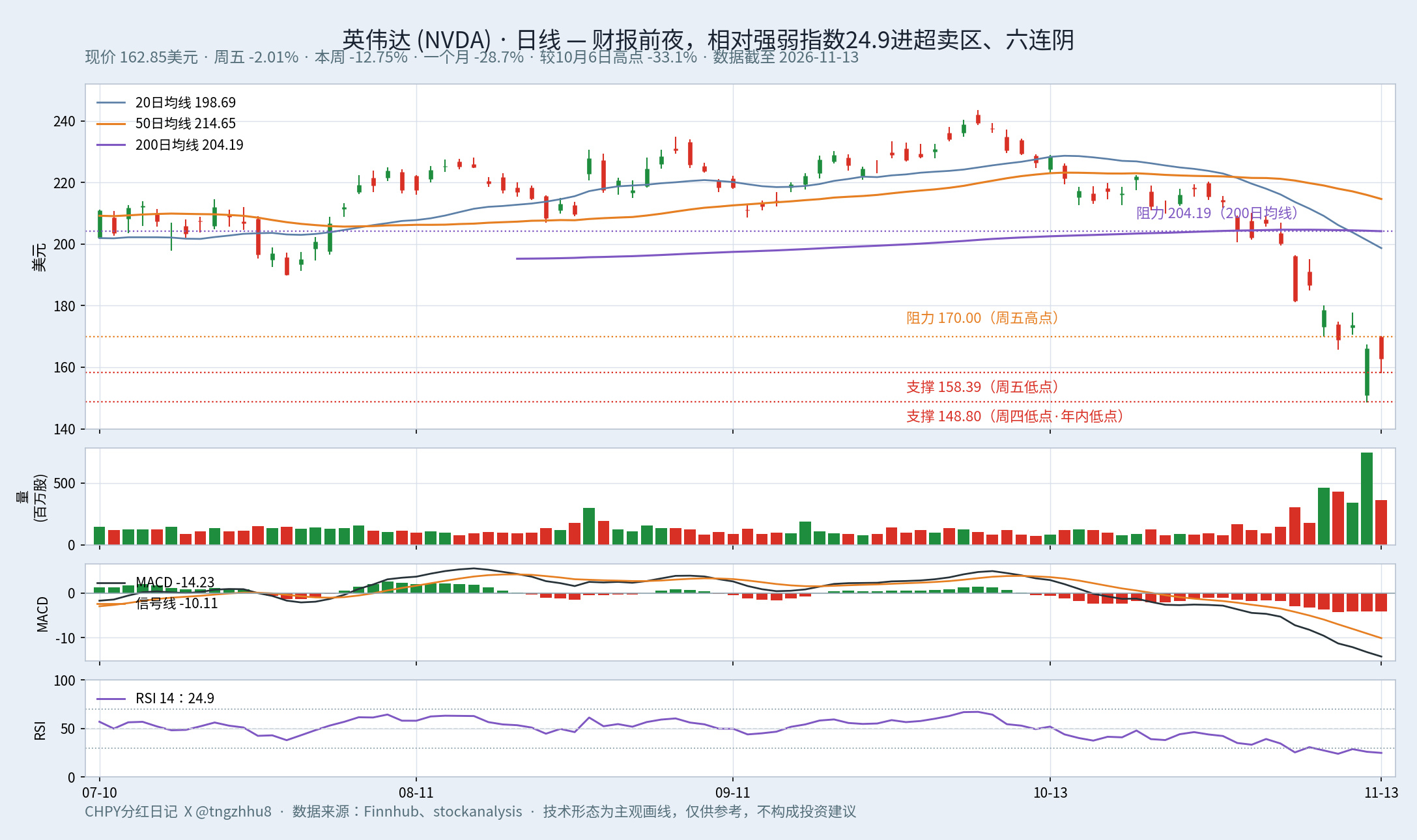
First, the numbers. NVIDIA closed at $162.85 on Friday, down 2.01% for the day and 12.75% for the week. It has now fallen for six consecutive weeks, its longest losing streak since 2012. Its market cap is about $3.93 trillion; in early October it was about $5.8 trillion, meaning roughly $1.9 trillion was wiped out in just over a month. The stock is down 28.74% in a month (from its October 13 close of $228.52), and 33.09% from its October 6 intraday high of $243.37.
Three technical indicators, each colder than the last. The 14-day Relative Strength Index is just 24.9, in oversold territory below 30. In plain English: down days have overwhelmingly dominated the past 14 days, and bearish momentum has yet to fade. Oversold only means the decline has been steep; it doesn’t mean the bottom is in. The stock has closed below its 200-day moving average of $204.19 for eight straight sessions, and is 20.25% below that line. The 20-day moving average ($198.69) and 50-day moving average ($214.65) are both looming overhead. The 200-day moving average is simply the average closing price over the past 200 trading days; until the stock can reclaim it, the market remains bearish. The MACD is -14.23, with a histogram reading of -4.12, and it has stayed below the zero line for 25 consecutive days. In plain English: the short-term moving averages are pulling farther and farther away from the long-term averages, and downward momentum has yet to ease.
Trading volume is worth a look, too. On Thursday, when the resignation news broke, volume hit 748 million shares—five times the 60-day average. The stock plunged to an intraday low of $148.80, its low for the year, before recovering to close at $166.19. On Friday, volume was 364 million shares, 2.1 times the 30-day average. The $162.85 close was the lowest closing price in 52 weeks, and the stock slipped further to $161.04 after hours. Panic selling is underway, but so is dip-buying; the buyers just haven’t managed to push the price back above $170.
The market winds aren’t any warmer this Monday. Asian chip stocks are broadly lower, TSMC is down 4%, S&P 500 futures are down 0.2%, and Nasdaq 100 futures are down 0.4%. The leadership question remains unresolved: reports say the board has approached Arm CEO Rene Haas, but the board denies formally contacting any candidates and is still selecting an executive search firm. A petition calling for Jensen Huang to return has topped 115,000 signatures, while prediction markets favor internal engineer Ian Buck, at around 33%. On the other hand, CoreWeave’s third-quarter results beat expectations and its shares are up 15% premarket. Demand for computing power hasn’t collapsed; what has collapsed is the valuation investors are willing to assign to NVIDIA alone.
Tomorrow’s test is already on the table: the third-quarter report comes out after the market closes. In August, the company guided to revenue of around $108 billion, plus or minus 2%. The market expects revenue of about $109 billion and earnings per share of $2.47 to $2.52, with data center revenue of about $101.8 billion. Fourth-quarter guidance is expected to be around $125 billion. Options markets are pricing in a move of about 7% in either direction on earnings day, meaning traders are betting the stock could move roughly 7% after the report. Interim CEO Colette Kress will host the earnings call for the first time. Investors will be listening for more than just the numbers: they want to know whether the new management team can still stand behind next year’s growth outlook.
Here are the levels to watch: the first hurdle above is $170.00 (Friday’s high); only above that can the stock make a case for $173.73 (Wednesday’s close). The real dividing line is the 200-day moving average at $204.19. Talk of a reversal is premature until the stock gets back above it. The first support below is $158.39 (Friday’s low), followed by $148.80 (Thursday’s low and the low for the year). If the stock closes below that, the next stop is the $140 round-number level.
To put it boldly, buying the dip or betting on further declines on the eve of earnings amounts to betting on the same thing: oversold conditions create room for a bounce, but they don’t provide a reason for one. If earnings beat expectations and fourth-quarter guidance holds near $125 billion, the first target for an oversold bounce is $170. If either the results or the guidance disappoints, $148.80 will be the next test. There are two key risks: first, if a successor is not named soon, valuation will shift away from next year’s results and toward fiscal 2028 and 2029; second, the entire chip sector fell broadly on Friday, with Advanced Micro Devices down 8.75% and Broadcom down 4.76%. NVIDIA isn’t falling alone. Until the sector stabilizes, any bounce in an individual stock should be viewed as an oversold rebound. Technical patterns are subjective chart interpretations, for reference only, and not investment advice.
#英伟达 #TechnicalAnalysis
$NVDA $QQQ $SPY