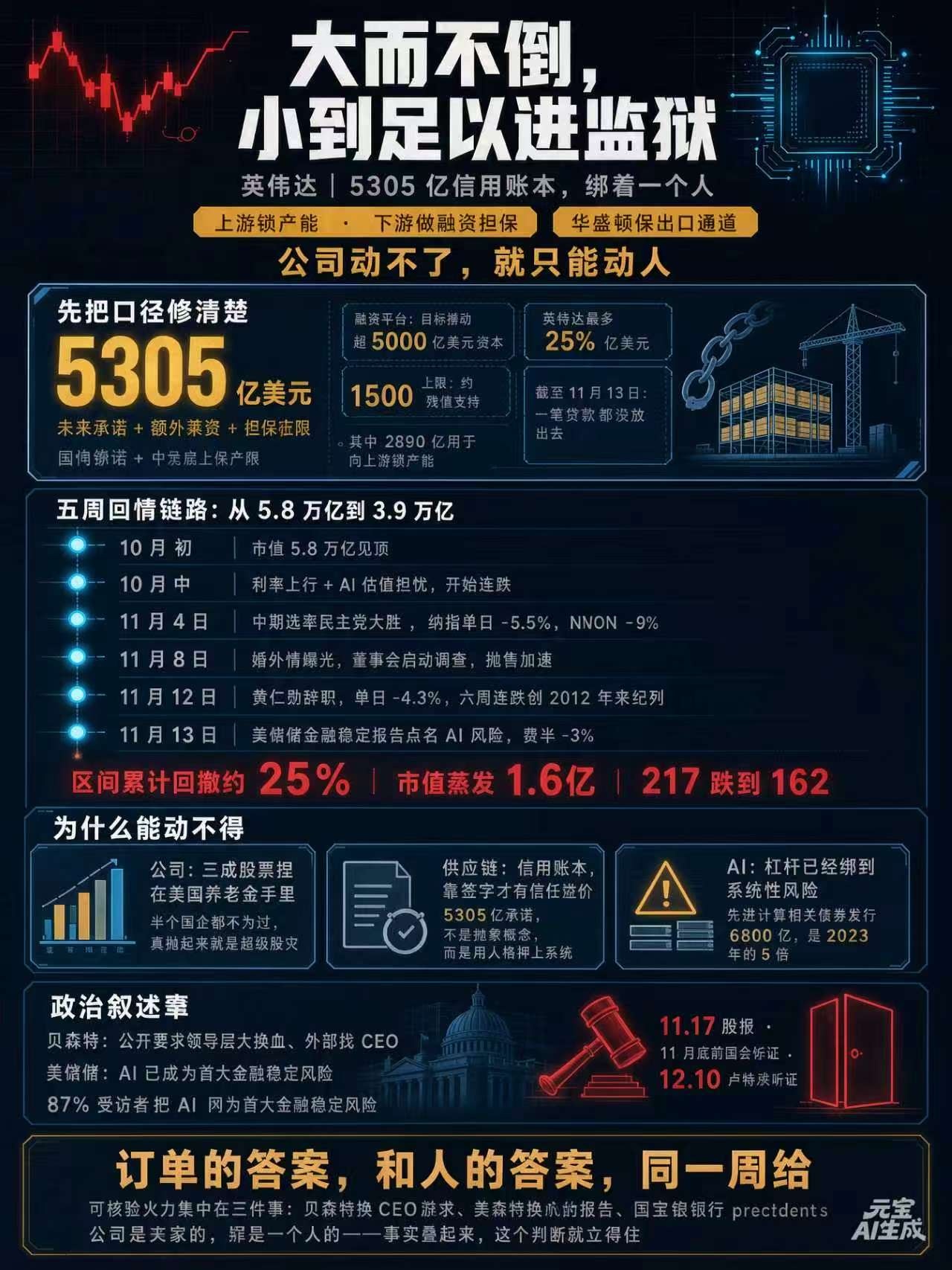


Put these two statements together, and the market action over these five weeks suddenly makes complete sense.
First, let’s talk about how important he is.
The money on the line doesn’t lie: he has $500 billion in guarantees under his name, across four deals, backing the financing credit of a group of AI startups;
There’s no long-term contract with TSMC. Expanding capacity takes just one phone call—it rests on decades of personal ties with two generations of leaders.
He doesn’t use the kind of bureaucracy you find at big corporations. He goes straight to the front-line engineers: he understands technology and management, has connections, and works with superhuman intensity. He even puts his own name behind it, adding leverage to the entire supply chain.
You can’t replace someone like that.
He built the leadership relationships across the supply chain one personal connection at a time.
Bring in another professional manager, and they won’t know you at all. They simply won’t be able to make it work.
Why do so many factories collapse when the second generation takes over?
It’s the same principle: relationships are built around people, not positions.
Some people compare him to Steve Jobs. That’s wrong.
When Steve Jobs left, there was still Tim Cook. Jensen Huang has been doing the work of two people—technical research and development, plus supply chain management. He’s been Steve Jobs and Tim Cook rolled into one.
Don’t overestimate the old men in Washington. Many can’t even be bothered to turn on a computer. They think you can put anyone in that seat and Nvidia won’t change.
But Apple makes consumer products, and ordinary people recognize the brand. Nvidia’s customers don’t care about the brand—they care about the person.
So when people say Nvidia will become like Apple, I think they’re giving it too much credit.
It’s more likely to end up like Intel.
Wall Street is getting nervous precisely because he matters so much.
The scheme of guaranteeing four orders to help startups raise financing already has plenty of supporters in the US tech world. His Silicon Valley allies are backing him, and some major Nvidia shareholders on Wall Street are asking the board to reconsider whether Jensen Huang should be brought back.
But they’re putting their support in the wrong place.
If he’d been forced out over personal conduct or a disagreement with the board about how to run the company, support from his Silicon Valley allies could have made a difference.
But this time he’s been turned into a tool in a political fight. These Silicon Valley people are way out of their depth; they have no say in this.
In the White House and on Capitol Hill, these people—including Musk—don’t have much support left.
Look at a few of the key players in Trump’s administration.
Rubio has reportedly been the one leading the charge against Jensen Huang.
Bessent keeps calling for Nvidia to face intense scrutiny, insisting the CEO must come from outside the company and that every current executive must be vetted one by one before they can stay on.
Lutnick has enough problems of his own.
Captain Hegseth is on the neoconservative side, and neoconservatives are the faction most determined to keep Nvidia’s exports under tight control.
Vance is practically an independent now, so how much influence he has left in the administration is anyone’s guess.
In the entire White House, the only person who might still speak up for Jensen Huang is Trump himself.
But who listens to Trump anymore? The trusted aides he appointed have already turned him into a figurehead—either they publicly take the opposite position or they scheme behind his back.
And don’t even get me started on Capitol Hill.
Republican neoconservatives, establishment figures from both parties, and progressive Democrats have all said Huang should get ready to face the music.
And it’s not just him. Lutnick is bound to be in trouble too; they might even investigate Trump himself.
Why is nobody willing to back down?
The Democrats rode a midterm landslide into power. If they can’t even pull off this bit of pressure, who’ll take their threats seriously in the future?
Partisan warfare has become a fight to the death.
Why did Trump lose so badly in the midterms? Wasn’t it because he started something in Iran and couldn’t see it through?
So if Trump’s opponents go after Jensen Huang, they either leave him alone or make sure he can never appear in public again.
If they go after him for a few days and then bring him back, how is that any different from what Trump did in Iran? Nobody dares take that gamble.
And there’s already a ready-made script for finding a scapegoat.
In the 2008 financial crisis, Wall Street blew up, but the ones ultimately criminally prosecuted were a small Chinese-American bank in Chinatown—ranked 2,787th in the country, with just 9 defaults among 3,000 mortgages, far below its peers. Yet it was the only bank in the country to face criminal charges, and its employees were paraded before the media in handcuffs.
The Sun family refused to plead guilty, spent more than ten million dollars on legal fees, and was ultimately acquitted.
The documentary’s title says it all: “Abacus: Small Enough to Jail.”
Too big to fail, small enough to jail.
That was the logic in 2008, and it’s the same this time.
Nvidia can’t be touched: US pension funds hold 30% of its shares. It’s practically half state-owned. A sell-off would trigger a catastrophic market crash, and the first people hit would be the lawmakers’ own pension funds.
If they can’t go after the company, they can only go after the person.
So Bessent and the Fed suddenly started sounding the alarm about the dangers of an AI bubble, with Bessent even calling Jensen Huang out by name.
The company belongs to everyone; the blame belongs to one person—that’s the ironic version of “social responsibility of state-owned capital.”
And as for taking over from Jensen Huang? You’d have to groom someone for the job like a crown prince—someone you absolutely trust, shadow them for years, and teach them every last detail step by step.
Politics doesn’t give you that kind of time.
Musk is a cautionary tale: while he was busy with politics, Starship kept blowing up. Once he came back and took charge himself, the booster recovery worked right away.
Nvidia reports earnings on the 17th; Congress holds its hearing on the 18th. We’ll get answers about both the orders and the person within a week.
Either way, moving forward or backing down will be difficult.