
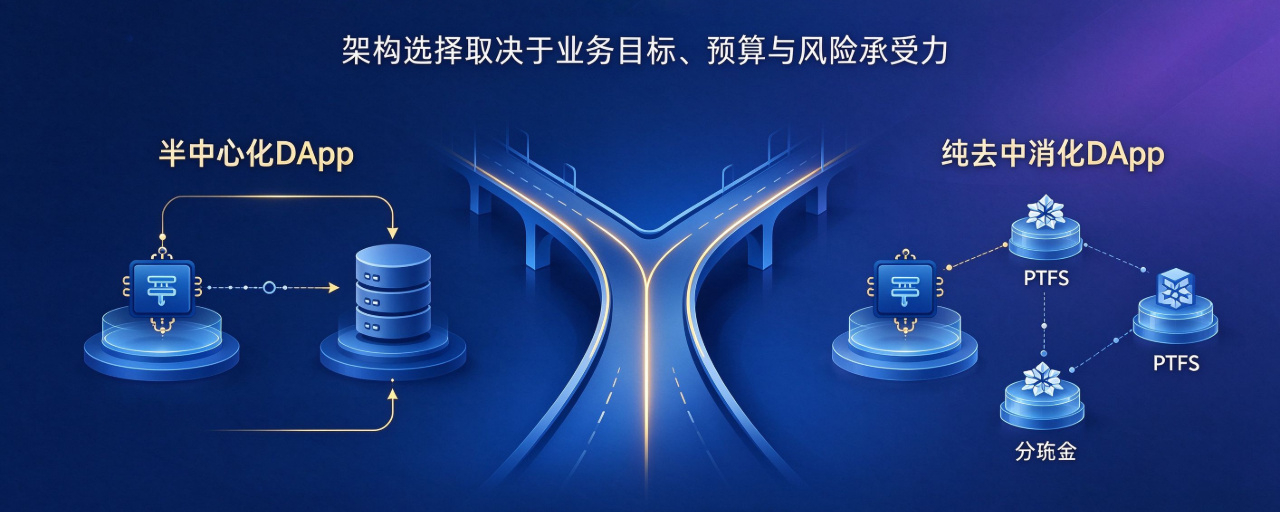

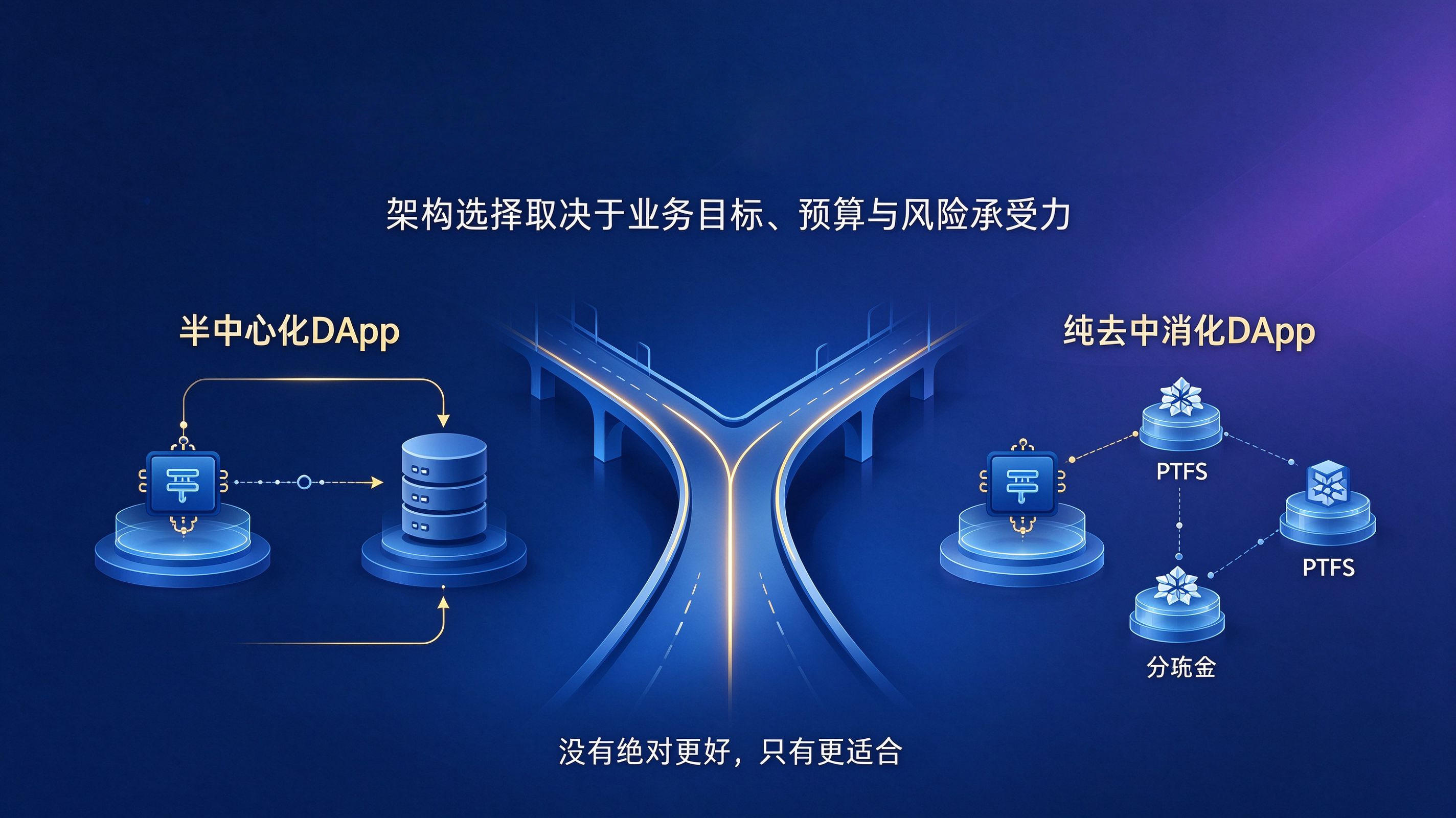
Many teams preparing to enter Web3 face the same dilemma: should our DApp be semi-centralized or fully decentralized? Some people get caught up in the idea of “decentralization,” assuming that the more decentralized a project is, the more advanced it must be. In reality, neither approach is inherently better or worse, and there’s no one-size-fits-all answer. The key is to choose an approach that fits your business positioning, budget, and the level of risk your team can take on.
The semi-centralized DApp, also known as a hybrid-architecture DApp, is currently the most widely used approach in the industry. Its design is straightforward: core rules closely tied to money and rights—such as asset ownership verification, token transfers, NFT minting, and reward distribution—are executed by on-chain smart contracts. High-frequency interactions, such as page rendering, user matching, game battle logic, backend analytics, fraud prevention, and notifications, run on centralized servers.
The advantages of this model align well with the practical needs of most projects. A centralized server can handle a large volume of high-frequency computations, keeping interaction latency low and Gas costs manageable. The user experience is close to that of traditional internet products; development and iteration are faster, the backend can flexibly adjust operational strategies, and risk controls can be implemented easily to block artificial traffic and cheating. Of course, its drawbacks are just as clear: the frontend and business backend are centralized nodes. If the server has problems or the operator shuts down the service, users can no longer use the product normally. This creates a single point of failure, and the level of decentralization is relatively low.
The most typical example is Axie Infinity, a classic semi-centralized blockchain game. Ownership of Axie pet NFTs, transfers of the SLP and AXS tokens, staking, and reward distribution are all handled by smart contracts. On-chain records guarantee that players own their assets, and the project team cannot arbitrarily confiscate them. However, gameplay logic such as player battles, matchmaking, level completion, and leaderboards runs on centralized servers. Only after a match ends does the system batch the reward results onto the blockchain. This approach allows the game to support large numbers of players online at the same time and ensures a smooth gaming experience. It was also key to blockchain games gaining widespread popularity early on.
By contrast, a fully decentralized DApp is designed according to a completely different logic. Its core business rules and all state changes are written into smart contracts, while the frontend is generally hosted on decentralized storage such as IPFS, without relying on a separate centralized backend. All operations are completed through on-chain transactions, with no business server that an operator can control unilaterally. Its greatest value lies in censorship resistance and transparent rules: once a contract is deployed on-chain, its rules are fixed, and no one can secretly alter the protocol logic. Trust in assets and the protocol is guaranteed entirely by code and the blockchain, without needing to trust the project’s operating team.
But this high level of trust comes at a cost. Every interaction requires an on-chain transaction, resulting in high Gas costs and slow page loading; the user experience is generally inferior to that of centralized services. If business rules need to be changed later, configurations cannot simply be modified in the backend—a new contract must be deployed, making migration costly and iteration cycles lengthy. It is also difficult to block malicious activity and attacks without centralized risk controls, while development and auditing costs are higher.
Uniswap is a benchmark for fully decentralized DApps. All of its core trading logic is in smart contracts: liquidity pools, exchange algorithms, and fee rules are all executed by on-chain code. The frontend is hosted on IPFS, so even if the official website’s domain is inaccessible, users can still use another compatible frontend to call the contracts directly and swap tokens. The project team has no authority to freeze users’ funds or secretly change the underlying trading rules. This is the fundamental reason it has become a cornerstone of DeFi.
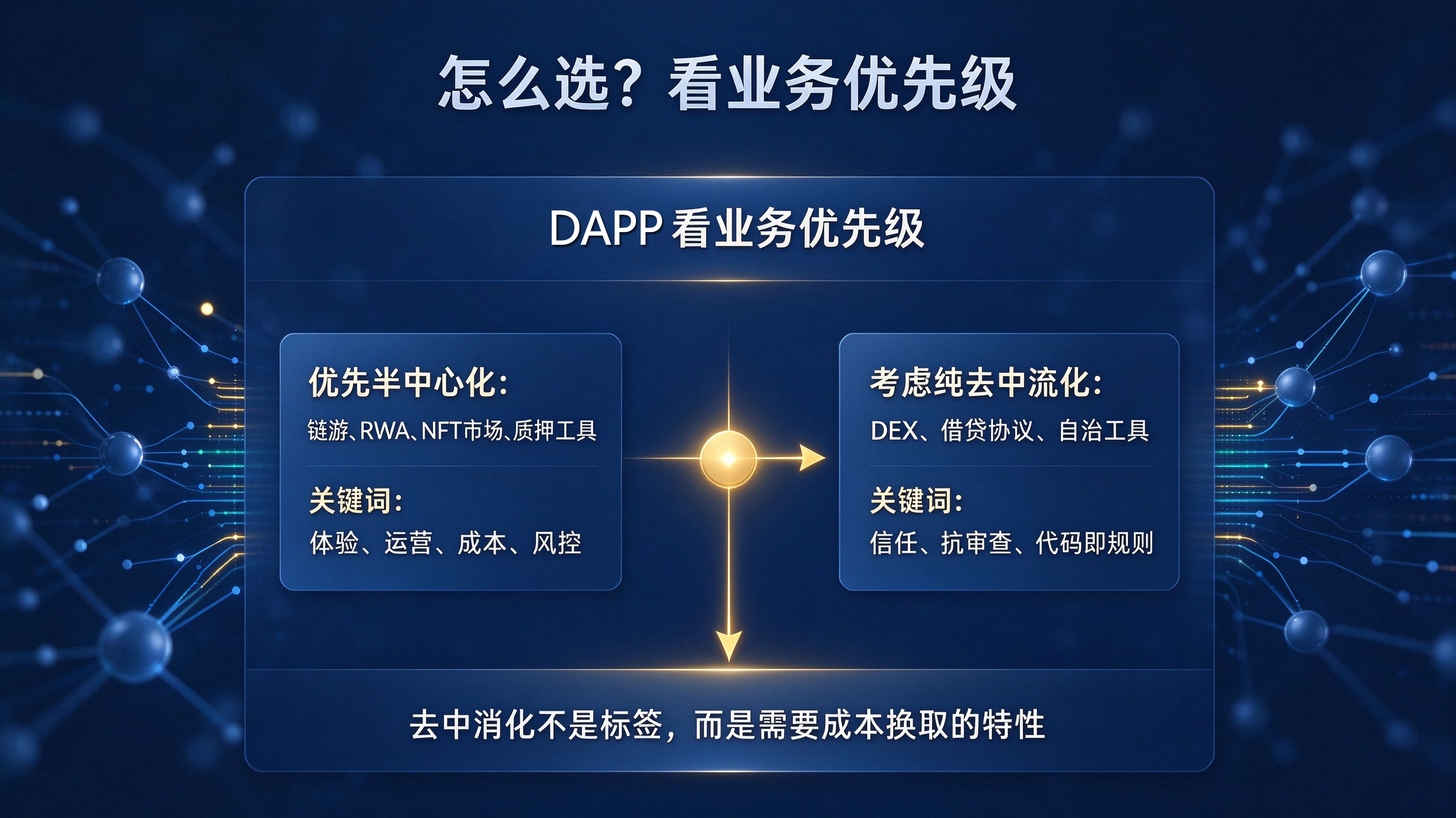
After looking at these examples, we can establish a clear framework for choosing an architecture. If your project is a blockchain game, an RWA asset platform, an NFT marketplace, or a staking and wealth management product, a semi-centralized hybrid architecture is the preferred choice. These use cases have high demands for user experience, operational flexibility, and anti-cheating measures. Putting asset ownership on-chain while running gameplay and business functions through centralized services is the most cost-effective approach, and it is the choice most new projects make when starting out.
If your project is a decentralized exchange, lending protocol, or governance tool, and its core selling points are permissionless access, censorship resistance, and code as law—with users placing the greatest importance on their assets not being controlled by a platform—then consider a fully decentralized architecture. Users of these projects already expect on-chain interactions and are willing to accept higher Gas costs and a less polished user experience in exchange for trust.
In short, decentralization is not a label to slap on a project; it is a characteristic that comes at a cost. There is no need to pursue complete decentralization blindly. The best solution is the architecture that suits your business needs.