


LedgerX, a U.S. derivatives exchange, changed hands four times in five years.
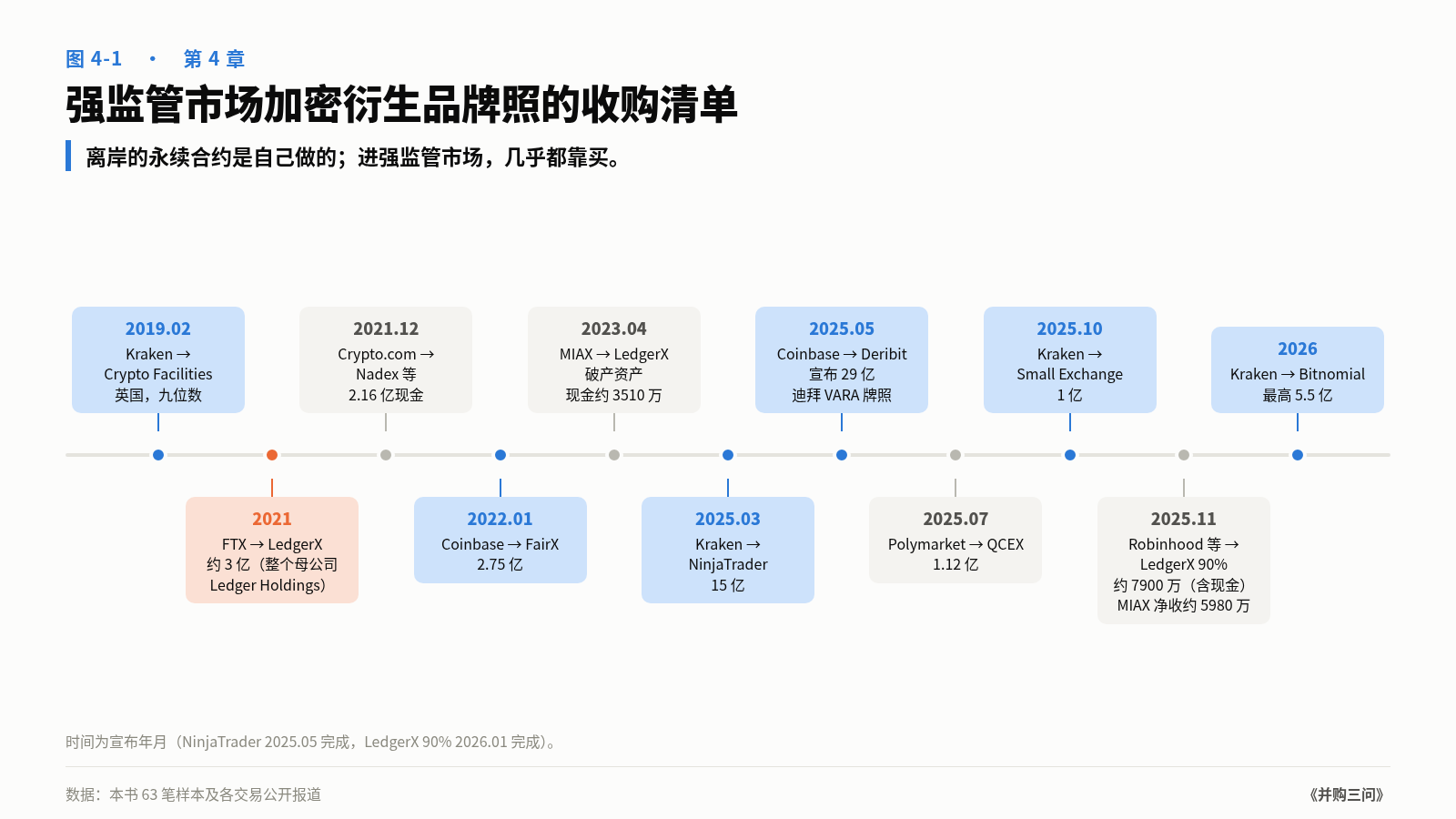
It was one of the first U.S. exchanges to receive CFTC approval to trade and clear bitcoin options. In October 2021, FTX US bought its parent company, Ledger Holdings, which also included businesses such as LedgerPrime. According to audited financial statements seen by CoinDesk, the price was about $298 million. FTX filed for bankruptcy in November 2022. In May 2023, LedgerX, which was not part of the bankruptcy proceedings, was bought by Miami International Holdings (MIH, which owns the MIAX exchange; referred to below as MIAX) through its subsidiary M7 Holdings for about $35.1 million in cash (FTX debtors said the total recovery was about $50 million). In November 2025, Robinhood and market maker Susquehanna announced they were forming a joint venture, Rothera, to buy a 90% stake from MIAX. The deal closed on January 20, 2026, with the buyers paying about $79 million in cash (according to Robinhood, including cash transferred with the company; MIAX received about $59.8 million net of that amount). The exchange was renamed Rothera and began handling some of Robinhood’s contracts in late May 2026.
LedgerX has been acquired three times: FTX US bought its entire parent company, Ledger Holdings, for about $298 million; during the bankruptcy liquidation, LedgerX on its own was valued at about $35.1 million; and in Robinhood’s hands, a 90% equity stake was valued at about $79 million, becoming the starting point for a new business. The scope and equity stake differed in each deal, so the prices can’t be directly treated as changes in the value of the same license. What we can see is that a license’s value depends on who holds it and what they use it for.
This chapter is about the battle for crypto derivatives licenses. These are among the most expensive crypto M&A deals, and they best illustrate “what a license is worth.”
A basic fact: in highly regulated markets, crypto derivatives licenses are mostly acquired through purchases
The world’s largest crypto derivatives exchanges are Binance, OKX, and Bybit. Their perpetual futures businesses were mainly built in-house, though they have also made acquisitions: in September 2019, Binance acquired JEX, which offered futures, options, and perpetual futures, and renamed it Binance JEX. Their perpetual futures businesses operate offshore and don’t rely on U.S., U.K., or Japanese derivatives licenses (these groups have separately licensed spot businesses in some markets—for example, Binance bought the licensed Japanese exchange SEBC in 2022 and renamed it Binance Japan). But offshore registration still has to comply with the rules where customers are located; Binance being sued by the CFTC in the U.S. is one example.
But once they try to enter highly regulated markets, the situation is completely reversed. Consider all the crypto derivatives businesses in this book’s sample that entered highly regulated markets:
Kraken: bought Crypto Facilities (U.K.) in 2019, NinjaTrader (U.S. futures broker) and Small Exchange (U.S. designated contract market) in 2025, and Bitnomial (with a full set of U.S. licenses) in 2026;
Coinbase: bought FairX (a U.S. designated contract market) in 2022 and Deribit (which holds a Dubai VARA license) in 2025;
FTX: bought LedgerX in 2021;
Crypto[.]com: announced in 2021 that it would buy Nadex (U.S.), a subsidiary of IG Group, and other assets for $216 million in cash;
Polymarket: bought QCEX in 2025;
Robinhood: announced jointly with Susquehanna in November 2025 that it would buy 90% of LedgerX; completed in January 2026.
There have been a few cases of companies applying for licenses themselves, but not many. The clearest example is prediction market company Kalshi, which obtained CFTC-designated contract market (DCM) status in November 2020. It took about ten months from the formal application in December 2019 to approval, not counting the additional preparation beforehand. Another category is traditional exchange groups. For example, CME launched Bitcoin futures itself in 2017, as it already held a full set of licenses.
Why do crypto companies prefer to buy? Because a U.S. derivatives business needs not one license, but a set:
DCM (Designated Contract Market): can list futures and options for trading;
DCO (Derivatives Clearing Organization): can clear and guarantee trades;
FCM (Futures Commission Merchant): can serve retail customers and collect margin.
Each license requires a separate application. Preparation and supplemental filings can take more than a year, and regulators scrutinize new applicants extremely closely. Kalshi’s formal application materials were filed in December 2019 and the application was approved in November 2020. On December 6, 2021, FTX applied to the CFTC to amend its clearing status, hoping to allow retail customers to trade on margin directly without an FCM. When the proposal was publicly discussed in 2022, it drew opposition from the entire futures industry. A hearing was held, but approval never came. On November 11, 2022, FTX withdrew its application; it went bankrupt that same month.
Buying an existing licensed institution is like buying several years of waiting time. That’s another way to put the third question: you’re not buying a license, you’re buying time.
Two price lines: shell price and business price
The prices of derivatives licenses appear to have risen quickly: nine figures in U.S. dollars in 2019 (at least $100 million; the amount wasn’t disclosed) and $2.9 billion in 2025. But if we divide the deals in the sample into two groups based on whether they came with an existing business, we see two very different lines.
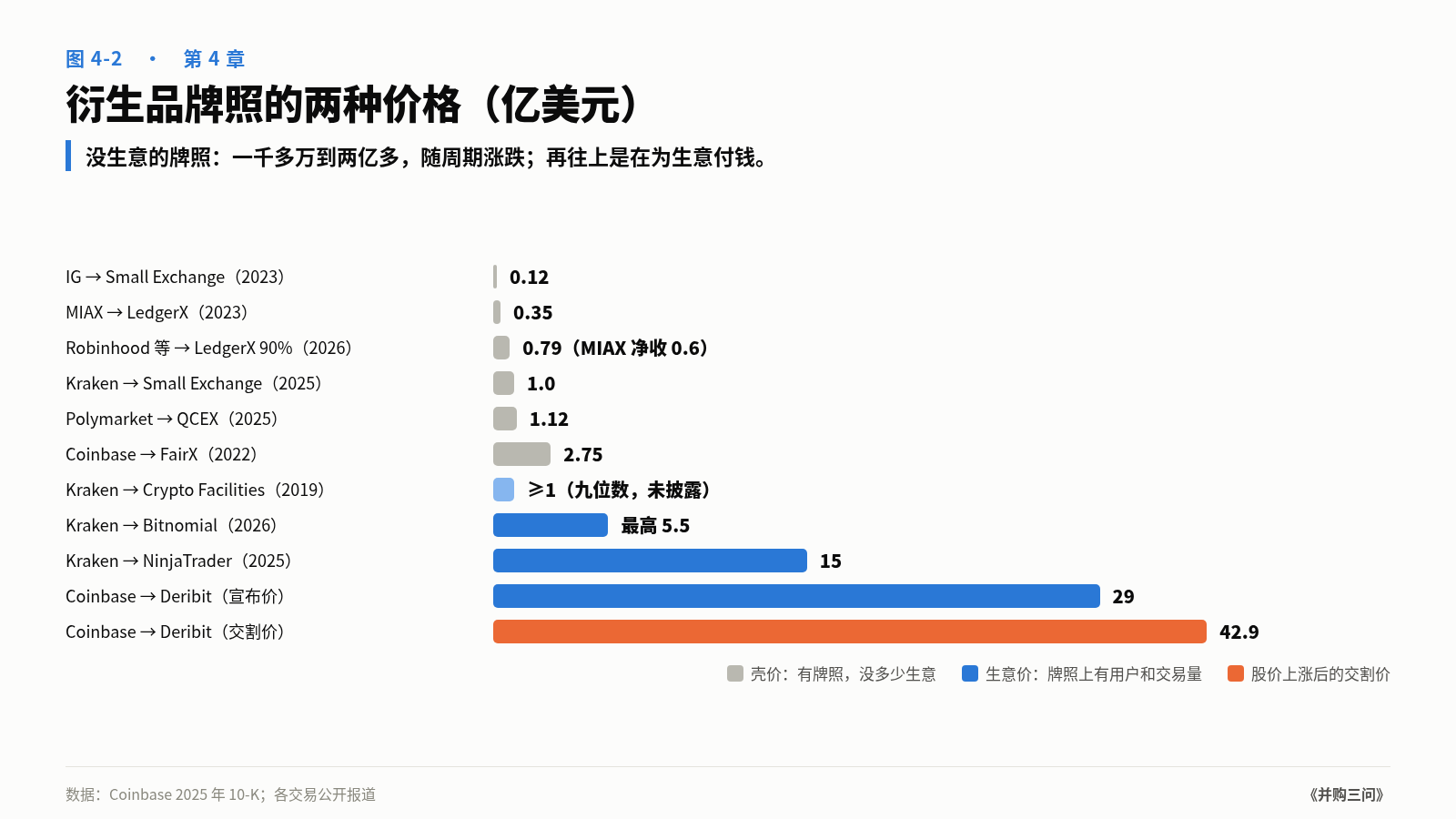
The first line, “shell price”: from just over $10 million to more than $200 million, rising and falling with the cycle.
January 2022, Coinbase buys FairX: total consideration of $275.1 million ($67.2 million in cash, with the rest in Coinbase stock);
2023, IG Group buys Small Exchange: about $11.9 million;
2023, MIAX buys LedgerX from the FTX bankruptcy estate: about $35.1 million in cash;
July 2025, Polymarket buys QCEX: $112 million;
October 2025, Kraken buys Small Exchange from IG Group: $100 million ($32.5 million in cash plus $67.5 million in stock);
January 2026, the joint venture between Robinhood and Susquehanna buys 90% of LedgerX from MIAX: the buyer pays about $79 million in cash (including cash transferred with the company; MIAX nets about $59.8 million).
These licenses don’t all confer the same qualifications: LedgerX has DCM, DCO, and SEF licenses; QCEX has DCM and DCO; Small Exchange and FairX have only DCM licenses. What they have in common is that there isn’t much trading volume on them. The buyer is mainly paying to “save several years of regulatory approval time,” and the price of that time isn’t fixed: over two and a half years, the price of the same Small Exchange license rose from $11.9 million to $100 million, about eightfold; LedgerX went from about $35.1 million in bankruptcy to a buyer paying about $79 million for 90% of its equity in 2026 (MIAX nets about $59.8 million after deducting the cash sold with the company). MIAX recorded a gain of about $50.5 million on the sale. The most expensive shell, FairX, was signed in January 2022, just after the peak of the 2021 boom. Shell prices follow the cycle and the buyer’s urgency: just over $10 million in a bear market, more than $200 million in a hot market.
The second line, “business price”: from hundreds of millions to tens of billions of dollars.
Announced in March 2025 and completed in May, Kraken buys NinjaTrader: $1.5 billion. NinjaTrader is a U.S. retail futures broker with nearly 2 million users;
May 2025, Coinbase buys Deribit: announced price of $2.9 billion, about $4.3 billion at closing based on Coinbase’s share price. Deribit is the world’s largest Bitcoin options exchange, with trading volume exceeding $1 trillion in 2024;
2026, Kraken buys Bitnomial: up to $550 million.
The price of these targets is mainly not the price of the license, but the price of the business built on top of it: users, trading volume, market-maker relationships, and clearing members.
Put the two lines together and the conclusion is: licenses without a business cost between just over $10 million and more than $200 million, rising and falling with the cycle; at prices of hundreds of millions or tens of billions, the extra amount is mainly payment for the business.
This conclusion is directly useful to buyers. If you only need a license, first consider where you are in the cycle: something you can buy for just over $10 million to tens of millions in a bear market could cost $100 million or $200 million when the market is hot. If the price exceeds that range, ask: what part of the business am I getting for the extra money? If you’re buying a license with a business attached, your valuation should be of the business, not the license.
Deribit: The answer on the balance sheet
Coinbase’s acquisition of Deribit is the largest completed deal in the sample and the one with the fullest disclosure. Its accounting treatment answers the question “what is the buyer paying for?”
According to Coinbase’s 2025 annual report, the deal closed on August 14, 2025, for total consideration of about $4.29 billion: $720 million in cash, plus Coinbase stock worth about $3.57 billion based on the closing price on the closing date. The difference between the $2.9 billion announced price and the $4.3 billion closing value was about $1.4 billion, almost entirely due to Coinbase’s share price rising over the three months.
How was the $4.29 billion allocated?
Goodwill: about $2.82 billion, or two-thirds. Coinbase explained that goodwill mainly reflects Deribit’s team and the expected synergies from integrating Deribit’s trading platform with Coinbase’s existing platform;
Identifiable intangible assets: $1.39 billion. This includes $1.06 billion in customer relationships (amortized over 15 years), $288 million in developed technology (6 years), and $43 million in trademarks (8 years);
Other items: about $160 million in crypto assets held by Deribit itself, about $110 million in cash, and so on.
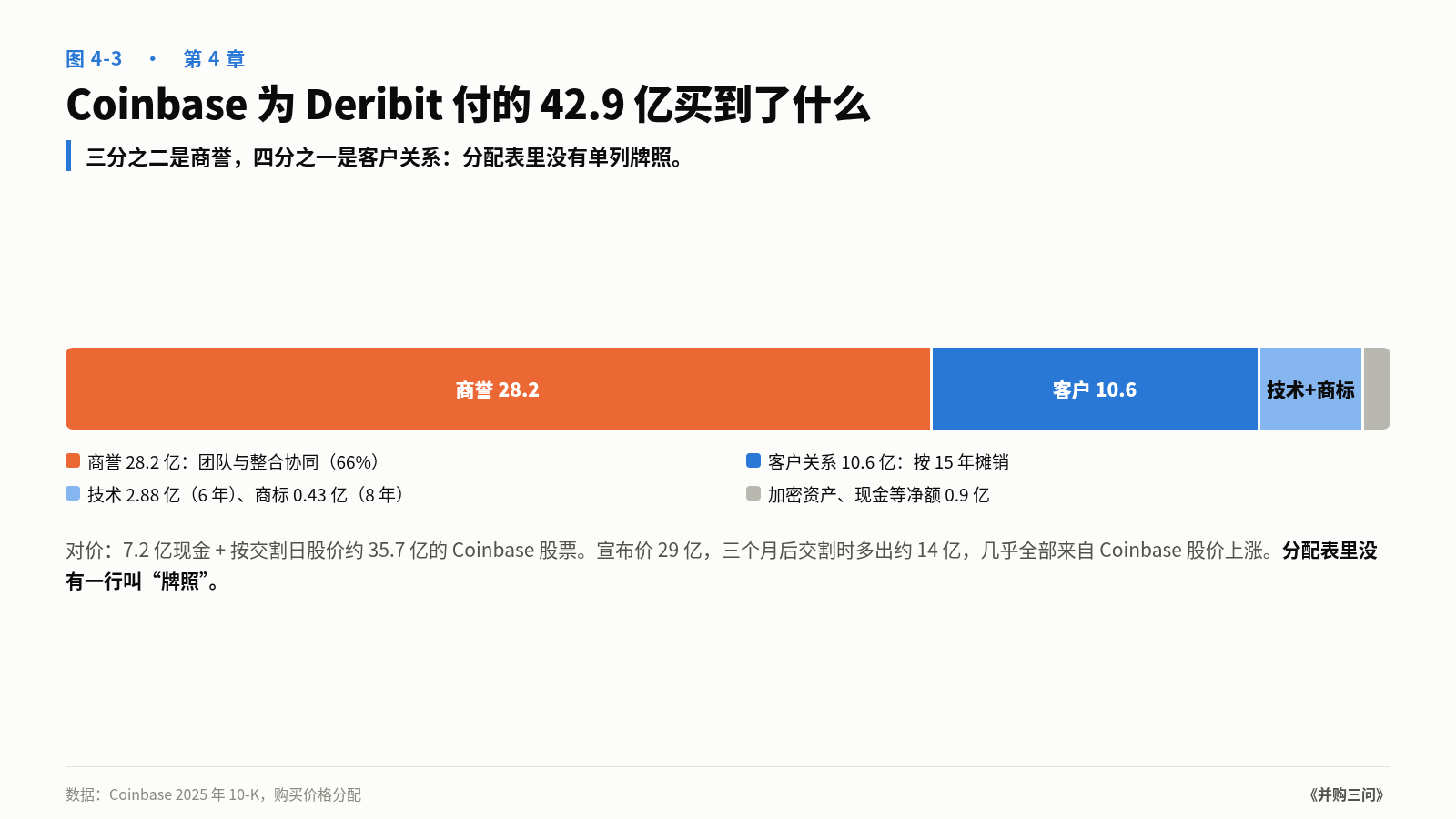
There’s no line item called “license” in this table. Deribit holds a license from Dubai’s Virtual Assets Regulatory Authority (VARA), but in the accounts its value is bundled into customer relationships and goodwill.
The purchase price allocation doesn’t list the license separately. Customer relationships, at $1.059 billion, and goodwill, at about $2.82 billion, make up most of the value. My view is that the $4.3 billion was paid mainly for customers and the business, not the license. Amortizing customer relationships over 15 years is an accounting estimate; customers may not stay for 15 years. Goodwill makes up two-thirds, suggesting that Coinbase is betting it can “build something bigger after integration.”
It’s too early to say how the deal is going. Coinbase hasn’t consistently disclosed Deribit’s revenue separately; at closing, it only said that Deribit’s trading revenue exceeded $30 million in July 2025. According to Coinbase, its derivatives trading volume was about $1.09 trillion in the first quarter of 2026, up 169% year over year for the trailing 12 months. A rough annualization of the July 2025 figure puts revenue at about $360 million, but the company hasn’t provided an annual figure. If it comes close to that level for a full year, a $4.3 billion price would be about 12 times revenue—not unreasonable for a global market leader.
Deribit’s own history also says a lot about the relationship between licenses and location. It was founded in 2016 by the Jansen brothers (John and Marius) in the Netherlands. According to reports, in early 2020 it moved its operations to Panama to avoid tightening EU rules; in 2024, it obtained a license from Dubai’s Virtual Assets Regulatory Authority and moved its global headquarters to Dubai. An exchange that moved three times for regulatory reasons ultimately sold to U.S.-listed Coinbase.
There was competition over who would buy it. In early 2025, media reports said Kraken had been in talks to acquire Deribit. Bloomberg reported that Deribit could be valued at more than $5 billion, and Coinbase was also interested. Deribit responded at the time that it was not up for sale. A few months later, Coinbase won with an announced price of $2.9 billion, below the rumored valuation, but about three-quarters of the consideration was in Coinbase stock—and that stock rose substantially before closing.
Three questions about Deribit:
Timing: May 2025, midway through a bull market, just as regulation was shifting. Not the bottom, but not the top either;
Assets: institutional customer relationships, a market-maker network, and options liquidity. These are the hardest things to move in the exchange business. Once options liquidity is concentrated on one exchange, it’s hard for others to take it away;
Fit: Coinbase has U.S. futures licenses (from FairX), global institutional customers (from custody and Prime), and spot trading. Deribit fills its biggest gap: options.
One other detail is worth noting: $150 million of Coinbase’s consideration was placed in an indemnity escrow account and won’t be released until 15 months later. This is a common protection clause in M&A agreements, covering indemnity liabilities that only come to light after closing.
Kraken’s approach: buying licenses one by one
If Coinbase’s purchase of Deribit was a single acquisition of a global leader, Kraken’s approach has been to put the pieces together one at a time.
February 2019, Crypto Facilities: an FCA-regulated derivatives platform in London. Kraken called it a “nine-figure” deal, meaning at least $100 million. This was the starting point for Kraken Futures, but U.S. customers couldn’t use it at the time;
Announced in March 2025 and completed in May, NinjaTrader: $1.5 billion, a CFTC-registered futures commission merchant with nearly 2 million retail users. This gave Kraken the ability to offer futures legally in the U.S. for the first time;
October 2025, Small Exchange: $100 million, a U.S. designated contract market that allows Kraken to list contracts itself;
2026, Bitnomial: up to $550 million, with a full set of licenses as a U.S. exchange, clearinghouse, and broker. Soon after completing the acquisition, Kraken launched CFTC-regulated margin trading under this license.
In seven years, Kraken went from a U.K. futures platform to obtaining every license needed for a U.S. derivatives business: FCM (NinjaTrader), DCM (Small Exchange, Bitnomial), and DCO (Bitnomial). Chapter 12 will lay out Kraken’s entire acquisition strategy; for now, one point is enough: each license it bought already had a product waiting to use it. Crypto Facilities fit Kraken’s existing spot customers; NinjaTrader fit U.S. retail futures; Bitnomial fit margin trading.
Polymarket and QCEX: the ten months after buying a license
Polymarket is the comparison case.
Polymarket is one of the world’s largest prediction markets, but after reaching a settlement with the CFTC in 2022, it was barred from operating in the U.S. Under that settlement, Polymarket paid a $1.4 million penalty and agreed to restrict U.S. users. In November 2024, the FBI also searched founder Shayne Coplan’s home and seized his electronic devices, but did not arrest or charge him. It wasn’t until mid-July 2025 that Polymarket received notice from the Department of Justice and the CFTC that the matter was closed. A few days later, it announced its acquisition of QCEX. The acquisition came right after the case was closed. In July 2025, it bought QCEX, which held CFTC exchange and clearing licenses, for $112 million, preparing to re-enter the U.S. The regulatory matter wasn’t entirely over, however: according to Reuters on October 27, 2026, the CFTC was reinvestigating whether Polymarket had violated its 2022 settlement; no violation has been established so far.
Polymarket had acquired the license, but what came afterward was slower than expected. It began opening access to waitlisted users in stages in December 2025 and didn’t remove the waitlist until mid-May 2026—about ten months in all. By then, competitor Kalshi had already taken a clear lead in trading volume. In the last week of May 2026, nominal trading volume on Polymarket’s U.S. platform was about $439 million; in the first week of June, it was about $882 million.
Why the delay? My inference is that QCEX had DCM and DCO qualifications but almost no existing business. What is documented is that its July 2025 designation order explicitly prohibited FCMs from intermediating trades until it was amended. Polymarket submitted an application in August, and the amendment order wasn’t issued until November 2025. During the application period, the exchange had already built its surveillance system and arranged third-party reporting services, but it still had to complete reporting tests before launch and put clearing-related rules and procedures in place. Polymarket’s main product is a global on-chain market; rebuilding a compliant version on a U.S. license was almost like building a new product from scratch.
The contrast with Kraken/Bitnomial is clear: judging from how quickly Kraken launched margin trading after closing, its product was basically ready when it bought Bitnomial—it just needed a U.S. license. When Polymarket bought QCEX, its U.S. version still had to be rebuilt on that license using an FCM intermediary model (this, too, is an inference).
A license is an entry ticket; the fit is what gets you a seat. Many people can buy a ticket, but few can sit down straight away.
Prediction markets: four ways to get the same ticket
Since 2025, the battle for derivatives licenses has opened a new front: prediction markets. In the U.S., a legally operating prediction market must either hold CFTC-designated contract market status or operate through a licensed institution. So companies looking to enter the market have pursued different strategies:
Apply yourself: Kalshi obtained CFTC-designated contract market status in November 2020, after a formal application process of about ten months. It is now the leading regulated prediction market in the U.S.;
Buy a shell: Polymarket bought QCEX for $112 million in July 2025; sports betting company DraftKings bought the CFTC-regulated exchange Railbird in October 2025 (Railbird had not yet launched a product) and launched DraftKings Predictions in December 2025;
Buy a second-hand license: Robinhood and Susquehanna announced in November 2025 that they would buy 90% of LedgerX, completing the deal in January 2026;
Joint venture: another sports betting company, FanDuel, announced in August 2025 that it would form a non-clearing futures commission merchant (FCM) with CME Group. FanDuel Predicts launched on December 22, 2025.
The four approaches correspond to the point made at the start of Chapter 4: a license is time. Those willing to wait apply for one themselves; those who can’t wait buy one; and those who can’t find the right one form a joint venture with a licensed institution.
LedgerX: four owners of the same license
Back to LedgerX, where we began.
Putting its four owners over five years side by side reveals another side of license pricing:
LedgerX’s founding team: applied on its own and obtained DCM, DCO, and SEF (swap execution facility) licenses; the process took several years;
FTX (2021, reportedly about $300 million, buying the entire parent company, Ledger Holdings): bought at the top, intending to use it for U.S. retail margin trading. The fit was there, but FTX itself collapsed;
MIAX (2023, about $35.1 million in cash): bought it out of the bankruptcy estate at a bargain price and renamed it MIAXdx. MIAX is a traditional options exchange group; the fit was with its existing derivatives business;
Robinhood and Susquehanna (announced in November 2025 and completed in January 2026; buyer paid about $79 million in cash): acquired 90%, with MIAX retaining 10%. Robinhood has tens of millions of retail users, and Susquehanna is one of the world’s largest options market makers, committed to providing liquidity from day one.
The price of LedgerX went from about $298 million (for all of Ledger Holdings) to about $35.1 million (for LedgerX alone), then to about $79 million for 90% of the equity (buyer’s figure; MIAX netted about $59.8 million). The three figures cover different scopes and can’t be treated as price movements for the same asset. MIAX made money on the buy and sell. LedgerX’s value changed depending on the buyer: in FTX’s hands, it was part of an aggressive plan; for MIAX, it was an idle asset; in Robinhood’s hands, it could plug into a business that already had users and market makers.
Chapter 7 will focus on this: a license can lose value. Its worth isn’t determined by the license itself, but by “who owns it.”
FairX: a small exchange, a big starting point
Finally, let’s look at a deal that didn’t seem very significant at the time.
In January 2022, Coinbase announced its acquisition of FairX, a small futures exchange in Chicago; the deal closed on February 1. The price wasn’t disclosed when announced, but Coinbase’s subsequent annual report stated total consideration of $275.1 million ($67.2 million in cash, with the rest in stock). FairX held CFTC-designated contract market status and had very little trading volume.
Under this chapter’s framework, FairX belongs on the “shell” line, but it wasn’t cheap: at $275 million, it was the most expensive shell in the sample. After acquiring it, Coinbase quickly launched “nano Bitcoin futures,” with each contract representing just 0.01 Bitcoin and aimed specifically at retail users. FairX was renamed Coinbase Derivatives and became the licensed foundation of Coinbase’s U.S. futures business. Coinbase later added perpetual-style futures, Ethereum futures, and more products on top of it.
FairX and QCEX were both licenses with little business behind them, but they had different outcomes because the buyers did—or didn’t—have an existing product. In 2022, Coinbase already had the largest retail crypto user base in the U.S. Its goal was to give those users another futures button in the same app. Even that took more than a year and a half: FairX provided only DCM status, and at first Coinbase could access it only through a third-party FCM. Coinbase Financial Markets obtained FCM status in August 2023, and U.S. eligible users could trade directly through Coinbase Advanced starting November 1.
If you’re competing for a derivatives license
First work out whether you want a shell or a business. If you only need a license, the price depends on the cycle: in this sample, licenses without a business cost anywhere from just over $10 million to more than $200 million. If you want a business, value it as a business, using revenue, trading volume, and customer retention—not “license scarcity.”
Approval time is what you’re buying. Compare how long it would take to apply yourself (in the U.S., a DCM application, including preparation and supplemental filings, can take more than a year; DCO and FCM are separate) and then decide whether the acquisition price is worth it.
Set a timeline for the fit before signing. How many days after closing will which of your products launch under this license? In my view, that timeline is the main difference between Kraken/Bitnomial and Polymarket/QCEX.
Look at the accounting treatment, not just the press release. The share of goodwill and the number of years over which customer relationships are amortized say more about what the buyer is paying for than headlines like “largest ever.”
When paying with stock, remember that the announced price and the closing price can differ. Deribit was announced at $2.9 billion and closed at $4.3 billion; the seller benefited from the rise in the buyer’s share price. Conversely, if the buyer’s share price falls, the seller bears the loss. Chapter 11 will cover this in detail.
The conclusion of this chapter on derivatives licenses, in one sentence: the shell price of a license rises and falls with the cycle, while the real expense is the business built on it; buying a shell is buying time, but buying a business is buying profit.
Sources for this chapter
Deribit closing date, $4.29 billion consideration, $2.82 billion goodwill, $1.39 billion intangible assets and amortization periods, $150 million indemnity escrow: Coinbase 2025 10-K; announced price of $2.9 billion and open interest: The Block; Q1 2026 derivatives trading volume: Coinbase Q1 2026; Deribit trading revenue in July 2025: Coinbase closing announcement; Deribit revenue estimate (third-party model): siddhant
Kraken/Crypto Facilities: Kraken press release, The Block
Kraken/NinjaTrader: The Block, BNN Bloomberg, acquisition completion, Kraken Q1 2025
Kraken/Small Exchange: Kraken press release, Kraken blog (DCM only), The Block; IG’s 2023 purchase price of $11.9 million: IG 2023 annual report, note 31; Investing[.]com
Kraken/Bitnomial: Finance Magnates
Crypto[.]com/Nadex: The Block
Polymarket/QCEX: Blockworks, QCEX qualifications (DCM, DCO); amended designation order: CFTC; U.S. launch and market share: Prediction Markets World, SBC Americas 2026-05-13; weekly trading volume: DeFi Rate 2026-06-08; CFTC reinvestigation: CNBC 2026-10-27; amended designation order (application period 2025-08-14 to 11-24, surveillance system, reporting arrangements, pre-launch testing): CFTC
Kalshi DCM: CFTC press release 8302-20, designation order; FTX clearing status application and withdrawal: CFTC 8626-22
Binance/JEX: Yahoo Finance; CFTC lawsuit against Binance: CFTC 8837-23; Binance’s acquisition of Japan’s SEBC: Binance
LedgerX: about $298 million in 2021 (for all of Ledger Holdings): CoinDesk (citing FTX audit report); $35.1 million MIH cash consideration: MIH SEC filing, republished by CoinDesk, Cleary deal description, MIAX completion announcement; Robinhood/Susquehanna acquisition of 90%: Covers; buyer’s $79 million payment and closing date: Robinhood Q1 2026 10-Q, MIH Q1 2026 10-Q (net cash consideration of $59.8 million after deducting cash sold with the company; $50.5 million gain)
Coinbase/FairX: The Block; total consideration of $275.1 million: Coinbase 2022 10-K; FCM approval: Coinbase blog; FCM approval in August 2023: The Block; opened to eligible U.S. users on November 1: PYMNTS
Deribit relocation and talks with Kraken: The Block, CoinDesk, MT/Sprout
Polymarket’s 2022 settlement, FBI search, and 2025 case closure: The Block, Decrypt
DraftKings/Railbird, FanDuel and CME joint venture (non-clearing FCM): CME announcement 2025-08-20, SBC Americas, Covers; FanDuel Predicts launch: StockTitan
Data notes: The price of LedgerX’s 90% equity stake is reported in two ways: Robinhood’s 10-Q records about $79 million in cash paid by the buyer, including cash transferred with the company; MIAX’s 10-Q records about $59.8 million net of that cash. This chapter focuses on what the buyer paid for the license, so it uses $79 million and notes the net figure each time; Chapter 07 uses $59.8 million from the seller’s perspective. LedgerX’s approximately $298 million price in 2021 comes from FTX’s audited financial statements as reported by CoinDesk and covered all of Ledger Holdings; MIAX’s $35.1 million in 2023 is the cash consideration in MIH’s filing, while $50 million was the total recovery cited by FTX’s debtors—the discrepancy has not been checked against the original court documents. Deribit’s annualized revenue is a rough estimate based on the single-month July 2025 figure published by Coinbase; the company has not provided an annual figure. Polymarket’s weekly U.S. trading volume comes from secondary sources; no usable primary data is available for Kalshi’s market share, so the main text says only that it was “clearly ahead.” FTX’s 2022 clearing application and the launch of Coinbase nano futures are public knowledge and are not separately sourced.
—
This is Chapter 4 of my new book, Three Questions on M&A (16 chapters in total), published one chapter a day.
Author: Wang Xiaoming (Blue Lotus)