


null
Author: Lockridge Okoth, BeInCrypto

On November 15, Bitcoin fell to $62,006 on Binance, its lowest level in nearly three months. The world’s largest cryptocurrency had fallen about 15% over 11 days. During the same period, U.S. investors withdrew $1.91 billion from U.S.-listed Bitcoin funds. (All times in this article are converted to Beijing time.)
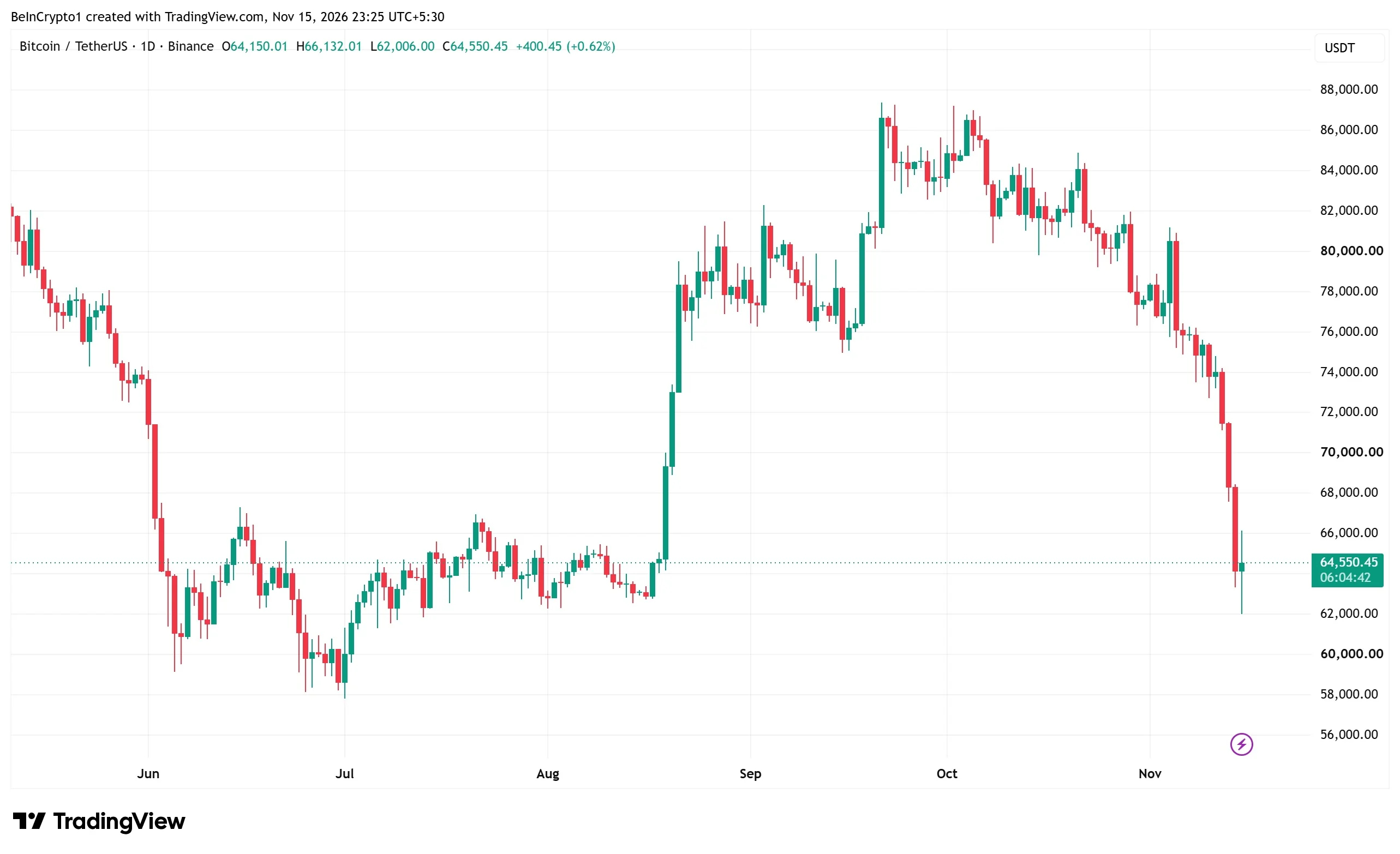
Chart: Bitcoin (BTC) price performance. Source: TradingView
Binance co-founder Changpeng Zhao (CZ) listed six possible reasons in the early hours of November 16, opening with a caveat: “Why is crypto falling? No one can say for sure. Correlation does not imply causation.”
Bitcoin’s decline
At the end of September, bitcoin was trading near $87,000. By November 4, it was still hovering around $81,000. On November 13, its price fell below $70,000, then hit a low of $62,006 on November 15 before rebounding to about $64,500.
Leveraged bullish traders suffered the heaviest losses. Around $1.96 billion in leveraged long positions were liquidated across the crypto market within 24 hours, including about $600 million in bitcoin long positions.
Below are six possible reasons put forward by CZ, along with the available public information that can substantiate them.
Is money flowing out of crypto markets to participate in Anthropic’s IPO?
CZ’s first hypothesis: Investors are selling cryptocurrency to participate in Anthropic’s IPO. To support this view, he cited a post by Matt Cole, chairman and CEO of bitcoin treasury company Strive.
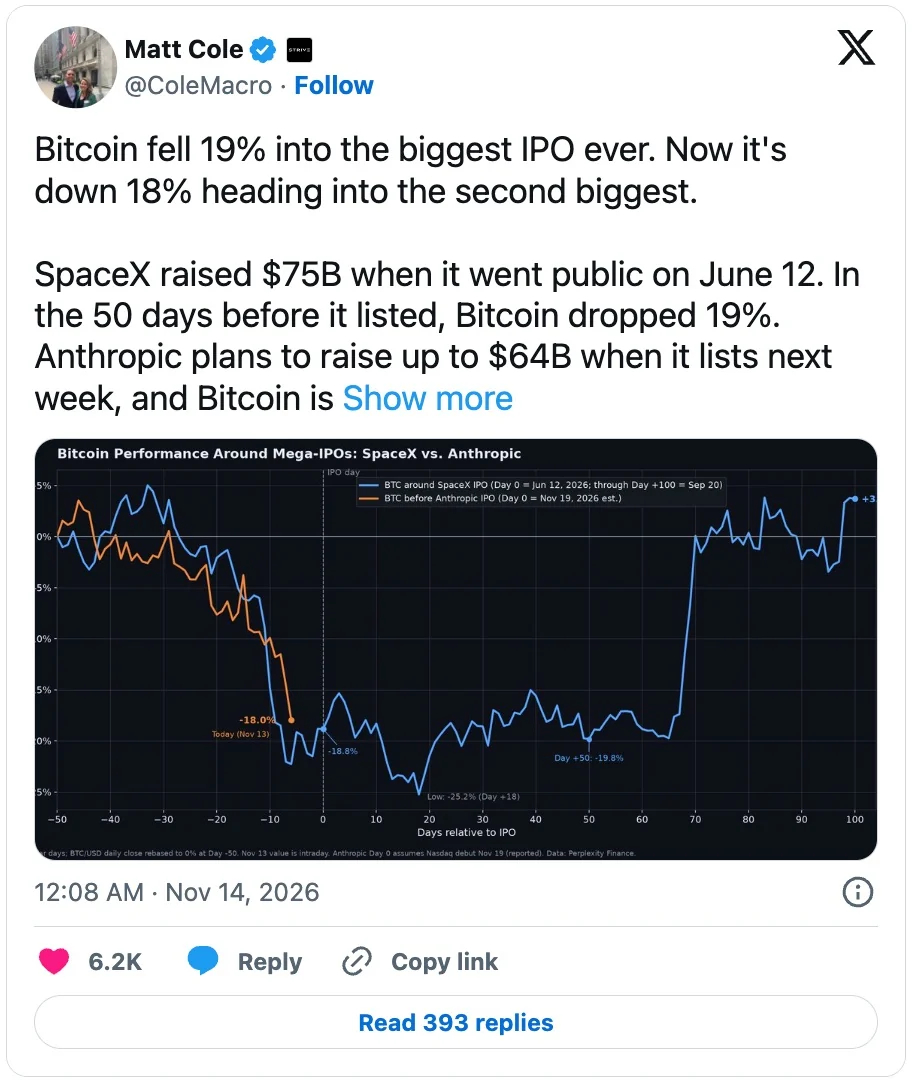
Matt Cole compared bitcoin’s performance ahead of the massive SpaceX and Anthropic IPOs, suggesting that bitcoin’s pre-IPO decline might reflect capital being withdrawn to participate in new share offerings. BitMine chairman Tom Lee has expressed a similar view.
This is a massive IPO. According to an amended filing Anthropic submitted to the U.S. SEC on November 10, the AI company behind the Claude conversational model plans to issue 825 million shares at a price range of $70 to $75. (Note: Pricing is expected after the U.S. market closes on November 18, which is after 5 a.m. Beijing time on November 19.)
There are currently no public data confirming how much bitcoin has been sold to participate in this IPO—or even whether such selling has actually taken place.
Are U.S. investors redeeming their bitcoin funds?
Yes. This is the only one of the six hypotheses supported by quantifiable data.
Spot bitcoin ETFs hold actual bitcoin and trade on U.S. stock exchanges like ordinary stocks. Many U.S. retail investors and institutions gain exposure to bitcoin through these ETFs.
SoSoValue data shows that the ETFs saw net outflows totaling $1.91 billion over seven consecutive trading days, from November 5 to 13. On Friday alone, $185.4 million flowed out, including $148 million from BlackRock’s IBIT.
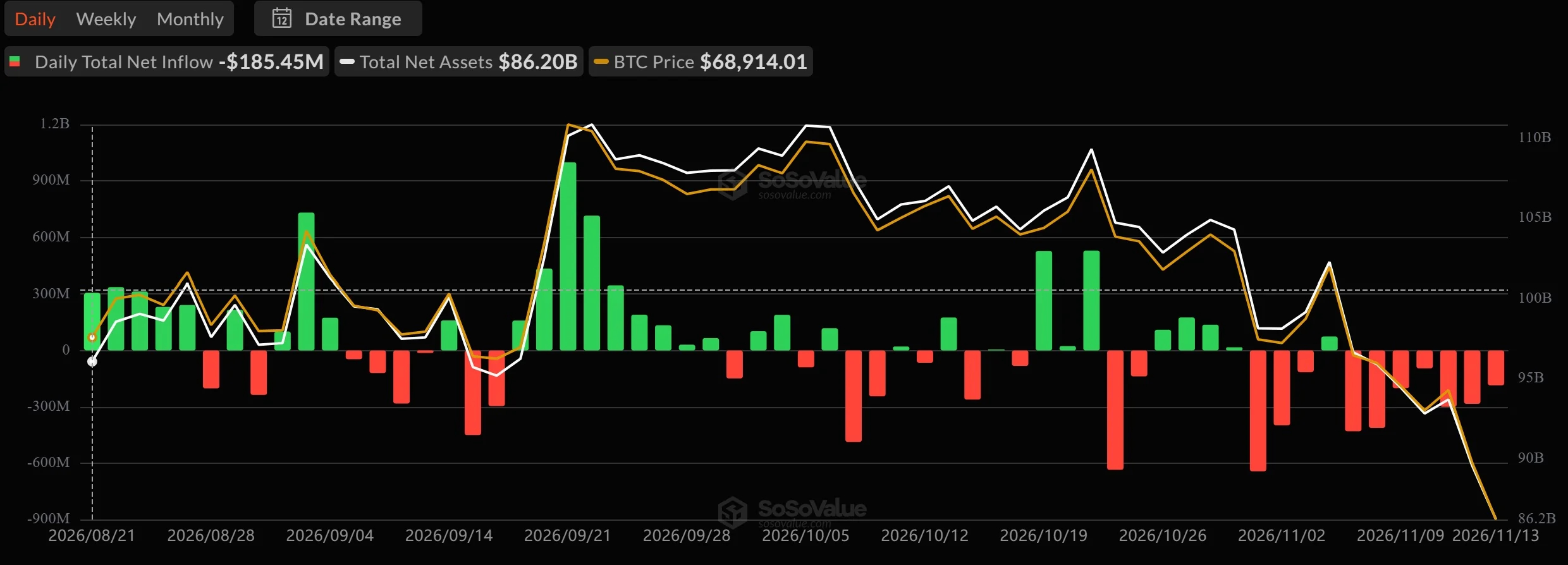
Chart: Spot bitcoin ETF flows. Source: SoSoValue
Binance Research described this as one of the most severe seven-day periods of outflows since spot ETFs launched.
Have hacks and security vulnerabilities sparked investor panic?
CZ pointed to a series of recent security incidents: a Binance hack, crypto wallets being drained on iPhones, a critical Chrome vulnerability, and widespread Microsoft service outages.
Binance: In the early hours of October 30, hackers stole about $6.3 billion from the exchange, the largest theft in crypto history. The attack was attributed to North Korean hackers. Binance said users’ funds were safe and that it had replenished about 98% of the stolen assets.
iPhone: Security firm CertiK warned that early versions of iOS had a zero-day vulnerability that allowed attackers to gain full control of a device. Large numbers of iPhone users have reported having their crypto wallets stolen.
CZ wrote: “A series of security incidents could make some investors reluctant to continue holding crypto assets.”
Will higher-than-expected inflation prompt the Fed to consider resuming rate hikes?
The U.S. CPI rose 0.4% month over month in October, exceeding the market’s 0.3% expectation. Core CPI, excluding food and energy, rose 0.3%.
Fed Governor Christopher Waller said he favored a rate hike in December, while Dallas Fed President Lorie Logan also voiced support for further tightening. Expectations of higher macro interest rates directly weighed on risk assets across the board.
Are rising Treasury yields and a stronger dollar weighing on bitcoin?
CZ said: “Rising yields and a stronger dollar put pressure on risk assets such as cryptocurrencies.” As the risk-free yield on U.S. Treasuries rises, bitcoin—which generates no interest—becomes less attractive.
Finwire cited institutional research from Coinbase: As of November 13, futures markets were pricing in a cumulative 64 basis points of Fed rate hikes over the next year, up from just 37 basis points expected at the start of the month.
Could the results of the U.S. midterm elections pave the way for stricter crypto regulation?
The Democrats won control of both chambers of Congress in the November 3 midterm elections. The industry had high hopes for the CLARITY Act, which aims to establish a clear regulatory framework for crypto markets. But the bill failed to pass a key Senate vote in September, with 49 votes in favor and 50 against.
Bitcoin’s reaction to the election results was mixed: Its price briefly fell to around $75,600 during vote counting, then rebounded to about $81,000 the next day.
Binance management’s view
CZ said Binance did not sell any crypto assets during this downturn. “I actually bought cryptocurrency over the past few days, because I just received some stablecoins. (Maybe that’s what caused the drop.)” he said half-jokingly.
Binance co-CEOs Richard Teng and He Yi posted identical messages on X on Sunday, 70 minutes apart.
“The market is under short-term pressure, a normal reaction to tighter macro conditions and a shift in sentiment around AI financing. But the long-term fundamentals of bitcoin and the crypto industry have not changed.”
Binance Research linked the drop to concerns about financing for AI companies. During the 11 trading days in which bitcoin fell 15.6%, futures tied to U.S.-listed AI cloud provider Nebius also plunged 27.5%.
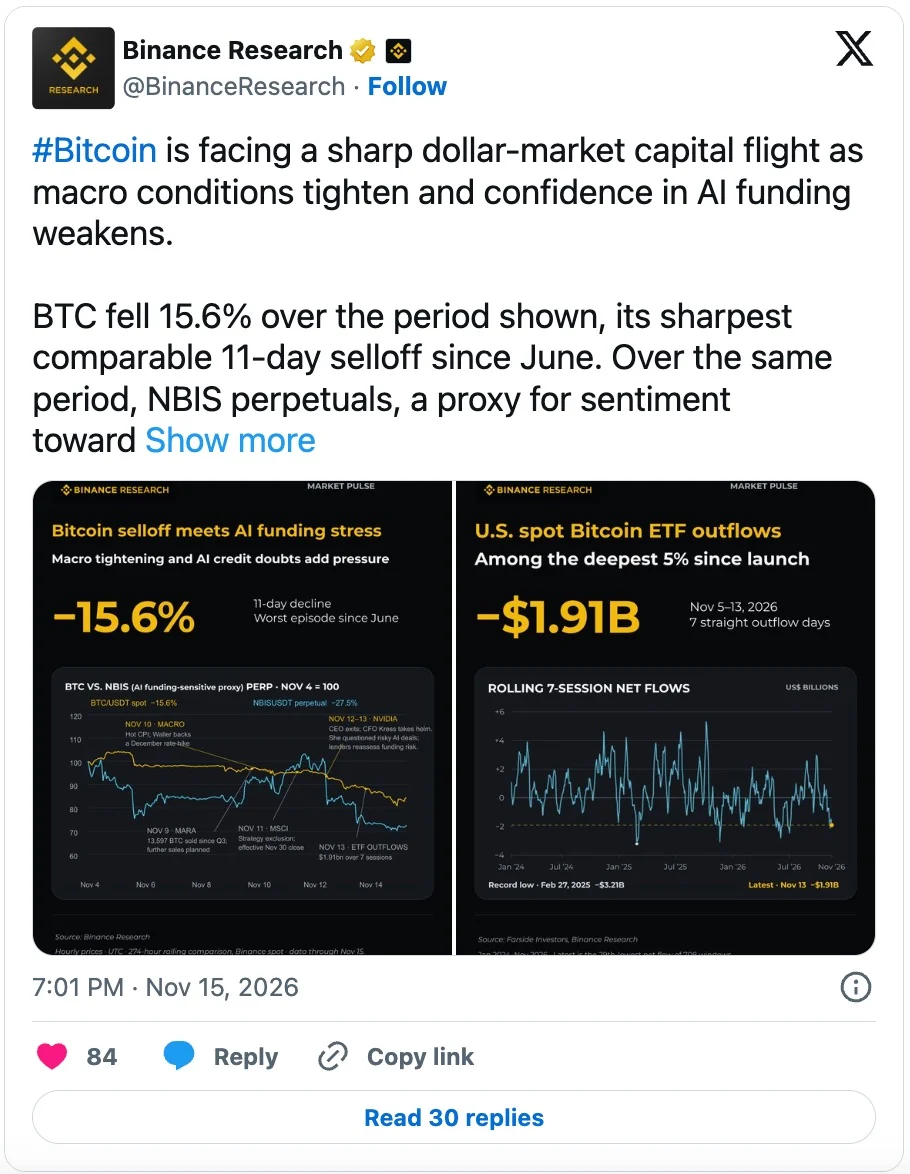
In its post, Binance Research said tighter macro conditions and weakening confidence in AI financing had triggered significant outflows from bitcoin. Bitcoin fell 15.6% in 11 days, while NBIS perpetual futures, a proxy for AI sentiment, plunged over the same period. This coincided with seven consecutive days of significant net outflows from spot bitcoin ETFs.
The article also noted that this comparison in price movements does not prove that capital flight from the AI sector directly caused bitcoin’s decline.
Some traders offered a more straightforward explanation. Analyst Michaël van de Poppe said the pullback was an unusual bout of concentrated deleveraging, with large numbers of leveraged long positions being liquidated at once and triggering a cascade. He also said he was buying the dip.
Key upcoming events to watch
Three key developments to follow this week:
November 16: The latest ETF flow data will be released following Friday’s outflows.
November 17: Nvidia reports earnings. This is the first earnings report since Jensen Huang stepped down as CEO on November 12 and CFO Colette Kress took over. Markets are on edge.
November 18: Anthropic stock pricing. If the final price lands at the upper end of the $70–$75 range—or is raised further—it could mean more liquidity is diverted from the market.
CZ concluded with his long-term outlook: “Over the medium to long term, the crypto industry will continue to grow. These are my personal views only and not investment advice.”