

Xapo first became famous for its vault.
In 2013, Argentine entrepreneur Wences Casares founded Xapo to provide Bitcoin custody. According to public reports, Xapo stored its clients’ private keys in a decommissioned military fortress in the Swiss Alps, in an underground bunker carved into a granite mountainside, with backup facilities on several continents. This story made Xapo one of the best-known custodians in the early Bitcoin world.
In 2019, Xapo sold its institutional custody business to Coinbase for $55 million (Chapter 3). After the sale, Xapo shut down its operations in Switzerland and the United States, moved its headquarters to Gibraltar, obtained a local banking license, and became a retail-focused Bitcoin bank. Swiss financial media outlet finews later published an article titled “How Switzerland Lost a Bitcoin Bank.”
This story is almost a microcosm of crypto M&A in Europe: Switzerland incubated a large number of high-quality crypto companies, but most of them were eventually sold to someone else.
This chapter is about Europe, which plays two roles in crypto M&A: Switzerland is where targets come from, and the EU’s MiCA is a passport.
Switzerland: the factory for targets
Look back at the deals discussed in this book, and a pattern emerges: many of the key targets come from Switzerland.
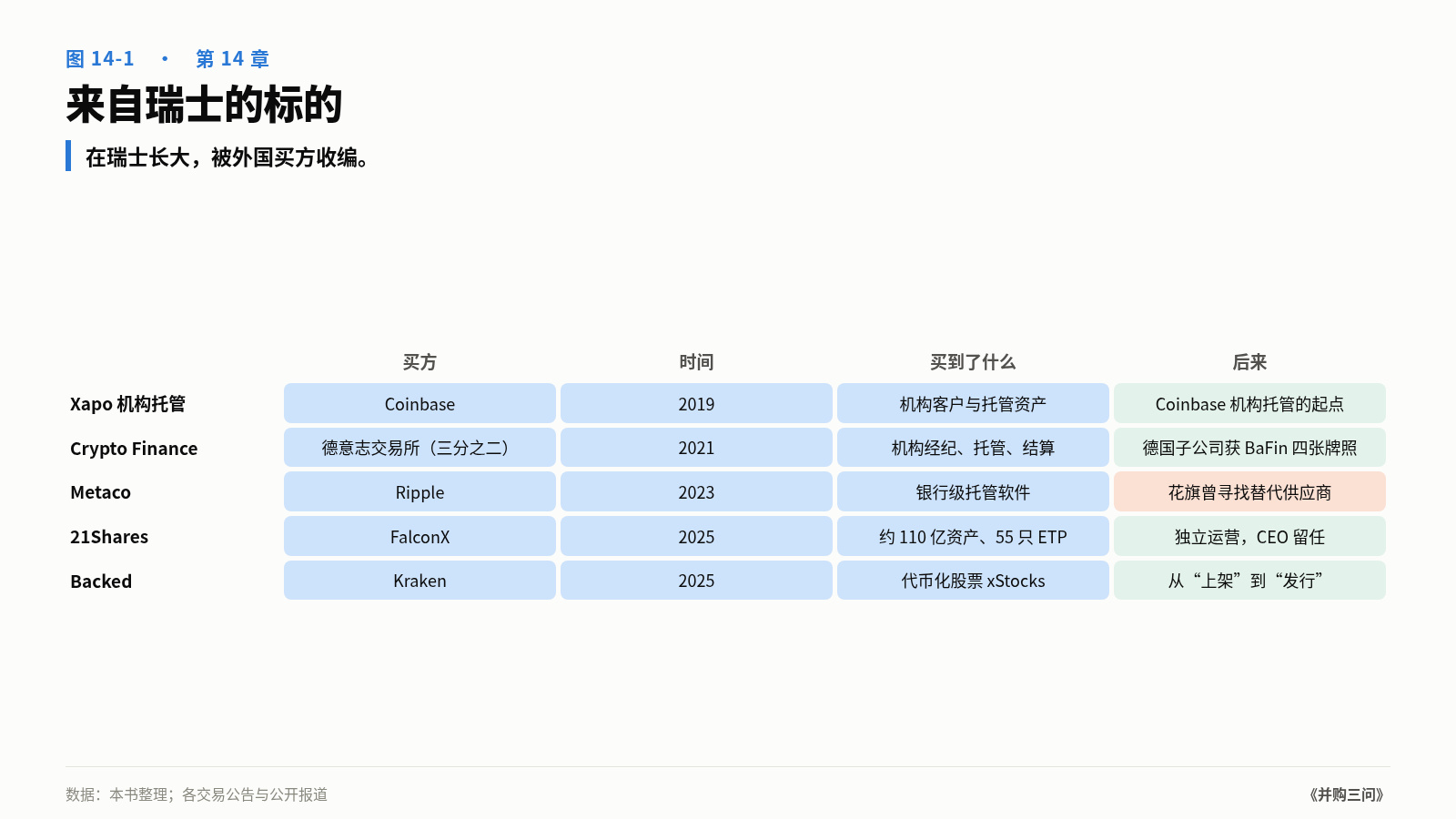
Xapo institutional custody (2019, acquired by Coinbase): the starting point for institutional custody;
Metaco (2023, acquired by Ripple for $250 million): bank-grade custody software, with clients including Citi, BNP Paribas, and Société Générale (Chapter 3);
Crypto Finance (2021, Deutsche Börse acquired a two-thirds stake): institutional crypto brokerage, custody, and settlement;
21Shares (2025, acquired by FalconX): one of the world’s leading crypto ETP issuers;
Backed (2025, acquired by Kraken): issuer of tokenized stocks xStocks (Chapters 9 and 12).
Why Switzerland?
First, regulation came early. Switzerland’s Financial Market Supervisory Authority (FINMA) issued guidance on token issuance in 2018, providing an answer to “what crypto businesses are under the law?” several years before most countries did. The canton of Zug is known as “Crypto Valley” and is home to many crypto companies and foundations.
Second, it has a mature financial infrastructure. Switzerland has some of the world’s leading private banking and custody businesses, with expertise in safeguarding assets for high-net-worth clients and institutions. Xapo’s vault and Metaco’s bank-grade custody software are extensions of this tradition.
Third, the domestic market is too small. Switzerland has a population of fewer than 9 million, so a Swiss crypto company must serve global clients to grow. Once it reaches a certain size, the most natural way forward is to sell to a buyer with global distribution capabilities: a U.S. exchange, a crypto infrastructure company, or a European exchange group.
So Swiss crypto companies share a common fate: they grow up in Switzerland and are brought in-house by foreign buyers. Viewed through the three questions, most answer the second one well: solid technology, institutional clients, and a complete compliance record make them assets that “remain even after the people leave.” What buyers need to do is provide the connections.
Deutsche Börse: the one that got it right in the first wave
Chapter 8 discussed how most traditional institutions that entered the market in the 2021 wave failed: Cboe wrote down $460 million, and Mastercard discontinued CipherTrace’s core product. But that same year, a European exchange group made a deal with a different outcome.
In 2021, Deutsche Börse Group announced that it would acquire a two-thirds majority stake in Swiss company Crypto Finance. The investment was reportedly in the “mid-three-digit millions of francs,” or several hundred million francs. Crypto Finance founder Jan Brzezek and the management team retained a substantial shareholding and continued to run the business.
Around February 2024, Crypto Finance’s German subsidiary obtained four licenses from Germany’s Federal Financial Supervisory Authority (BaFin), covering regulated digital asset trading, settlement, and custody. At the time, Deutsche Börse was preparing to launch its own digital asset trading platform.
Why didn’t Deutsche Börse’s deal, made at the same 2021 market peak, repeat Cboe’s failure? The deal structure highlights several differences:
Phased acquisition: it bought only two-thirds, while management retained a stake. This reduced the upfront payment and aligned the founding team’s interests with the company’s long-term performance;
The business being acquired was institutional: Crypto Finance provides institutional brokerage, custody, and settlement—the same kind of business as Deutsche Börse’s own post-trade services (settlement and custody). It was a piece that could fit into the core business, not a whole new venture;
A clear licensing path: after the acquisition, Crypto Finance applied for local licenses in Germany, paving the way for the group’s own digital asset business.
This is almost exactly like the “second wave” pattern summarized in Chapter 8, except that it happened during the first wave. The timing was poor, but the assets and connections were right, so the outcome was different.
Asset management: ETP issuers are brought in-house
One of Europe’s most advanced crypto businesses is exchange-traded products (ETPs). Years before the U.S. approved spot Bitcoin ETFs in 2024, investors in Europe could already buy Bitcoin-linked ETPs on exchanges in Switzerland, Germany, and Sweden. This gave rise to a group of specialist crypto ETP issuers in Europe.
After 2024, these issuers began to be acquired or moved to the United States.
FalconX acquired 21Shares (announced in October 2025). FalconX is a U.S. crypto prime broker; 21Shares is a Switzerland-based ETP issuer that reportedly manages about $11 billion in assets and has 55 listed products worldwide. The price was not disclosed. After the deal closes, 21Shares will continue to operate independently, with CEO Russell Barlow remaining in his role.
The connection in this deal is clear: FalconX serves institutional trading clients, while 21Shares has ready-made investment products. A prime broker buying a product issuer extends its business from “helping institutions trade” to “providing institutions with products they can buy.”
CoinShares took a two-step approach. One of Europe’s largest crypto ETP issuers, CoinShares reportedly holds about 34% of the European market and manages around $10 billion in assets. It took a different route: first, it acquired U.S.-based Valkyrie Funds in 2024, gaining an entry point into the U.S. ETF business; then, in September 2025, it announced plans to list on the Nasdaq in the United States by merging with SPAC company Vine Hill. The transaction valued CoinShares at about $1.2 billion pre-money.
The two deals went in opposite directions, but followed the same logic: European ETP issuers are ahead on products, but the largest pool of capital is in the United States. They can either be acquired by U.S. buyers or go to the United States themselves.
MiCA: a passport that makes licenses cheaper
On December 30, 2024, the EU’s Markets in Crypto-Assets Regulation (MiCA) came fully into effect for crypto-asset service providers. Chapter 7 discussed its impact on the value of licenses: a CASP (crypto-asset service provider) license obtained in any EU member state is valid across all 30 countries of the European Economic Area.
This change has three direct consequences for the M&A market.
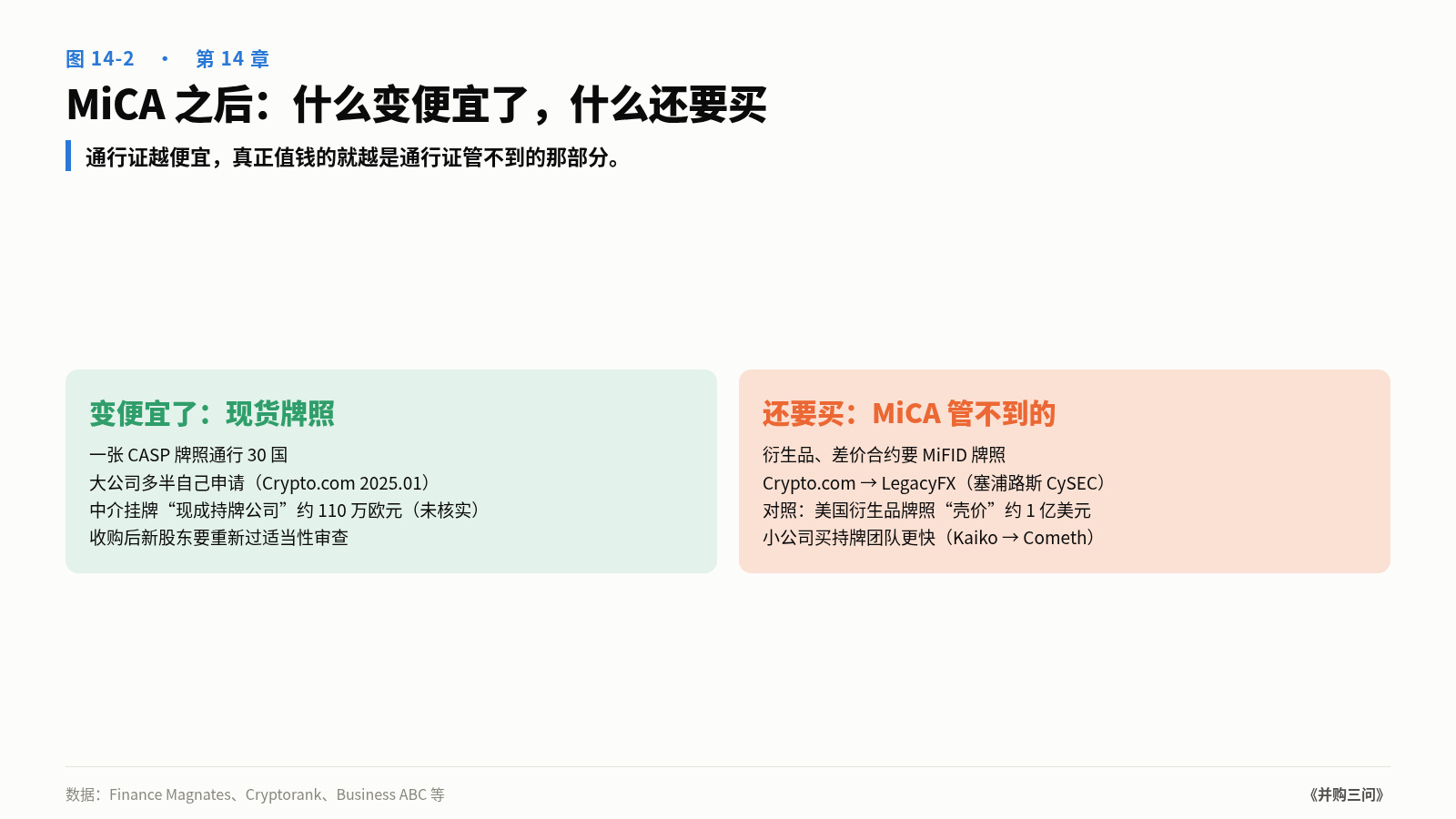
First, MiCA licenses themselves have become less valuable. Since any eligible company can apply under the rules, a MiCA license commands little scarcity premium. Intermediary firms have even publicly advertised “ready-made MiCA-licensed companies” for sale, some priced at only around €1.1 million (these are promotional prices quoted by intermediaries and have not been verified). By comparison, as discussed in Chapter 4, the “shell price” for a U.S. derivatives license is around $100 million.
Second, acquiring a licensed company triggers a fresh review. Under MiCA, acquiring a licensed company is not just a transfer of shares. The new controlling shareholder must notify the regulator in advance; the regulator will reassess the suitability of the new shareholder and management, and has the right to object. Some of the time saved by buying a shell may be lost to the new review.
Third, licenses outside MiCA are what have truly become scarce. MiCA covers crypto spot trading, custody, and stablecoin issuance, among other things, but not derivatives. Companies wishing to offer crypto contracts for difference (CFDs) or futures in Europe still need a traditional financial MiFID license.
Crypto[.]com’s approach illustrates this well. In January 2025, it obtained a MiCA license, allowing it to offer crypto services across Europe. It later acquired LegacyFX, a Cyprus-based brokerage regulated by CySEC, in order to obtain MiFID authorization and offer CFDs. It applied for its MiCA license itself, but bought its MiFID license.
This neatly confirms the conclusion of Chapter 4: in tightly regulated markets, derivatives licenses are generally acquired rather than obtained from scratch. MiCA lowered the bar for spot licenses, but not for derivatives licenses.
Stablecoin issuance: the license worth buying is an e-money license
MiCA includes one type of license that is much harder to obtain than a CASP license: authorization to issue stablecoins. Under MiCA, an issuer of a stablecoin pegged to a single fiat currency in the EU must be a licensed electronic money institution (EMI) or a credit institution.
U.S. stablecoin issuer Paxos chose to buy one outright. On November 19, 2024, it announced the acquisition of Finnish electronic money institution Membrane Finance, which was completed on February 4, 2025. Membrane issues the euro stablecoin EUROe, and its Finnish e-money license is recognized in 30 European countries. This made Paxos a licensed electronic money institution in the EU, able to issue MiCA-compliant stablecoins.
This once again confirms the pattern described in Chapters 4 and 7: the more broadly a passport is recognized, the cheaper the license; the more tightly an area is regulated, the more likely it is that the license will still need to be bought. CASP licenses can be obtained by applying directly, while e-money licenses for issuing stablecoins and MiFID licenses for derivatives are more often acquired.
Another reason to buy a MiCA-licensed company
Some companies have also made acquisitions to obtain a MiCA license, but they are usually small companies, and the license is not all they are buying.
In May 2026, crypto data company Kaiko reportedly acquired French DeFi infrastructure company Cometh, also obtaining Cometh’s CASP license. For a data company, applying for a MiCA license from scratch and building a compliance team would cost considerable time and money. Buying a small company that is already licensed and has complementary operations is a faster route.
These deals are all small, and their prices are mostly undisclosed. They show that the value of a MiCA license depends largely on how long it would take you to obtain one yourself. For a large company, applying directly is usually more cost-effective; for a small company, buying an already licensed team makes more sense.
Robinhood and Bitstamp: a transatlantic case study
Chapter 7 discussed Robinhood’s acquisition of Bitstamp. The deal has another layer of significance from a European perspective.
Bitstamp is one of Europe’s oldest exchanges. Founded in Slovenia in 2011, it later based its European operations in Luxembourg, where it holds a payment institution license. It also obtained a CASP license after MiCA came into effect. By buying it, Robinhood gained European regulatory credentials, European institutional clients, and an exchange that had been operating for more than a decade—all at once.
For a U.S. company seeking to enter Europe, this is much faster than applying from scratch in every country. For NXMH, Bitstamp’s former South Korean shareholder, it was an exit. NXMH’s parent company NXC later sold about 92% of South Korean exchange Korbit to a company owned by South Korean brokerage group Mirae Asset. Announced in February 2026, the deal was worth about 133.5 billion won and still required approval from South Korea’s Fair Trade Commission. NXC thereby largely exited the crypto exchange business.
The European pattern
Taken together, crypto M&A in Europe follows three patterns:
First, Switzerland creates the targets, and foreign buyers bring them in-house. Swiss crypto companies have strong technology, high-quality clients, and complete compliance records, but the domestic market is small. Most are ultimately acquired by U.S. or German buyers.
Second, MiCA makes spot licenses cheaper, while derivatives licenses still have to be bought. A unified passport lowers the barrier to entry for spot businesses and reduces the scarcity premium on spot licenses. Companies that want to offer derivatives still need to buy a MiFID license.
Third, Europe’s product advantage needs the U.S. pool of capital. European ETP issuers have been ahead on products for years, but to scale up, they must either be acquired by U.S. buyers or list in the United States themselves.
If you’re doing a crypto deal in Europe
First, calculate how long it would take to obtain a MiCA license yourself. If you have a compliance team, applying directly is often more cost-effective than buying a shell; a shell acquisition also means facing a suitability review of the new shareholder.
Plan your derivatives business separately. MiCA does not cover derivatives, and MiFID licenses remain scarce, making this an area worth spending money to acquire.
For Swiss targets, look at the assets; buyers need to provide the connections. Most Swiss companies have answered the second question well. Whether a deal succeeds depends on whether you can connect them to global distribution.
Consider phased acquisitions. Deutsche Börse’s approach of buying only two-thirds and allowing management to retain equity can also help manage risk at the top end of the market.
Value European ETP and asset management businesses in the context of the U.S. market. Their growth potential lies in the United States.
The conclusion of this chapter in one sentence: in European crypto M&A, Switzerland creates the targets and MiCA provides the passport; the cheaper the passport, the more valuable the things it does not cover.
Sources for this chapter
Xapo’s Swiss vault and move to Gibraltar: finews, The National, Decrypt (Gibraltar banking license)
Deutsche Börse/Crypto Finance: Deutsche Börse announcement, crypto[.]news (two-thirds stake, mid-three-digit millions of francs); four BaFin licenses: Cointelegraph
FalconX/21Shares (about $11 billion in assets, 55 products, CEO staying on): FalconX press release, ETF[.]com, Blockworks
CoinShares/Vine Hill ($1.2 billion pre-money valuation, around $10 billion in assets, about 34% European market share): The Block
Crypto[.]com/LegacyFX: Finance Magnates; Kaiko/Cometh: Cryptorank; acquisitions of licensed companies require a fresh review: Business ABC
Bitstamp obtains a CASP license: The Paypers
Mirae Asset acquires about 92% of Korbit: Cointelegraph, Ledger Insights
Paxos/Membrane Finance: Paxos press release (completion), The Block
Data notes: the approximately €1.1 million asking price for a “ready-made MiCA-licensed company” comes from an intermediary’s promotional page; the article notes that it has not been verified. The article does not provide the specific terms of CoinShares’ acquisition of Valkyrie or say whether the Vine Hill merger has been completed. FINMA’s 2018 guidelines on token issuance are a matter of public record.
—
This article is Chapter 14 of my new book, “Three Questions for M&A” (16 chapters in total). One chapter is published each day.
Author: Wang Xiaoming (Blue Lotus)