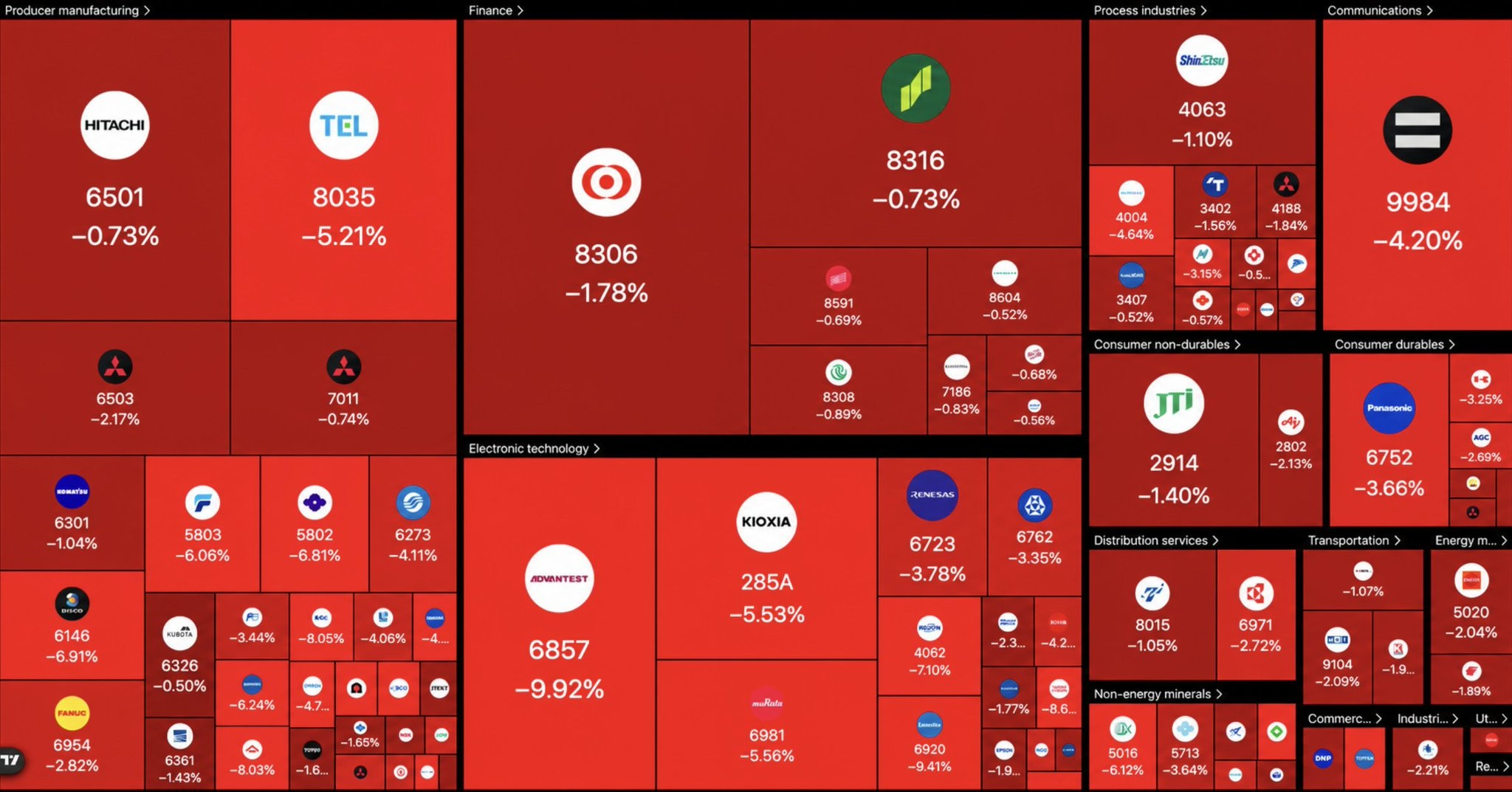

Around 19 trillion Japanese yen has been wiped off the market value of Japanese stocks after the preliminary third-quarter GDP reading came in at -0.1%, against expectations of +0.3% growth.
It’s a major miss compared with expectations, and investors are starting to wonder what could happen next.
But the real story goes much deeper than just a disappointing economic report.
🇯🇵 The Japanese economy is facing several pressures at the same time:
📉 Economic growth is losing momentum: A contraction instead of the expected growth has raised new concerns about the Japanese economy’s underlying strength and its ability to continue expanding in the coming periods.
🏦 The Bank of Japan faces a difficult dilemma: Monetary policymakers must balance inflation, economic growth, and interest rates. Excessive monetary tightening could add further pressure to an economy already struggling with slowing growth.
💴 The Japanese yen is another part of the equation: Movements in the Japanese currency could create more uncertainty for investors, international trade, and financial markets, especially if it experiences sharp fluctuations.
🌍 Global markets may feel the impact: Japan is one of the world’s major financial powers, and any significant shift in its monetary policy could affect international bond yields, currency markets, and cross-border capital flows.
⚠️ Carry trade risks: For many years, investors have borrowed in low-interest-rate currencies, such as the Japanese yen, to invest in assets and markets offering higher returns.
But if borrowing costs rise or the yen appreciates sharply, some investors may be forced to close these positions and sell their assets, potentially triggering waves of selling and adding further pressure to global markets.
📊 Investor confidence has become a decisive factor: When economic expectations weaken, investors typically begin reassessing the level of risk they are taking on. This may lead them to reduce their investments in riskier assets, opening the door to volatility that extends beyond Japan.
And this raises the bigger question:
What will happen if the Japanese economy continues to weaken while global markets face uncertainty, rising borrowing costs, and shifting monetary policies in major economies?
Could this situation become a new source of pressure on global stock markets, cryptocurrencies, and financial markets in general?
Or will policymakers be able to contain the situation and restore stability before its effects spread to other markets?
One thing is certain: Japan’s economic figures deserve close attention. Upcoming revisions to GDP data, Bank of Japan decisions, and movements in the Japanese yen could all become highly important signals for investors around the world.
The story may be much bigger than what is happening inside Japan!
It’s starting to unfold... 👀🔥